 The African diaspora or Afro diaspora is the diaspora created by the movements and culture of Africans and their descendants throughout the world, to places such as the Americas, (including United States, Canada, the Caribbean, Central America, and South America) Europe and Asia . The majority of the African diaspora are descended from people taken into slavery, with the largest population living in Brazil. In recent years they include a rising number of voluntary emigrants and asylum-seekers as well. More broadly, the African diaspora comprises the indigenous peoples of Africa and their descendants, wherever they are in the world. Pan-Africanists and Afrocentrism often also consider other Negroid (or "Africoid") peoples as diasporic "African peoples." These groups include Negritos of the Andamanese islands, Philippines, Malay Peninsula (Orang Asli), New Guinea, and the aboriginal peoples of Melanesia. The African Union has defined the African diaspora as "[consisting] of people of African origin living outside the continent, irrespective of their citizenship and nationality and who are willing to contribute to the development of the continent and the building of the African Union." Its constitutive act declares that it shall "invite and encourage the full participation of the African Diaspora as an important part of our Continent, in the building of the African Union."
the Atlantic Slave Trade, c.1450—1870 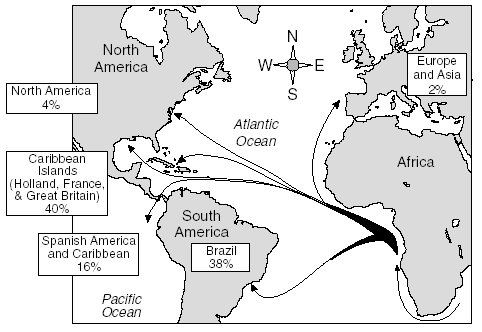
The Atlantic slave trade was the purchase and transport of black Africans into bondage and servitude in the New World. It is sometimes called the Maafa by African Americans, meaning holocaust or great disaster in kiSwahili. The slaves were one element of a three-part economic cycle—the Triangular Trade and its infamous Middle Passage—which ultimately involved four continents, four centuries and the lives and fortunes of millions of people. Research published in 2006 [1] reports the earliest known presence of slaves in the New World. A burial ground in Campeche, Mexico suggests slaves had been brought there not long after Hernán Cortés completed the subjugation of Mexico. Contemporary historians estimate -preciser records fail often- some 12 million individuals were taken from west Africa to North, Central and South America and the Caribbean Islands by European colonial/imperialist powers. [citation needed] • Origins The slave trade originated in a shortage of labour in the new world. The first slaves used were Aboriginal peoples, but they were not numerous enough and were being decimated by European cruelty and diseases. It was also difficult to get Europeans to emigrate to the colonies, despite incentives such as indentured servitude or even distribution of free land (mainly in the English colonies that became the United States). Massive amounts of labour were needed for mining, and especially for the plantations in the labor-intensive growing, harvesting and (semi-)processing of sugar (also for rum and molasses), cotton and other prized tropical crops which could not be grown profitably - in some cases, could not be grown at all - in the colder climes of Europe. (It was cheaper to import them American colonies than to import them from the Ottoman empire, etc.) To meet this demand for labour European traders thus turned to Western Africa, especially Guinea as a source of slaves. There, Europeans tapped into the African slave trade that saw slaves transported to the coast of Guinea where they were sold at European trading forts in exchange for muskets, manufactured goods, and cloth. As a rule [citation needed], they were not stolen by the Europeans but captured in tribal wars, in many cases even started with a view to the capture of fellow Africans- given the modest prices they asked, African labor was clearly considered abundant, not very valuable. The principal areas of the slave trade in Africa were Senegambia (present day Senegal, Gambia, Guinea and Guinea Bissau), Sierra Leone (including the area that later became Liberia), Windward Coast (modern Ivory Coast), Gold Coast (Ghana), Bight of Benin (Togo, Benin and western Nigeria), Bight of Biafra (Nigeria south of the Benue River, Cameroon and Equatorial Guinea), Central Africa (Gabon, Angola, Democratic Republic of the Congo) and Southeast Africa (Mozambique and Madagascar). The number of slaves sold to the new world varied throughout the slave trade. The most widely accepted statistics [citation needed] claim Senegambia provided about 5.8%, Sierra Leone 3.4%, Windward Coast 12.1%, Gold Coast 14.4%, Bight of Benin 14.5%, Bight of Biafra 25%, Central Africa 23% and Southeast Africa 1.8%. African slaves were usually sold to European traders by powerful coastal or interior states in exchange for European goods, such as textiles and firearms. Africans were rarely kidnapped by Europeans, except as the opportunity presented itself, because they did not know the lay of the land. As coastal and near-coastal nation states in Africa expanded through military conflicts, the captives of these wars, usually civilians but sometimes defeated warriors, were enslaved and sold. Collection of slaves was sometimes a basis for warfare but more often than not, enslavement was simply a by-product of war. Slavery had been a staple of African political life long before the coming of Europeans. Conviction of a crime was another way to become a slave. Since most if not all of these nations did not have a prison system, criminal slaves were usually sold. There were over twenty-five known kingdoms or empires that participated in the slave trade [citation needed]:
The first slave traders (or 'slavers') were Portuguese who desired workers for their mines and sugar plantations in Brazil. When the Dutch seized much of Brazil and became the dominant trading power in seventeenth century they became the leading traders selling slaves to both their own colonies and to British and Spanish ones. As Britain rose in naval power and controlled more of the Americas they became the leading slave traders, mostly operating out of Liverpool and Bristol. By the late 17th century, one out of every four ships that left Liverpool harbour was a slave trading ship [citation needed]. Other British cities also profited from the slave trade. Birmingham was the largest gun producing city in Britain at the time, and guns were traded for slaves. 75% of all sugar produced in the plantations came to London to supply the highly lucrative coffee houses there. Reproduction of a handbill advertising a slave auction in Charleston, South Carolina, in 1769. The slave trade was part of the triangular Atlantic trade, which was probably the most important and profitable trading route in the world. Ships from Europe would carry a cargo of manufactured trade goods to Africa. They would exchange the trade goods for slaves which they would transport to the Americas. In the Americas, they would sell the slaves and pick up a cargo of agricultural products, often produced with slave labour, for Europe. The value of this trade route was that a ship could make a substantial profit on each leg of the voyage. The route was also designed to take full advantage of prevailing winds and currents. For example, the trip from the West Indies or the southern US to Europe would be assisted by the Gulf Stream. The outward bound trip from Europe to Africa would not be impeded by the same current. Even though since the Renaissance some ecclesiastics actively pleaded slavery to be against the Christian teachings, as now generally held, others supported the economically opportune slave trade by church teachings and the introduction of the concept of the black man's and white man's burdens [citation needed]. Under this black men were expected to labour because they were not Christian and white men were charged with the duty of imposing the conditions of labour upon them. Slavery was involved in some of the most profitable industries of the time: 70% of the slaves brought to the new world were used to produce sugar, the most labour intensive crop. The rest were employed harvesting coffee, cotton, and tobacco, and in some cases in mining. The West Indian colonies of the European powers were some of their most important possessions and they went to extremes to protect and retain them. For example, in 1763, France agreed to giving the vast colony of New France in exchange for keeping the minute Antillian island of Guadeloupe (still a French overseas département). By far the most successful West Indian colonies in 1800 belonged to the United Kingdom. After entering the sugar colony business late, British naval supremacy and control over key islands such as Jamaica, Trinidad, and Barbados and the territory of British Guiana gave it an important edge over all competitors; while many lost their shirt, some made enormous fortunes, even by upper class standards. This advantage was reinforced when France lost its most important colony, St. Dominigue (western Hispaniola, now Haiti), to a slave revolt in 1791 and supported revolts against its rival Britain, after the 1793 French revolution in the name of liberty (but in fact opportunistic selectivity). The British islands produced the most sugar, and the British people quickly became the largest consumers of sugar. West Indian sugar became ubiquitous as an additive to Chinese tea. Products of American slave labour soon permeated every level of British society with tobacco, coffee, and especially sugar all becoming indispensable elements of daily life for all classes. [edit] End of the Atlantic slave trade In Britain, and in other parts of Europe, opposition developed against the slave trade. Led by the Religious Society of Friends (Quakers) and establishment Evangelicals such as William Wilberforce, the movement was joined by many and began to protest against the trade. They were opposed by the owners of the colonial holdings; despite this Britain banned the slave trade in 1807, imposing stiff fines for any slave found aboard a British ship. That same year the United States banned the importation of slaves. Denmark, who had been very active in the slave trade, was the first country to ban the trade through legislation (1792) to take effect from 1803. The Royal Navy, which then controlled the world's seas, moved to stop other nations from filling Britain's place in the slave trade and declared that slaving was equal to piracy and could be punished by death. For the British to end the slave trade, significant obstacles had to be overcome. In the 18th century, the slave trade was an integral part of the Atlantic economy. The economies of the European colonies in the Caribbean, the American colonies, and Brazil required vast amounts of man power to harvest the bountiful agricultural goods. In 1790 the British West Indies, islands such as Jamaica and Barbados had a slave population of 524 000, while the French had 643 000 in their West Indian possessions. Other powers such as Spain, the Netherlands, and Denmark had large numbers of slaves in their colonies as well. Despite these high populations more slaves were always required. Harsh conditions and demographic imbalances left the slave population with well below replacement fertility levels. Between 1600 and 1800 the English imported around 1.7 million slaves to their West Indian possessions. The fact that there were well over a million fewer slaves in the British colonies than had been imported to them illustrates the conditions in which they lived. How did the abolition of the slave trade occur if it was so economically important and successful? The historiography of answers to this question is a long and interesting one. Before the Second World War the study of the abolition movement was performed primarily by British scholars who believed that the anti-slavery movement was probably "among the three or four perfectly virtuous pages ... in the history of nations" (Lecky [citation needed]). This opinion was controverted in 1944 by the West Indian historian, Eric Williams, who argued that the end of the slave trade was a result of economic transitions totally unconnected to any morality. Williams' thesis was soon brought into question as well, however. Williams based his argument upon the idea that the West Indian colonies were in decline at the early point of 19th century and were losing their political and economic importance to Britain. This decline turned the slave system into an economic burden that the British were only too willing to do away with. The main difficulty with this argument is that the decline only began to manifest itself after slave trading was banned in 1807. Before then slavery was flourishing economically. The decline in the West Indies is more likely to be an effect of the suppression of the slave trade than the cause. Falling prices for the commodities produced by slave labour such as sugar and coffee can be easily discounted as evidence shows that a fall in price leads to great increases in demand and actually increases total profits for the importers. Profits for the slave trade remained at around ten percent of investment and showed no evidence of being on the decline. Land prices in the West Indies, an important tool for analyzing the economy of the area did not begin to decrease until after the slave trade was discontinued. The sugar colonies were not in decline at all, in fact they were at the peak of their economic influence in 1807. Williams also had reason to be biased. He was heavily involved in the movements for independence of the Caribbean colonies and had a motive to try to extinguish the idea of such a munificent action by the colonial overlord. A third generation of scholars lead by the likes of Seymour Drescher and Roger Anstey have discounted most of Williams' arguments, but still acknowledge that morality had to be combined with the forces of politics and economic theory to bring about the end of the slave trade. The movements that played the greatest role in actually convincing Westminster to outlaw the slave trade were religious. Evangelical Protestant groups arose who agreed with the Quakers in viewing slavery as a blight upon humanity. These people were certainly a minority, but they were a fervent one with many dedicated individuals. These groups also had a strong parliamentary presence, controlling 35-40 seats at their height. Their numbers were magnified by the precarious position of the government. Known as the "saints" this group was led by William Wilberforce, the most important of the anti-slave campaigners. These parliamentarians were extremely dedicated and often saw their personal battle against slavery as a divinely ordained crusade. After the British ended their own slave trade, they were forced by economics to press other nations into placing themselves in the same economic straitjacket, or else the British colonies would become uncompetitive with those of other nations. The British campaign against the slave trade by other nations was an unprecedented foreign policy effort. Denmark, a small player in the international slave trade, and the United States banned the trade during the same period as Great Britain. Other small trading nations that did not have a great deal to give up such as Sweden quickly followed suit, as did the Dutch, who were also by then a minor player. Four nations objected strongly to surrendering their rights to trade slaves: Spain, Portugal, Brazil (after its independence), and France. Britain used every tool at its disposal to try to induce these nations to follow its lead. Portugal and Spain, which were indebted to Britain after the Napoleonic Wars, slowly agreed to accept large cash payments to first reduce and then eliminate the slave trade. By 1853 the British government had paid Portugal over three million pounds, and Spain over one million in order to end the slave trade. Brazil, however, did not agree to stop trading in slaves until Britain took military action against its coastal areas and threatened a permanent blockade of the nation's ports in 1852. For France, the British first tried to impose a solution during the negotiations at the end of the Napoleonic Wars, but Russia and Austria did not agree. The French people and government had deep misgivings about conceding to Britain's demands. Not only did Britain demand that other nations ban the slave trade, but also demanded the right to police the ban. The Royal Navy had to be granted permission to search any suspicious ships and seize any found to be carrying slaves, or equipped for doing so. It is especially these conditions that kept France involved in the slave trade for so long. While France formally agreed to ban the trading of slaves in 1815, they did not allow Britain to police the ban, nor did they do much to enforce it themselves. Thus a large black market in slaves continued for many years. While the French people had originally been as opposed to the slave trade as the British, it became a matter of national pride that they not allow their policies to be dictated to them by Britain. Also such a reformist movement was viewed as tainted by the conservative backlash after the revolution. The French slave trade thus did not come to a complete halt until 1848.
An African American (also Afro-American, Black American, American-African or simply black), is a member of an ethnic group in the United States whose ancestors, usually in predominant part, were indigenous to Africa. Many African Americans have European and/or Native American ancestry as well. Some have Asian ancestry too. The term refers specifically to black African ancestry; not, for example, to white or Arab African ancestry, such as Moroccan or white South African ancestry. Blacks from non-African countries such as Haiti, Cuba, or Australia are theoretically referred to by their nation of origin and not African American, but in general the cultural assumption in the U.S. is that if a person is black, he or she is "African American."
Nomenclature
The term "African American" has been in common usage in the United States since the late 1980s, when greater numbers of African Americans began to adopt the term self-referentially. Malcolm X favored the term "African American" over "Negro" and used the term at an OAAU (Organization of Afro American Unity) meeting in the early 1960s, saying, "Twenty-two million African-Americans - that's what we are - Africans who are in America." Former NBA player/coach Lenny Wilkens is another who used the term as a teenager when filling a job application. Many blacks began to abandon the term "Afro-American", which had become popular in the 1960s and '70s, for "African-American,"
because they desired an unabbreviated expression of their African heritage that could not be mistaken or derided as an allusion to the afro hairstyle. The term became increasingly popular, and by the 1980s, Jesse Jackson and others pressed for its adoption and acceptance. Users of the term argued that "African-American" was more in keeping with the nation's immigrant tradition of so-called "hyphenated Americans", who were known by terms like "Irish-American", or "Chinese-American", "Polish-American"), which link people with their, or their ancestors', geographic points of origin.
Terms used at various points in American history include Negroes, colored, blacks and Afro-Americans. Negro and colored were common until the late 1960s, but are now less commonly used and considered derogatory. African American, black and, to a lesser extent, Afro-American are used interchangeably today, but their precise meanings and connotations are in dispute.
The term African American is sometimes problematic because of its imprecise cultural and geographic meaning. It also means that the people it is refering to are black. The term as originally applied refers to only those descended from a small number of colonial indentured servants and the estimated 500,000 Africans taken to the U.S. as slaves (of approximately 11 million Africans taken to the western hemisphere in general). In slightly broader usage, the term can include Indians and Afro-Latino immigrants whose African ancestors also survived the Middle Passage, recent African immigrants, children of immigrants, with American citizenship, but these groups tend to use the ethnic terms Latino or Hispanic, or identify themselves by their countries of origin (i.e., as Dominican or Jamaican instead of African American). The term does not include white, Indian or Arab immigrants from the African continent, as they are not generally considered 'Africans'. Racial identification has always been somewhat arbitary, depending less on ancestry and more on community membership. Thus large numbers of African Americans "passed" into the white community and they and their descendants are not considered African American. The father of Senator Barak Obama was a man from Kenya, his mother was of European descent; he was raised in Hawaii and Indonesia and eventually chose to identify with the African American community, and has become an important leader. Many other political leaders, especially in New York City, are descended from West Indians, including Colin Powell and Shirley Chisholm. Walter White, longtime NAACP leader, appeared white, a point he emphasized in his autobiography A Man Called White (p. 3): "I am a Negro. My skin is white, my eyes are blue, my hair is blond. The traits of my race are nowhere visible upon me."[1]
In some contexts, the term African American has been used to refer to people such as the black Loyalists who never gave their allegance to the USA - in this context "American" refers to the American continents.
Current Demographics
Population density of African Americans in 2000
According to 2003 U.S. Census figures, some 37.1 million African Americans live in the United States, comprising 12.9 percent of the total population. At the time of the 2000 Census, 54.8 percent of African Americans lived in the South. In that year, 17.6 percent of African Americans lived in the Northeast and 18.7 percent in the Midwest, while only 8.9 percent lived in the western states. Almost 88 percent of African Americans lived in metropolitan areas in 2000. With over 2 million black residents, New York City had the largest black urban population in the United States in 2000. Among cities of 100,000 or more, Gary, Indiana, had the highest percentage of black residents of any U.S. city in 2000, with 85 percent, followed closely by Detroit, Michigan, with 83 percent. Atlanta, Georgia, has a large African-American population of about 65 percent. The nation's capital, Washington, D.C., had a 60 percent black population
African American history
Main article: African American history
Blacks in America, like their White counterparts, are composed of many diverse ethnic groups. Over 40 identifiable ethnic groups from 25 different kingdoms were sold to the United States during the Atlantic Slave trade. These people came from an area spanning from present day Senegal all the way to Democratic Republic of Congo as well as the Portuguese colonies of Angola and Mozambique. Over time, Africans in America formed a new and common identity focused on their mutual condition in America as opposed to cultural and historic ties to Africa. Africans were sold and traded into bondage and shipped to the American South from 1619. In 1807, the importation of slaves by U.S. citizens became illegal, yet the practice continued. By 1860, there were 3.5 million enslaved Africans in the Southern United States, and another 500,000 Africans lived free across the country. Slavery was a controversial issue in American society and politics. The growth of abolitionism, which opposed the institution of slavery, culminated in the 1860 election of Abraham Lincoln as President of the United States, and was one reason for the secession of the Confederate States of America, which lead to the American Civil War (1861 - 1865).
The Emancipation Proclamation of 1863 declared all slaves in the Confederacy free under U.S. law. It did not, however, apply to people enslaved in territories that were still in the Union, and thus did not immediately free a single enslaved person, since U.S. law held no sway over the Confederacy at the time. The Thirteenth Amendment to the United States Constitution, ratified in 1865, freed all enslaved people, including those in states that had not seceded. During Reconstruction, African Americans in the South obtained the right to vote and to hold public office, as well as a number of other civil rights they previously had been denied. However, when Reconstruction ended in 1877, southern, European American landowners reinstituted a regime of disenfranchisement and racial segregation, and with it a wave of terrorism and repression, including lynchings and other vigilante violence.
The desperate conditions of African Americans in the South that sparked the Great Migration of the early 20th century, combined with a growing African American intellectual and cultural elite in the Northern United States, led to a movement to fight violence and discrimination against African Americans that, like abolitionism before it, crossed racial lines. One of the most prominent of these groups, the NAACP, galvanized by outspoken journalist and activist Ida B. Wells Barnett, led an anti-lynching crusade. In the 1950s, the organization mounted a series of calculated legal challenges to overturn Jim Crow segregation, culminating in the landmark Brown v. Board of Education of Topeka, Kansas decision.
The Supreme Court's decision in Brown v. Board was one of defining moments of the modern-day Civil Rights Movement. It was part of a long-term strategy to strike down Jim Crow segregation in public education, the hospitality industry, public transportation, employment and housing, granting equal access to African Americans and ensuring their right to vote. The movement reached its peak in the 1960s under leaders such as Dr. Martin Luther King, Jr., Whitney Young, and Roy Wilkins, Sr. At the same time, Nation of Islam spokesman Malcolm X and, later, Stokely Carmichael, the Black Panther Party, and the Republic of New Africa called for African Americans to embrace black nationalism and black self-empowerment, propounding ideas of African (black) unity and solidarity and pan-Africanism.
Contemporary issues
Main article: African American contemporary issues
African Americans significantly have improved their social and economic standing since the Civil Rights Movement, and recent decades have witnessed the expansion of a robust, African American middle class across the United States. African Americans as a group remain at a pronounced economic, educational, and social disadvantage relative to whites. Economically, the median income of African Americans is roughly 55 percent of that of European Americans[citation needed]. Persistent social, economic, and political issues for many African Americans include inadequate health care access and delivery; housing[citation needed], education, policing, criminal justice and employment; crime; poverty; and substance abuse. They are also more likely to be incarcerated. African Americans also have higher prevalence of some chronic health conditions and out-of-wedlock births relative to the general population. These problems and potential remedies have been the subject of intense public policy debate in the United States in general, and within the African American community in particular.
Culture
Main article: African American culture
African American culture is an amalgam of influences, including African, Caribbean, European, and Latino cultures. From its music and dance, to speech, demeanor, and foodways, African American culture bears the strong imprint of West Africa, particularly in rural portions of the Deep South and Sea Islands of Georgia and South Carolina.
African American music is one of the most pervasive African American cultural influences in the United States today. Hip hop, rock, R&B, funk, and other contemporary American musical forms evolved from blues, jazz, and gospel music. African American Vernacular English (AAVE) is a dialect of English spoken by many African Americans to varying degrees.
Many African American authors have written stories, poems, and essays influenced by their experiences as African Americans, and African American literature is a major genre in American literature. Famous examples include Langston Hughes, James Baldwin, Richard Wright, Zora Neale Hurston, Ralph Ellison, Toni Morrison, and Maya Angelou.
The term African American
Political overtones
The term African American carries important political overtones. Previous terms used to identify Americans of African ancestry were conferred upon the group by whites and were included in the wording of various laws and legal decisions which became tools of white supremacy and oppression. There developed among blacks in America a growing desire for a term of their own choosing.
With the political consciousness that emerged from the political and social ferment of the late 1960s and early 1970s, Negro fell into disfavor among many African Americans. It had taken on a moderate, accommodationist, even Uncle Tomish, connotation. In this period, a growing number of blacks in the U.S., particularly African American youth, celebrated their blackness and their historical and cultural ties with the African continent. The Black Power movement defiantly embraced black as a group identifier—a term they themselves had repudiated only two decades earlier—a term often associated in English with things negative and undesirable, proclaiming, "Black is beautiful."
In this same period, others favored the term Afro-American; this particular term never gained much traction, but by the 1990s, the term African American had emerged as the leading choice of self-referential term. Just as other ethnic groups in American society historically had adopted names descriptive of their families' geographical points of origin (such as Italian-American, Irish-American, Polish-American), many blacks in America expressed a preference for a similar term. Because of the historical circumstances surrounding the capture, enslavement and systematic attempts to de-Africanize blacks in the U.S. under chattel slavery, most African Americans are unable to trace their ancestry to a specific African nation; hence, the entire continent serves as a geographic marker.
For many, African American is more than a name expressive of cultural and historical roots. The term expresses African pride and a sense of kinship and solidarity with others of the African diaspora—an embracing of the notion of pan-Africanism earlier enunciated by prominent African thinkers such as Marcus Garvey, W.E.B. Dubois and, later, George Padmore.
A discussion of the term African American and related terms can be found in the journal article "The Politicization of Changing Terms of Self Reference Among American Slave Descendants" in American Speech v 66 is 2 Summer 1991 p. 133-46.
Who is African American?
To be considered African American in the United States of America, not even half of one's ancestry need to be black African. The nation's answer to the question "Who is black?" long has been that a "black" is any person with any known African ancestry. This definition reflects the long experience with racism, white supremacy, slavery, and, later, with Jim Crow laws.
In the Southern United States, it became known as the one-drop rule, meaning that a single drop of "black blood" makes a person "black". Some courts have called it the traceable amount rule, and anthropologists call it the hypo-descent rule, meaning that racially mixed persons are assigned the status of the subordinate group. This definition emerged from the American South to become America's national definition, generally accepted by whites and blacks -- but for different reasons. White supremacists, whose motivation was racist, considered anyone with African ancestry tainted, inherently inferior morally and intellectually and, thus, subordinate. During slavery, there was also a strong economic incentive to maximize the number of individuals who could be owned, bred, worked, traded and sold outright as human chattel. The designation of anyone possessing any trace of African ancestry as "black", and, therefore, of subordinate status to whites, guaranteed a source of cheap labor during slavery and for decades afterward. For African Americans, the one-drop system of racial designation was a significant factor in ethnic solidarity. African Americans generally shared a common lot in society and, therefore, common cause -- regardless of their ethnic admixture and social and economic stratification.
The United States Supreme Court formalized the legal status of this rule in Plessy v. Ferguson (1896), where the Court affirmed the legality of racial segregation and upheld the State of Louisiana's ruling that, despite being 7/8 white, Homer Plessy's one black great-grandparent rendered him legally non-white and, therefore, subject to being barred from whites-only railway carriages.
Caucasoid peoples, Indians, Asians and Arabs are traditionally not considered African American, though they or their ancestors may have emigrated from the African continent after generations of residence. In relatively rare cases when South African whites, Caucasoid North Africans or Asian immigrants from Africa living in America have self-identified as African American in an attempt to benefit from Affirmative Action or other entitlement programs, their claims generally have not been upheld.
In the 1980s, parents of mixed-race children began to organize and lobby for the addition of a more inclusive term of racial designation that would reflect the heritage of their offspring. As a result, the term biracial has become more widely used and accepted to classify people of mixed race.
Terms no longer in common use
The term Negro, which was widely used until the 1960s, today increasingly is considered passé and inappropriate or derogatory. It is still fairly commonly used by older individuals, in the Deep South, and by medical/anthropological texts. Once widely considered acceptable, Negro fell into disfavor for reasons already herein stated. The self-referential term of preference for Negro became black.
Negroid is a term used by European anthropologists first in the 18th century to describe indigenous Africans and their descendants throughout the African diaspora. As with most descriptors of race based on inconsistent, unscientific phenotypical standards, the term is controversial and imprecise. Because of its similarity to Negro, growing numbers of blacks have substituted the term Africoid which, unlike Negroid, encompasses the phenotypes of all indigenous African peoples.
Other largely defunct, seldom used terms to refer to African Americans are mulatto and colored. Even so, the use of the word "colored" can still be found today in the National Association for the Advancement of Colored People, or NAACP. The American use of the term mulatto originally was used to mean the offspring of a "pure African black" and a "pure European white". The Latin root of the word is mulo, as in "mule", implying incorrectly that, like mules, which are horse-donkey hybrids, mulattoes are sterile crosses of two different species. For example, in the early 20th century, African American leaders such as Booker T. Washington and Frederick Douglass, who had enslaved blacks as mothers and white fathers, were referred to as mulattoes. While not as common as "mixed" or "biracial," or even "multiracial," mulatto is still sometimes used to refer to people of mixed parentage and, despite its origin, is not considered inherently derogatory.
The term quadroon referred to a person of one-fourth African descent, for example, someone born to a Caucasian father and a mulatto mother. Someone of one-eighth African descent technically was an octoroon, although the term often was used to refer to any white person with even a hint of black ancestry.
Mulatto and terms with the -roon suffix persisted in a social context for a number of decades, but by the mid twentieth century, they no longer were in common use. With the end of slavery, there was no longer a strong commercial incentive to classify blacks by their African-European ancestral admixture. The occasional use of these terms, however, does still persist in electronic media, literature and in some social settings.
Criticisms of the Term
Some criticism has arisen with the use of the term "African American". To be African-American, some would argue that an individual would have to be born in Africa and then immigrate to U.S. and obtain citizenship. So an overwhelming majority of Black Americans would not be African-American, but of African American descent. Some inaccuracies also exist with the term. It is associated with black people however one could be completely white and still technically be "African American" if they were born in Africa and immigrated to the U.S.
However, some counter that the "hyphenated American" is used to describe one's national origin, so any person born in Africa would take on the name of their country. For example, indivuals from Nigeria would be called Nigerian-American as it describes their national origin as opposed to African-American. The term African-American is preferred among many because although the regional/national origin of black Americans in Africa is not traceable, due to slavery, the continent of Africa provides a descriptive term of themselves.
Black American population
The following gives the black population in the U.S. over time, based on U.S. Census figures. (Numbers from years 1920 to 2000 are based on U.S. Census figures as given by the Time Almanac of 2005, p 377)
Year Number Percentage of total population
1790
757,208 19.3% (highest historic percentage)
1800
1,002,037 18.9%
1810
1,377,808 19.0%
1820
1,771,656 18.4%
1830
2,328,642 18.1%
1840
2,873,648 16.8%
1850
3,638,808 15.7%
1860
4,441,830 14.1%
1870
4,880,009 12.7%
1880
6,580,793 13.1%
1890
7,488,788 11.9%
1900
8,833,994 11.6%
1910
9,827,763 10.7%
1920
10.5 million 9.9%
1930
11.9 million 9.7% (lowest historic percentage)
1940
12.9 million 9.8%
1950
15.0 million 10.0%
1960
18.9 million 10.5%
1970
22.6 million 11.1%
1980
26.5 million 11.7%
1990
30.0 million 12.1%
2000
34.6 million 12.3% (current percentage)
note: The CIA World Factbook gives the current 2005 figure as 12.9% [2]
Latin American is a person from Latin America who has black ancestry. Concepts of "Black", negro or "African" are vastly different in Latin America than how they are applied within the English-speaking nations of America, since the one-drop theory was never used. Latinos believe the term "Afro-Latino" is not necessary as the term "Latino" itself ecompasses and includes a melée of various ethnic heritages that includes Indigenous, African and European bloodlines. Many in Latin America feel that certain allegedly politically-correct citizens of the United States lack a thorough understanding of what it actually means to be a Latino in America. They feel that many U.S. persons are trying to impose their views on how to define Latino culture by viewing and comparing everyone's history through their own cultural and racial experiences in the United States and not through the cultural and ethnic lens of Latino America itself.
In most Latin American contries, the term "negro" is sometimes used for people with very dark skin or even as a term of endearment regardless of ancestry. People of mixed ancestry are called mulatto, mestizo, or zambo. The difference between the terms is subjective and influenced by cultural biases. Because of the highly miscegenated nature of the majority of Latin America and the subjectivity of terminology, the number of "Afro-Latin Americans" is not able to be calculated.
Africans first arrived with the Spanish and Portuguese in the 16th Century. For example, Pedro Alonso Niño was a navigator in the 1492 Columbus expedition. Africans arrived in Latin America mostly as part of the Atlantic slave trade as agricultural, domestic and menial laborers and mineworkers. They were also employed in mapping and exploration (for example, Estevanico); and were even involved in conquest (for example, Juan Garrido and Juan Valiente). They were mostly brought from the West Africa and Central African nations of Nigeria, Benin, Angola, and Congo . There was also an existing African diaspora born in Spain and Portugal. Most of the slaves were delivered to Brazil and the Caribbean, but also were to be found everywhere along the Atlantic coast between Mexico and Brazil, including Central America, Colombia and Venezuela. Countries with significant black populations include Brazil (60 million), Honduras, Panama, El Salvador, Colombia, Venezuela, Cuba, Dominican Republic, and Puerto Rico. Traditional terms for an Afro-Latinos with Amerindian ancestry (or vice versa) include Miskito and Garifuna (in Honduras and Belize), lobo in Mexico, cafuzo or mameluco (in Brazil); and zambo in the Andes and Central America.
The mix of these African cultures with the Spanish, Portuguese and indigenous cultures of Latin America has produced many unique forms of language (e.g., Palenquero and Garífuna), religions (e.g., Candomblé, Santería, Lucumi and Vodun), music (e.g., salsa, bachata, cumbia, plena), martial arts (capoeira) and dance (rumba, merengue). Many of these cultural expressions are now pervasive in Latin America.
Central and Latin America were affected more directly by the slave trade, Afro-Latinos are more prevalent there.
•
Brazil
Main Article : Afro-Brazilian most of the black brazilians originate from countries like the Gambia, Nigera,Benin and Angola
Colombia
Colombia's blacks make up 21% (mixed-race (formally known as "mulatto" 14%, pure blacks 4%, and zambos 2%) of the population, mostly concentrated on the northwest coast and in such departments as Chocó. Not all mulattos and zambos define themselves by their ethnic and racial origins, though many are apparently beginning to do so. In practice, it has been argued by observers that Black Colombians may often encounter a noticeable degree of passive racial discrimination and prejudice, as a socio-cultural leftover from colonial times. Many of their traditional settlements around the Pacific coast have remained underdeveloped, for the most part. Black Colombians are affected by Colombia's ongoing internal conflict, both as victims of violence and displacement and also as members of armed factions, such as the FARC and the AUC. Despite these problematic issues, Black Colombians have been able to overcome prejudices and have played a role in contributing to the development of certain aspects of Colombian culture. For example, several of Colombia's musical genres, such as cumbia, have African origins or influences.
Cuba
Main article: Afro-Cuban
Most Cubans (about 60-70 percent, according to a 2001 census) characterise themselves as "mulatto", that is of mixed-race ancestry, while close to 15 percent characterise themselves as black. A large majority of those living on the island thus affirm some part of African ancestry. The matter is further complicated by the fact that a fair number of people still locate their origins in specific African ethnic groups or regions, particularly Yoruba and Congo, but also Arará, Carabalí, Mandingo, Fula and others. Nevertheless, and despite the egalitarian project of the Cuban revolution, racial discrimination still exits in Cuba, though arguably less so than in most other countries of the Americas, including the United States. While institutionalized racism is illegal, some who lived before 1959 still harbor certain resentments towards those persons of color. .
Central America
The blacks of Central America are mostly found mostly in or near Caribbean coast. The blacks of Guatemala and Honduras are both of Garífuna and Afro-Caribbean heritage whereas those of Nicaragua, Costa Rica and Panamá are almost entirely of African-Caribbean heritage. Recent studies show that most people from El Salvador have at least one African ancestor in their family tree because it is said that African slaves working for the Spanish mixed their blood with the locals thus descending El Salvadors mestizos. The Garífuna people are descended from Africans who, after gaining their freedom from slavery, evolved their own language in isolation. Some of the Garífuna live in small secluded villages and preserve their culture to some extent. Many Afrcan-Caribbeans came to Panamá to help build the Panama Canal and to Honduras to get work in the banana plantations.
Dominican Republic
Around 84% of the Dominican Republic's people have some African heritage: 73% are a mixture of Spanish and African ancestry and 11% are pure black. Dominican blacks were brought as slaves in large proportions from West Africa to sugar cane plantations on the island. Blacks from Dominican Republic and Haiti are in the majority along the border between the two countries, and that is also where the pure blacks are mainly concentrated. Dominican culture is greatly effected by African tradition. The music, religion, language, food, and dress of the Dominican people have very noticeable African roots.
Ecuador
The African-Ecuadorian culture is found in the northwest coastal region of Ecuador. African-Ecuadorians make up the majority (70%) in the province of Esmeraldas, and are also found in Guayaquil. The culture developed among people who were descendants of slaves brought to work sugar plantations. It is known outside of Ecuador for a distinctive kind of marimba music. African-Ecuadorians make up 5 to 10% of the population of the country, where they have been the victims of discrimination.
Mexico
Main article: Black Mexican
Although importation of black-slaves was limited in Mexico, many communities in coastal areas such as Veracruz and Guerrero received African laborers to work in plantations of sugar-cane. In some areas blacks became a majority in the population although most of them were absorbed in the non-black population. Many black slaves fled the sugar cane plantations in the United States during the XIX century and escaped to the Mexican state of Coahuila, including several thousand Texas slaves. Fugitive slaves were a perennial bone of contention between Texas slaveholders and the Mexican government in the years after Texas won independence. Texas slaveholders staged several failed expeditions attempting to recover and capture fugitives. Slaveholders in particular targeted a community of maroons known as the Black Seminoles who had emigrated to Mexico in 1850. The maroons—descendants of free blacks and runaway slaves traditionally allied with Seminole Indians in Florida and the western U.S.—fled slaveholders in the Oklahoma Indian Territory to establish a free black community in Coahuila. They successfully resisted the Texas incursions. Known in Mexico as los mascogos, the Black Seminole maroons settled in Nacimiento, Coahuila, and later in communities along the Texas border, where their descendants still live to this day. Map showing Black Seminole migration to Mexico
Puerto Rico
According to the most recent census taken in Puerto Rico 8% are black and 10.9% are mixed and other. According to the most recent mitochondrial DNA testing, around 27% of all Puerto Ricans have at least one African female in their family tree. *See sources below
Most "pure" blacks in Puerto Rico are found in the coastal area (especially in the towns Loiza, Guayama, Ponce, and Carolina). The Puerto Rican musical genres of bomba and plena are of African and Caribbean origin respectively and danced to during parties and African-derived festivals. Most Black boricuas are descendants of enslaved Congo and Yoruba tribes from Africa. In all, about 31 African tribes have been recorded in Puerto Rico. They have been blended into the Puerto Rican population (as all the others have been) with Taino ancestry being the common thread that binds.
United States
In the United States, Afri-Colombian, Afri-Peruvian, Dominican, Afro-Cuban and other black Latino communities exist. In Brooklyn, New York, for example, the Panamanian community has an Afri-Panamanian Chamber of Commerce. Puerto Rican and Dominican communities exist in many long-established neighborhoods, such as Spanish Harlem, Inwood, and the Bronx, while the few Panamanian communities that exist in the U.S. are often nestled neatly within larger West Indian neighborhoods, as in parts of Los Angeles and Brooklyn's Flatbush and Crown Heights. Almost all of these groups consider themselves "Latinos".
Venezuela
Black Venezuelans make up 10% of the population. Many of these Venezuelans live in small coastal towns in the region called Barlovento. Afri-Venezuelans are descendants from African slaves. They have kept their traditions and culture alive especially through music. President of Venezuela Hugo Chávez is of Amerindian, African and Spanish ancestry; his father was a zambo and mother a mestiza.
Peru
Main article: Afro-Peruvian
Afro-Peruvians are citizens of Peru descended from African slaves who were brought to the New World from the arrival of the conquistadores to the end of the slave trade. They make about 1% of the Peruvian population.
Other parts of South America
Most other South American countries do not have significant black populations. For example, Uruguay (4%), Argentina, Bolivia and Chile all have very small populations of blacks. Ecuador (3%) is another South American country with Blacks, but these African descendants have preserved their culture and live in predominantly Afri-Ecuadorian neighborhoods or towns.
See also
• Afro-Caribbean
• Afro-Trinidadian
• Black Ladinos
• Black Seminoles
• Maroons
• Mulatto
• Palenquero
• Papiamentu
• Zambo
See also
• Black (people)
• Category:African Americans
• African American National Biography Project
• List of African Americans
• List of African-American-related topics
• List of U.S. metropolitan areas with large African-American populations
• List of U.S. cities with large African-American populations
• Race, Hyphenated American
• Terminology: Blacks, Colored, Creole, Negro
• African American history
o Racial segregation
o Black nationalism
• African American literature
• African American Vernacular English
• Affirmative action
• Black Indians
Other groups
• Americo-Liberian
• Afro-Argentinian
• Afro-Brazilian
• Afro-Cuban
• Afro-Ecuadorian
• Afro-Latin American
• Afro-Mexican
• Afro-Peruvian
• Afro-Trinidadian
• African American culture
• African American music
• Black Canadian
Hispanic, as used in the United States, is one of several terms used to categorize persons whose ancestry hails either from Spain, the Spanish-speaking countries of Latin America, or the original settlers of the traditionally Spanish-held Southwestern United States. The term is used as a broad form of classification in the U.S. census, local and federal employment, and numerous business market researches.
In Spain and Spanish-speaking Latin America, Hispano ("Hispanic") is ascribed as indicating a derivation from Spain, her people and culture. It follows the same style of use as Anglo indicates a derivation of England and the English. Thus, the Spanish-American War in Spanish is known as "Guerra Hispano-Estadounidense", the "Spanish-German Treaty" as "Tratado Hispano-Alemán", "Spanish America" as Hispanoamérica, etc.
The term is not commonly employed as a generalized indicator of ancestry and/or ethnicity in either Spain or Spanish-speaking Latin America, however, this can be implied depending on the context. When used in this manner, in Spanish-speaking Latin America an Hispano is commonly regarded to be any person whose ancestry and practiced culture both stem, whether in whole or in part, from the people and culture of Spain, to the contrast of the non-Hispanic (non-Spanish descended) populations. In Spanish America, when speaking of any given nation's Hispanic population, those who are implied include criollos, mestizos, and mulattos, but excludes indigenous Amerindians, the unmixed descendants of black African slaves, and other more recent non-Spanish immigrants which may now reside in Latin America. In this context, regardless of whether the excluded groups now use Spanish as their first and only language — as is the case with all blacks, most Amerindians and the great majority of immigrants — does not qualify for Hispanicity, since here the implication is based on more than just linguistic parameters. This use of the term is more so evident in addresses regarding affairs of indigenous and African-descended peoples made by government and minority agencies, where the creole, mestizo, and mulatto collective majority and their culture — which is accredited as the national identity — is distinguished as Hispanic for purposes of contrast to the plight of national minorities
History of the term "Hispanic"
Etymologically, the term Hispanic (Hispano) is derived from Hispania, the name given by the Romans to the entire Iberian Peninsula during the period of the Roman Republic. The Iberian Peninsula contains the nations of Spain and Portugal.
Its usage as an ethnic indicator in the United States is believed to have come into mainstream prominence following its inclusion in a question in the 1980 U.S. Census, which asked people to voluntarily identify if they were of "Spanish/Hispanic origin or descent".
[edit]
Criticisms on the U.S. application of "Hispanic"
[edit]
Racial Diversity
Hispanic, as the term is often defined and used in the United States (of Spanish-speaking Latin American or Spanish descent) encompasses a very diverse population, which often makes efforts toward creating a Pan-Hispanic sense of identity difficult. While in the United States "Hispanics" are often treated as a group apart from whites, blacks and other racial groups, they actually include people who identify with any or all of the aforementioned racial groups, as well as identifying as various others.
In the mass media and in law enforcement, as well as popular culture, "Hispanic" is often used to physically describe a subject's race or appearance. In general, Hispanics are assumed to have traits such as dark hair and eyes, and olive or brown skin, and are viewed as physically intermediate between whites and Amerindians (New World Mongoloids) or blacks. Hispanics with mostly Caucasoid or Negroid features may not be recognized as such by many people, despite the ethnic and racial diversity of most Latin American populations. People of Spanish or Latin American ancestry who do not "look Hispanic" may have their ethnic status questioned or even challenged by others.
In the United States, a great proportion of "Hispanics" identify as mestizo (mixed European and Amerindian), regardless of national origin. This is partly because much of Latin America is of that mixed ancestry, and mestizos constitute majority populations in most Latin American countries. Many other Hispanics may be of unmixed Spanish ancestry, primarily those from Uruguay and Argentina, or mestizos of predominantly Spanish ancestry, not uncommon amongst Costa Ricans and Chileans. Some may also be of unmixed Native American ancestry, many of those from Bolivia, Guatemala, Peru — where they constitute a majority or plurality of the population— and a considerable proportion of those from Mexico, while many Hispanics of Dominican, Puerto Rican, Cuban, and Colombian backgrounds may be mulatto (mixed European and black African) or of unmixed black African ancestry. The presence of these mentioned races and race-mixes are not country-specific, since they can be found in every Latin American country, whether as larger of smaller proportions of their respective populations.
On occasion the demographics of certain nations may not mirror the demographics of their nationals in the United States. This is the case with Cuban Americans. Most Cuban Americans are of relatively unmixed Spanish ancestry, despite Cuba being a mulatto/black majority country. The racial disparity between Cubans on the U.S. mainland and those on the island is caused largely by the fact that most emigrants with the means to flee communist Cuba belong to the upper and upper-middle classes; classes which have traditionally been predominantly white.
Additionally, a percentage of U.S. "Hispanics" may have no Spanish ancestry at all, and instead trace their ancestries from other European countries, the Middle East, or even East Asia. Examples of these would include Argentinian and Uruguayan-born Italians (around one third of their countries' populations); Colombian, Ecuadorian, and Mexican-born Lebanese; Cuban, Puerto Rican and Panamanian-born Chinese; Chilean and Paraguayan-born Germans; or Peruvian-born Japanese. However, when they migrate to the United States, the definition as most frequently advocated would consider them Hispanic.
See also: Asian Latino.
[edit]
As an ethnic identifier
In the U.S. some people consider "Hispanic" to be too general as a label, while others consider it offensive, often preferring to use the term "Latino", which is viewed as a self-chosen label. The preference of "Latino" over "Hispanic" is partly because it more clearly indicates that those it is referring to are the people from Latin America, and not Spain. Different labels prevail in different regions, as well. In places like Arizona and California, the Chicanos are proud of their personal association and their participation in the agricultural movement of the 1960s with César Chávez, that brought attention to the needs of the farm workers. Usually younger Hispanics will not refer to themselves as such, however.
Previously Hispanics were commonly referred to as "Spanish-Americans", "Spanish-speaking Americans", and "Spanish-surnamed Americans". These terms, however, proved even more misleading or inaccurate since:
• most U.S. Hispanics were not born in Spain, nor were most born to recent Spanish nationals;
• although most U.S. Hispanics speak Spanish, not all do, and though most Spanish-speaking people are Hispanic, not all are (e.g., many U.S. Hispanics by the fourth generation no longer speak Spanish, while there are some non-Hispanics of the Southwestern United States that may be fluent in the language), and;
• although most Hispanics have a Spanish surname, not all do, and while most Spanish-surnamed people are Hispanic, not all are (e.g., there are tens of millions of Spanish-surnamed Filipinos, but very few, less than 2%, would qualify as Hispanic by ancestry, language, or culture).
[edit]
Synonyms and antonyms
Often the term "Hispanic" is used synonymously with the word "Latino", and frequently with "Latin" as well. Even though the terms may sometimes overlap in meaning, they are not completely synonymous.
"Latin" in this context refers to "Latin America," a term introduced by the French in the 1860s when they dreamed of building an empire based in Mexico. It was closely connected to the introduction of French positivism into Latin American intellectual circles. [1] The French correctly understood "Latin" to include themselves and exclude the "Anglo-Saxons" of the US and the UK.
"Hispanic", on the other hand, specifically refers to Spain, and to the Spanish-speaking nations of the Americas as cultural and demographic extensions of Spain.
Meanwhile, Latinos are only those from the countries of Latin America, whether Spanish or Portuguese-speaking, though in the latter case, not so frequently and with some ambiguities.
The confusion that arises is from the similarity between the words Latino and Latin, and between the concept of Hispanic and Latino. Latino is a shortened version of the Spanish noun latinoamericano and is used for the inhabitants of Latinoamérica (Latin America). In the Spanish language "Latín" (Latin) is the name of the language of the Romans, Italians, Frenchmen, Romanians, Portuguese and as such is not confined solely to Hispanics and Latinos.
Thus, of a group consisting of a Brazilian, a Colombian, a Mexican, a Spaniard, and a Romanian; the Brazilian, Colombian, and Mexican would all be Latinos, but not the Spaniard or the Romanian, since neither Spain nor Romania are geographically situated in Latin America. Conversely, the Colombian, Mexican and Spaniard would all be Hispanics, but not the Brazilian or the Romanian, since Brazil was colonized by the Portuguese, and neither Portugal or Romania are extensions of Spain. The one exception for a Brazilian to be considered Hispanic is if his ancestry was Spanish. Finally, all of the above nationalities would all be Latin, including the Romanian.
Along the same lines, one should note that the term Latino is never, or very rarely, applied to French-speaking Québécois of Canada or Haitians. The categories of "Latino" and "Hispanic" are used primarily in the United States to socially differentiate people. As social categories they are not mutually exclusive and without ambiguities and cannot be seen as independent of social discrimination (socio-economic, ethnic or racial).
Aside from "Hispanic", "Latino", and "Latin", other terms are used for more specific subsets of the Hispanic population. These terms often relate to specific countries of origin, such as "Mexican", "Mexican-American", "Cuban", "Puerto Rican" or "Dominican", etc. Other terms signify distinct cultural patterns among Hispanics which have emerged in what is now the United States, including "Chicano", "Tejano", "Nuyorican", etc.
[edit]
U.S. Hispanic population
Roughly one in seven Americans is Hispanic. Hispanics constitute the largest minority group in the United States. As of July 1, 2004, Hispanics accounted for 14.1 % of the population, around 41.3 million people. Hispanic growth rate over the July 1, 2003 to July 1, 2004 period was of 3.6 % - higher than any other ethnic group in the United States, and in fact more than three times the rate of the nation's total population (at 1.0 %). The projected Hispanic population of the United States for July 1, 2050, is of 102.6 million people. According to this projection, Hispanics will constitute 24% of the nation’s total population on that date. [2]
Of the nations total Hispanic population, 49% lives in California or Texas. New Mexico is the state with the highest proportion of Hispanics, with 43% being of Hispanic-origin, followed by California and Texas, at 35 % each. The Hispanic population of Los Angeles County, California - numbering over 4.6 million - is the largest of any county in the nation. [3]
Sixty-four percent of the nation's Hispanic population are of Mexican background. Another approximately 10 % are of Puerto Rican background, with about 3 % each of Cuban, Salvadoran and Dominican origins. The remainder are of some other Central American, South American or other Hispanic or Latino origins. [4]
[edit]
Religious diversity
With regard to religious affiliation among Hispanics, Roman Catholicism is usually the first religious tradition that springs to mind. Indeed, the Spaniards brought the Roman Catholic faith to Latin America along with them, and Roman Catholicism continues to be the largest, but not the only, religious denomination amongst most Hispanics.
A significant number of Hispanics are also Protestant, and several Protestant denominations (particularly Evangelical ones) have vigorously proselytized in Hispanic communities.
There are also Jewish Hispanics, of which most are the descendants of Ashkenazi Jews who migrated from Europe (German Jews, French Jews, Russian Jews, Austrian Jews, Polish Jews, etc.) to Latin America, particularly Argentina, in the 19th century and during and following WWII, and from there to the United States. Some Jewish Hispanics may also originate from the small communities of reconverted descendants of anusim — those whose Spanish and Portuguese Sephardi Jewish ancestors long ago hid their Jewish ancestry and beliefs in fear of persecution by the Spanish Inquisition and Portuguese Inquisition (in the Iberian peninsula and Latin America) — or the now Catholic-professing descendants of marranos and the Hispano crypto-Jews believed to exist in the once Spanish-held Southwestern United States and scattered through Latin America. There are also likewise Sephardic Jews who are descendants of immigrants from Turkey, Syria, and North Africa, who have held on to some Spanish/Sephardic customs, such as the language Ladino. (See also History of the Jews in Latin America and List of Latin American Jews.)
Among the Hispanic Catholics, most communities celebrate their homeland's patron saint, dedicating a day for this purpose with festivals and religious services. Some Hispanics syncretize Roman Catholicism and African or Native American rituals and beliefs. Such is the case of Santería in Cuba and Puerto Rico, which combines old African beliefs in the form of Roman Catholic saints and rituals; or Guadalupism (the devotion towards Our Lady of Guadalupe) among Mexican Roman Catholics. This latter hybridizes Catholic rites for the virgin Mary with those venerating the Aztec goddess Tonantzin (earth goddess, mother of the gods and protector of humanity) and has all her attributes also endowed to the Lady of Guadalupe, whose Catholic shrine stands on the same sacred Aztec site that had previsously been dedicated to Tonatzín, on the hill of Tepeyac.
While a tiny minority, there is also a growing number of Hispanic Muslims as a result of conversions to Islam.
[edit]
Political diversity
Hispanics differ slightly on their political views. For example, many Cubans and Colombians tend to favor conservative political ideologies and support the Republicans, while Mexicans, Puerto Ricans, and Dominicans lean more towards the Democrats; however, because the latter groups are far more numerous (Mexicans alone are nearly 60% of Hispanics), the Democratic Party is considered to be in a far stronger position among Hispanics overall. In the past two national election cycles, however, the Presidency of George W. Bush has had a significant impact on the political leanings of Hispanic Americans. As a former Governor of Texas, President Bush has regarded the growing Hispanic community as a potential source of growth for the conservative and/or Republican movement--particularly because of the Catholic and more conservative social values that many Hispanic Americans share with the conservative element of the American political system. The U.S. Census indicates that the Hispanic population of the United States is the fastest growing minority in the country, and will hold considerable political clout within the next 50 years. Some political organizations associated with Hispanic Americans are LULAC, the United Farm Workers and the Cuban American National Foundation.
[edit]
Cultural trends
Popular culture varies widely from one Hispanic community to another, despite this, several features tend to unite Hispanics from diverse backgrounds. Many Hispanics, including U.S.-born second and third generation Hispanics, use the Spanish language to varying degrees. The most usual pattern is monolingual Spanish usage among new immigrants or older foreign born Hispanics, complete bilingualism among long settled immigrants and their children, and the use of Spanglish and colloquial Spanish within long established Hispanic communities by the third generation and beyond. In some families the children and grandchildren of immigrants speak mostly English with some Spanish words and phrases thrown in.
Also see: Association of Hispanic Arts
|
