

Note: This section is currently incomplete.
TABLE OF CONTENTS
Introduction | Genghis Khan | Alexander the Great | The Mongols | The Macedonians
Two men had a greater influence upon all history than any who had ever lived before or after them.
Two men whom, had they never been born, could not have directed the course of history that it had taken.
Imagine a world without a Genghis Khan or an Alexander the Great. The two most powerful rulers history has ever known, who, in their own times ruled the most powerful armies to ever march across the face of the world. And march they did! They both very nearly ground all of civilization beneath their boots and ruled all of humanity upon Eurasia with their iron wills.
It would be ludicrous not to introduce the History Fight Club without a battle of such titanic proportions.
Unfortunately, this area is, as of yet, incomplete. So, expect more in a week or so. Until then, send your suggestions as to the outcome to godemperorleto@hotmail.com. I anticipate INTELLIGENT thoughts and comments, both regarding the commanding styles, tactics, and nature of the armies of the two great leaders. Their armies will be roughly equivalent to Alexander's army just prior to the Battle of Gaugamela and Genghis Khan's horde just prior to the Battle of the Indus against the Qwarism Empire.
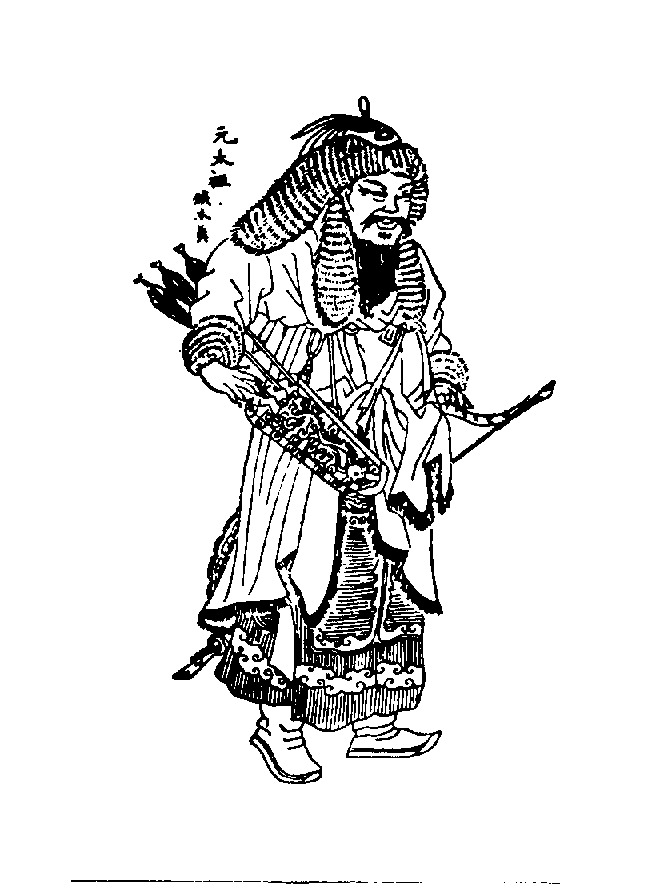 Genghis
Khan was a fierce Mongol chieftan who united the tribes of the steppe and
led them on campaigns that terrorized nearly the entire Eurasian continent.
One of history's greatest conquerors, Temujin was born circa 1165 AD, a
clot of blood clutched in his hand, signifying that he would accomplish
great deeds. He led a difficult life. His father was assassinated
when he was only 9, leaving he and his family destitute as their tribesmen
defected to other tribes. At age 15, he slew his elder brother Bekhter
with an arrow for constantly tormenting him and stealing all of the food
he foraged. He forged an alliance with his father's oath-brother,
Toghrul, leader of the Keraits, and with them managed to steal back his
newly wedded wife from the Merkits, who had taken her to avenge the theft
of Temujin's mother from them by his father. By 1206 at a kurultai
("great assembly" of the clans), Temujin is lauded as Genghis Khan ("strong
chieftain"), and head of all of the clans. From then on, he is known
to history by that title.
Genghis
Khan was a fierce Mongol chieftan who united the tribes of the steppe and
led them on campaigns that terrorized nearly the entire Eurasian continent.
One of history's greatest conquerors, Temujin was born circa 1165 AD, a
clot of blood clutched in his hand, signifying that he would accomplish
great deeds. He led a difficult life. His father was assassinated
when he was only 9, leaving he and his family destitute as their tribesmen
defected to other tribes. At age 15, he slew his elder brother Bekhter
with an arrow for constantly tormenting him and stealing all of the food
he foraged. He forged an alliance with his father's oath-brother,
Toghrul, leader of the Keraits, and with them managed to steal back his
newly wedded wife from the Merkits, who had taken her to avenge the theft
of Temujin's mother from them by his father. By 1206 at a kurultai
("great assembly" of the clans), Temujin is lauded as Genghis Khan ("strong
chieftain"), and head of all of the clans. From then on, he is known
to history by that title.
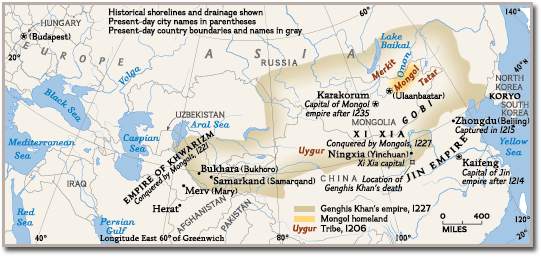 Genghis
Khan burst upon the world, a strong warrior determined to lead his people
into a new era of prosperity and strength. In 1209 he led an army
of thousands across the Gobi Desert, his men surviving on the milk and
blood of their horses, to attack and overrun the kingdom of Xi Xia (a splinter
of the fallen Tang Empire). Two years later, he began skirmishing
with the Jin Empire, the dominant power in northern China now that Xi Xia
was under the Mongol heel. Finally, full scale war erupted, and Genghis
Khan marched his armies into China in 1214. By the following year,
he had besieged Zhongdu (now Beijing), and was nearly bought off by the
Emperor, Xuanzong. But when the Jin ruler escaped to Kaifeng, he
suspected treachery, and captured the city of Zhongdu in 1215. He
crushed the Uighurs, the Khitans, and, in 1219, when enraged by the shah
of the Qwarism Empire's treachery (the shah killed Mongolian diplomats),
he brought the "vengence of God" upon his enemies. By his death in
1227, his empire spanned all of northern Central Asia.
Genghis
Khan burst upon the world, a strong warrior determined to lead his people
into a new era of prosperity and strength. In 1209 he led an army
of thousands across the Gobi Desert, his men surviving on the milk and
blood of their horses, to attack and overrun the kingdom of Xi Xia (a splinter
of the fallen Tang Empire). Two years later, he began skirmishing
with the Jin Empire, the dominant power in northern China now that Xi Xia
was under the Mongol heel. Finally, full scale war erupted, and Genghis
Khan marched his armies into China in 1214. By the following year,
he had besieged Zhongdu (now Beijing), and was nearly bought off by the
Emperor, Xuanzong. But when the Jin ruler escaped to Kaifeng, he
suspected treachery, and captured the city of Zhongdu in 1215. He
crushed the Uighurs, the Khitans, and, in 1219, when enraged by the shah
of the Qwarism Empire's treachery (the shah killed Mongolian diplomats),
he brought the "vengence of God" upon his enemies. By his death in
1227, his empire spanned all of northern Central Asia.
The above map is taken from http://www.nationalgeographic.com/genghis/khanmap.html and is copyrighted by National Geographic Society (1997), all rights reserved.
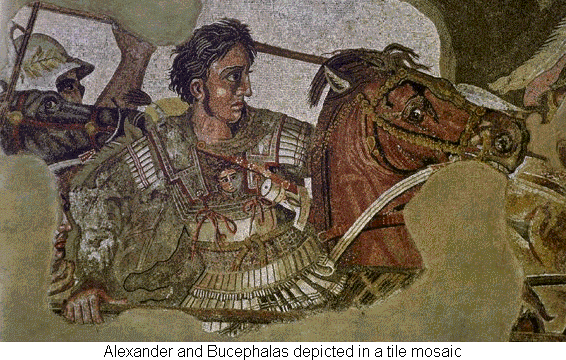 Alexander
the Great was possibly the greatest conqueror of the ancient world.
Trajan wept at the conclusion of his Parthian War, as he stood on the banks
of the Persian Gulf, because he idolized Alexander the Great, who had stood
at that point five hundred years before, at the age of 25, and Trajan was
many years older. Alexander became King of Macedonia through intrigue;
his mother, unwilling to give up the throne to his infant half-brother,
Amyntas, she murdered King Philip and had Amyntas and his mother removed,
long before Alexander's father could appoint Amyntas as his intended successor.
Alexander
the Great was possibly the greatest conqueror of the ancient world.
Trajan wept at the conclusion of his Parthian War, as he stood on the banks
of the Persian Gulf, because he idolized Alexander the Great, who had stood
at that point five hundred years before, at the age of 25, and Trajan was
many years older. Alexander became King of Macedonia through intrigue;
his mother, unwilling to give up the throne to his infant half-brother,
Amyntas, she murdered King Philip and had Amyntas and his mother removed,
long before Alexander's father could appoint Amyntas as his intended successor.
Alexander took up the reins of rulership swiftly. He had already decorated himself in service of his father, King Philip, but swiftly proved that he was as capable a king as he was a general. He subdued the various Greek cities beneath his banner, and then rallied the Greeks against the forces of their age-old enemy, Persia. Up until this point, all of the loot acquired in a campaign went to pay for the war before it. Thus, Alexander, seeking to relieve himself from being indebted to his army as his father had always been, led his forces on the greatest bandit-raid history has ever seen.
The iron discipline of the Macedonian army led them from the shores of Ionia to the capital of Persia in only 4 short years, seizing control of key cities and conquering all of the territories in between. He was even hailed as the new Pharoah of Egypt, and was deified by its people for liberating them from their Persian overlords.
The Mongol army was based on an elite force of mobile cavalry archers. They had very little in the way of infantry (indeed, their way of life made footsoldiers completely impractical). Raised on horses almost from birth, they had the capacity to shoot arrows with deadly accuracy at a full gallop. The compound shortbow had the power of a European crossbow, able to punch through armor and shoot great distances, and the stirrup gave his soldiers a great advantage in hand to hand combat as well as helping maintain balance while on horseback.
Rather than organizing his armies on tribal lines, which would have weakened his power base, Genghis Khan instead organized them in a more "metric" fashion, into units of 10, 100, 1000, and so on. His own personal bodyguard had swelled from a few hundred to 10,000 by 1219, all hand-picked for their fighting prowess and loyalty to the Khan. A system of hand signals was also developed, enabling him to command his troops through use of gestures, allowing him to direct the various units in the very heat of combat, a development that gave him a definite advantage over his opposition.
Quite possibly the greatest killing machine the world has ever seen. The army of Macedon had grown into a juggernaut of epic proportions under Alexander's command, and with this force, his list of successes could have gone on indefinitely. The Macedonian army had grown from an assemblage similar to the Greek hoplites of the previous centuries, but with one major change: the pike.
A pike is a long spear, approximately 15 to 18 feet in length. The Macedonians would form up in square units (often in units of 256 men, sixteen ranks deep, and sixteen ranks wide) called syntagma. Like the Greek hoplite formations, they would interlock their shields to increase protection for themselves as well as for their neighbors, forming a phalanx. Like the Greek hoplite formations, they fought in a offensive posture (spears held underarm, protruding from beneath the shield), rather than as many other cultures fought, in the defensive overarm posture (spears held overarm, raised above the head, poised to strike downward). They also wielded short swords that were primarily piercing weapons, thrust from below the shield at the opponent's groin or gut instead of swung down in a chopping motion. This maximized the defensive and offensive capabilites, making the soldiers more efficient and better protected.
The pike was the primary difference, though. The Greek spear was of average length (5 to 7 feet long). The pike was enormous. It was so long, the points of the first four ranks would protrude toward the enemy, creating the formidible "pike hedge." The enemy had to go through at least 10 feet of spear points before he could come within striking distance of his opponent. This was an incredible weapon against cavalry, although it had its shortcomings against short swordsmen (such as the Spanish discovered in the 16th and 17th centuries). Nevertheless, since most of the armies of the day had a core of spearmen and a number of cavalry and chariot auxiliaries, the pikeman was an effective soldier in the military scheme of his the ancient era.
Go to the
BATTLE
