Anatomy and Appearance Page
How do you describe your characters?
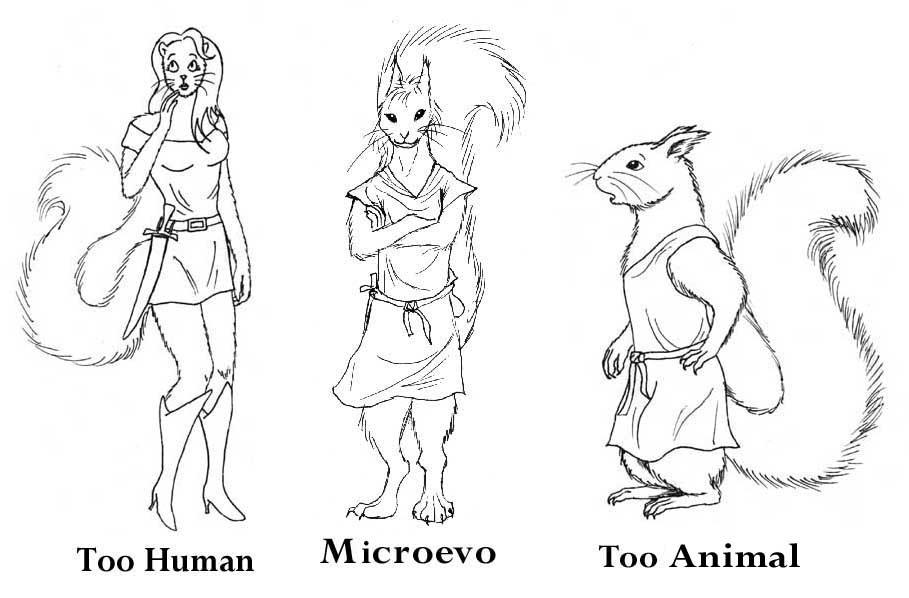
Which squirrel is your idea of a squirrel? I have a problem with the one on the far left. She has lost nearly all squirrelish characteristics. She is a fuzzy human with a squirrel nose and tail. When you describe your characters, keep in mind that they are animals. However evolved, they are not human. You should take this fact into account at all times. Now whether you choose to portray your characters as a real animal walking upright in clothes (as on the far right), or an animal evolved to walk upright and grasp objects is up to you. I used to be a real stickler for keeping animals as we see animals today, but after several drawings I've come to the conclusion that it is quite awkward to draw four-legged creatures on their hind legs all the time. I believe that the animals of the Redwall world have evolved not only be sentient, but their bodies evolved as well so that it is natural for them to walk upright and manipulate objects with adapted paws. This is microevolution - small changes to original anatomy rather than a complete overhaul (macroevolution).
Paw Transformations!
The appearance of creatures of the Redwall world has interested me since I started the series in junior high. How do they hold weapons? How can a mole do anything with its front legs built the way they are? How can a beast tell whether another is a female or male? Over time I have either found or made up my own answers to my questions. Since B.J. seems to want to leave most of these details up to the readers' imaginations, I have taken the initiative and imagined. You may agree or disagree, but this is how I picture it. Redwall is a "What if?" world. What if humans never existed and animals took their place? What if animals built their own 'civilization'? What would it be like? Redwall is that answer. And looking at it from that perspective, it is easy build on the idea. No humans means there are no domestic animals for one thing. No dogs or cows, and since there were never humans, the wolf is not extinct in Europe. The setting is Great Britain, thus, there are mainly European animals. Perhaps a few migrate in every now and then - maybe even over the ocean if they're lucky enough to make it that far (like Columbus to the Americas). Since the animals are assuming the human position, they must have thumbs. Thumbs are crucial to tool making. Without thumbs houses could not be built, fire could not be made, nor weapons weilded. Thumbs make it possible, so here is our first essential picture of our Redwallians: Animals with working hands and opposable thumbs.
The moles should still be able to dig, according to the stories, but they also need to be able to grip a ladle. Foxes can hold swords and axes, so their paws need a little work as well. So this is what I've come up with:

I was worried for a bit about how the males could tell which animals are female since they don't seem to have hair, or other really distinguishing characteristics, but then I realized that that was stupid. Humans rely more on sight than animals. Since these are not humans, they should be able to tell what species and what gender a beast is simply by sniffing the air. There are also questions about carnivores. What sort of foods are an acceptable food source for "good" vermin beasts I will not cover here since this page is dedicated to anatomy (see "Ethics"), but I will point out the anatomical differences between real carnivores (meat-eaters) and Redwall carnivores. Vermin in Redwall are not as carnivorous as they are in our world. They may eat fish and small birds, but if they ever threaten to eat another beast like a squirrel or a weasel, it would more likely be out of malice, not hunger. They seem to enjoy scones and pies as much as any mouse. Thus, in addition to walking on hind legs, speaking, dressing, and being able to grip objects, these creatures' digestive systems must be adapted to a different life-style as well. More omnivorous.
Redwall also does not seem to acknowledge the existance of ungulates like deer, boars, or wild sheep. I assume that, they do, in fact, exist, but since our characters are such small beasts, giant ungulates don't mean much to them and their world so they are left out of the picture. This theory fails if you believe in the downsizing factor, however (see "Exotics"). I have taken the liberty of recruiting boars into an RPG or two, since they are a more noticable size, and are fun to play. Some people may disagree with this, but I think that if wolves and badgers are acknowledged, boars should be too since some are about the size of a wolf.