
According to Nexus Law, all beings of human appearance are full humans.
Cosmetic and minor differences in physiology barely receive consideration
and if anything are seen as attractive in their diversity.
| Acamarian | Brekkian | Kriosian |
| Angelian | Deltan | Ligonian |
| Angosian | Edo | Mangrel |
| Bajoran | El Aurian | Rutian |
| Bandi | Iotian | Sebacean |
| Betazan | J'naii | Trill |
| Koblian | Ullian |
Bloody clan wars ruled Acamarian society for many generations, until peace was achieved over a century ago. However, some clans would not accept this peace, known as the Gatherers, they broke off and became pirates, preying on local towns and trade routes. They rejected all attempts at reconciliation, until they petitioned the Empire for memership and Ambassador Pitcairn helped force the sides into negotiations. Human in appearance, they have a distinguishing vertical crease in their forehead above the nose and wear identifying clan tattoos on one cheek.
Ruled by a constitutionally run, elected matriarchy, the society treated males as second class citizens. Angelian females are the larger of the sexes, being tall and stronger of build (although still attractive as many men will attest to) while the men are shorter and slight of build. Angelian is located fairly close to the Aurelian Elf Neutral Zone.
The Angosians are humanoids from the planet Angosia III. During the
mid-24th century the Angosians fought in the Tarsian War. During this war
the Angosian government used geneticically engineered 'super-warriors'
to fight for them, as most Angosians thought that fighting was inherently
wrong. These warriors had better tactical and intellectual capabilites
than the average Angosian, but were claimed to have inherent mental instability.
For this 'reason' the warriors were imprisoned at the end of the war. The
real reason for the incarceration of these people was the general Angosian
populace's revulsion to violence. Many of the warriors were sent to the
Lunar-V penal colony.
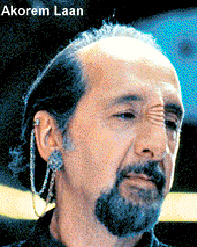 Bajorans are human
in form and function with the exception of a ridged nose. Slight deviations
from human physiology can be discerned through different reactions to body
change. During pregnancy Bajoran females do not nauseate instead they react
by sneezing. Bajoran fetuses are also irremovable due to the high degree
of vascularization in the placental/uterine interface.
Bajorans are human
in form and function with the exception of a ridged nose. Slight deviations
from human physiology can be discerned through different reactions to body
change. During pregnancy Bajoran females do not nauseate instead they react
by sneezing. Bajoran fetuses are also irremovable due to the high degree
of vascularization in the placental/uterine interface.
Society and Religion
Bajoran is a flourishing culture. The Bajorans are a people of master
artisans, architects, and scholars whose lives are centered on faith. Their
deeply religious culture honors the 'Prophets' who guide the Bajorans.
They believe in guidance from the prophecies revealed to ancient religious
men much in the same way as the Greeks believed in Delphi Oracles.
Prophets
The Prophets are the central figures of the Bajoran faith. Bajoran
faith believes the Prophets to be the embodiment of truth, who reveals
their wisdom through visions given by the Orbs. The Prophets are also the
ones who replenish the life force of Bajorans, the 'Pagh' that allows existence.
Orbs
Millenia ago, the first Orb, with eight others to follow, appeared
in the skies of Bajor. Taken as a gift from the Prophets to endow their
followers with wisdom and insight, the Orbs are traditionally housed in
four sacred shrines at temples and monasteries in Bajoran land. Each Orb
has a different function. The Orbs are:
* The Orb of Rhynn: Green energy form. It places the user into a vivid
distant memory.
* The Orb of Siron: Blue energy form. It presents the user with a surrealist
projection of the future, open to
interpretation but usually correct in some way.
* The Orb of Mayra: Pink energy form. It forces overseen knowledge
into the user's attention.
* The Orb of Danar: Purple energy form. It can transfer users back
or forwards in time.
The five lost orbs that were lost to thieves and war. Divine artifacts, the orbs are incapable of being destroyed but their current location is unknown.
Emissary
The title given to the person who would speak with the Prophets, then
unify the Bajoran people. Ro Laan was declared the Emissary when the Prophets
transported him two centuries from his lifetime in the past to the present.
After reinstating the unpopular D'jarra caste system, Ro Laan led the Bajoran
people to join the Empire.
D'jarra Caste
Bajorans live their lives according to the d'jarra caste system. A
Bajoran's social status and vocation is dictated by the d'jarra at birth
and usually indicated in part within the design of the earring.
Earring
The identity of Bajorans is intrinsically connected to their earring.
The designs is often deeply connected to family lineage and the d'jarra,
but some religious figures and Militia officers are known to change their
earrings to better adapt to their line of work. The earring is most often
worn on the right ear, and is usually platinum in substance.
Name
Bajoran custom places the family name before an individual name. Ro
Laan is therefore correctly addressed as Emissary Ro while his familiar
name is Laan. The titles of Bajoran rank also are tied to their religious
rank. The Kai is the spiritual leader of Bajoran faithful, and a new Kai
is named only when the preceding Kai dies or is incapacitated. The Vedek
assembly of 112 influential spiritual leaders is lower than the Kai and
acts as assistant and preacher to the masses. The political leadership
of Bajor is given to the First Minister, who can be any Bajoran national
chosen by democratic election.
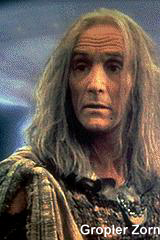 Once fantastic
architects, the Bandi suffered the destruction of their Capitol city
during the Godwars. They then resorted to their old ways of nomadic wandering
in clans in search of food and resorces. In the past 50 years the Bandi
have found the Empire and more and more clans see the Empire as a symbol
of hope where they can again regain their once greatness.
Once fantastic
architects, the Bandi suffered the destruction of their Capitol city
during the Godwars. They then resorted to their old ways of nomadic wandering
in clans in search of food and resorces. In the past 50 years the Bandi
have found the Empire and more and more clans see the Empire as a symbol
of hope where they can again regain their once greatness.
The Bandi are known for their stringy, white and grey hair.
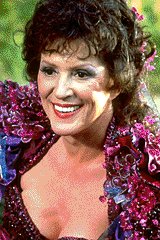 Betazans have
characteristic black irises and mental power of telepathy within the race.
Betazans have
characteristic black irises and mental power of telepathy within the race.
They also have varying empathic links to other races. Their empathic/telepathic
contact leads to a natural trait of complete honesty, somewhat troubling
to outworlders when practiced fully. The telepathy is not inborn but almost
always comes on with adolescence. The few individuals that are born with
their telepathic ability intact generally lack the ability to protect themselves
from unwanted thoughts of others. This usually results in extreme irritability
or even insanity if therapy is not provided.
Betazans are actually uncomfortable around those, whose minds they cannot read. Similarly, the minds of large animals can be a bit frightening to them, and they tend to prefer smaller animals. Their mind contains the paracortex, their telepathic lobe, which is highly capable of recovery from injury, and includes the "metaconsciousness," or a trauma filter. Betazans practice an old style of marriage arrangement called bonding, wherein children are promised to each other for marriage later by their parents. On the same note, Betazoids are known for their ability to love more than one person without losing their ability to love their mate, nor are they bound by their marriage customs. Because marriage is a celebration of the act of love to Betazans, the wedding ceremony itself is traditionally conducted in the nude. Childbearing is similar to humans, except the normal gestation rate for Betazoid females is 10 months rather than 9. Betazoid women are not considered to be "matured" until they at least reach their 40s in equivalent human years, which coincides with the timing of the female Betazoid "Phase" in which time, they experience a quadrupling of their sex drive.
Betazans of Nexus refer to themselves as The Fifth House, Holders of
the Sacred Chalice of Rixx, heir to the Holy Rings of Betazan. The Sacred
Chalice and Holy Rings are not however in the possession of the Betazan
people. Their location is unknown.
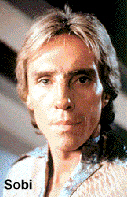 Brekkians have
an extra cartridge bridge on the nose and the unique ability to provide
a limited electrical discharge from the hands, while produced at great
strain to the Brekkian, it can incapacitate the unwary. Until induction
into the Empire, the entire Brekkian economy was entirely built around
supplying narcotics, when their last supply convoy was raided by bandits,
their economy failed. The Brekkian economy was in a depression at the time
and the Empire chose to step in, absorbing the people and saving the Brekkian
people from total collapse.
Brekkians have
an extra cartridge bridge on the nose and the unique ability to provide
a limited electrical discharge from the hands, while produced at great
strain to the Brekkian, it can incapacitate the unwary. Until induction
into the Empire, the entire Brekkian economy was entirely built around
supplying narcotics, when their last supply convoy was raided by bandits,
their economy failed. The Brekkian economy was in a depression at the time
and the Empire chose to step in, absorbing the people and saving the Brekkian
people from total collapse.
Brekkians are talented with unusually good development in the refinement
of narcotics.

The Deltan pheromone system causes many problems in contact with other humanoids, because they uncontrollably release a erotic attraction pheromone. Alchemical applications can reduce that effect, which is virtually neccessary for interactions in enclosed spaces. At great intensities, such as during intercourse, exposure can be damaging or even fatal to other humanoids.
Deltans also have an extra pheremone control system in thier bodies which allows them to produce pheremonal chemicals naturally. It is assumed that this system is used during normal courtship rituals between Deltans, but they can also control other pheremones besides the erotic enhancing ones. Among the pheremonal abilities of a trained Deltan is the ability to produce a pheremonal chemical which seems to reduce pain in most humanoid races.
The Deltans had established two large towns (Seyalia, and Cinera) and were actively seeking contact with other races when a Nexan exploration corp entered their lands.
A strange mixture of hedonistic sexuality and puritanical respect
for a draconian legal code. In the distant past, the Edo were a lawless
and chaotic people, through time they developed a legal system where
a small number of "mediators" patrol randomly selected "punishment zones"
where any infraction, even if accidental, results in immediate execution
without appeal. Since the "punishment zones" are randomly chosen and rapidly
changing, the system is a powerful incentive to obey all laws. The Edo
welcome visitors openly as long as they conform to their system of justice.
The Edo have two major temples to Rhynn and Alia.
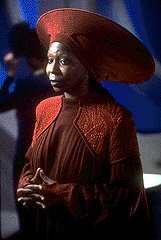 El Aurians are
a very rare and mysterious race of about whom very little is known. In
form they are standard humanoids who display a broad range of racial phenotypes,
comparable to Humans. Their homeland was destroyed by the metallic species
called the Sheen. The few surviving displaced El Aurians have found their
way to the Empire, although seldom if ever in positions of importance.
They seem to prefer to operate quietly in support positions. Much of this
seeming reticence comes from the El Aurian racial character. They appear
to be natural lore-keepers, and use their phenomenal lifespans and memories
to collect the stories and life experiences of various sentient beings.
They are a highly personably and empathic race, and as such are very willing
to help other sentients work out their problems, especially if the end
result is a good story for the "good listener"! Possibly as an offshoot
of their prodigious memories, El Aurians are extraordinarily sensitive
to disturbances in the space/time continuum, and will usually remember
the original version of history if a change is made in time. Although they
can fight when necessary, El Aurians are by and large a docile people.
They are actually capable of ageing, but with lifespans akin to Elves,
not in any meaningful human sense.
El Aurians are
a very rare and mysterious race of about whom very little is known. In
form they are standard humanoids who display a broad range of racial phenotypes,
comparable to Humans. Their homeland was destroyed by the metallic species
called the Sheen. The few surviving displaced El Aurians have found their
way to the Empire, although seldom if ever in positions of importance.
They seem to prefer to operate quietly in support positions. Much of this
seeming reticence comes from the El Aurian racial character. They appear
to be natural lore-keepers, and use their phenomenal lifespans and memories
to collect the stories and life experiences of various sentient beings.
They are a highly personably and empathic race, and as such are very willing
to help other sentients work out their problems, especially if the end
result is a good story for the "good listener"! Possibly as an offshoot
of their prodigious memories, El Aurians are extraordinarily sensitive
to disturbances in the space/time continuum, and will usually remember
the original version of history if a change is made in time. Although they
can fight when necessary, El Aurians are by and large a docile people.
They are actually capable of ageing, but with lifespans akin to Elves,
not in any meaningful human sense.
The Iotians are very intelligent and have a habit of imitating anything they see from outsiders. When first met by the Empire, the Io had no culture or civilzation, living as primitive tribesmen. Within 10 years the Iotian population had doubled and they lived within a town of their own making. One day an absent minded travelling Mage left his spellbook in the Iotian town and in a year there were 10 full fledged Iotian mages.
They are now virtually indistinguishable from the Empires people
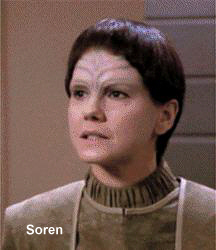 The J’nali have
suppressed the differences between genders and now appear to be one androgynous
gender. They procreate in a highly secretive ritual by means of a fibrous
husk, inseminated by each parent. The J'naii had no interest in becoming
members of the Empire, as the Empire principles of tolerance and understanding
run contrary to the J'naii laws requiring rigid enforcement of a code that
requires all J'naii from exhibiting any sign of gender specific behavior.
Violators are subjected to a psionic brainwashing without appeal.
The J’nali have
suppressed the differences between genders and now appear to be one androgynous
gender. They procreate in a highly secretive ritual by means of a fibrous
husk, inseminated by each parent. The J'naii had no interest in becoming
members of the Empire, as the Empire principles of tolerance and understanding
run contrary to the J'naii laws requiring rigid enforcement of a code that
requires all J'naii from exhibiting any sign of gender specific behavior.
Violators are subjected to a psionic brainwashing without appeal.
J'nalians that do escape from their lands and culture find a freedom
to express long denied desires but however they are hunted down to be brought
back for gender re-education.
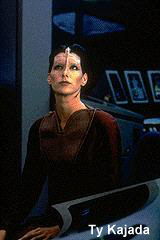 Koblian humans have
brown or black hair, brown eyes and a vertical ridge from the top of their
nose to the base of the skull. Koblians have short lifespans on the the
order of 25-30 years. The Koblian are known to have a major crime problem
related to theft or fraud of life extending magic such as potions of longevity
or elixers of youth. Fortunate for the few Kobliads that do buy or steal
these things is the fact that they have a doubled efficiency.
Koblian humans have
brown or black hair, brown eyes and a vertical ridge from the top of their
nose to the base of the skull. Koblians have short lifespans on the the
order of 25-30 years. The Koblian are known to have a major crime problem
related to theft or fraud of life extending magic such as potions of longevity
or elixers of youth. Fortunate for the few Kobliads that do buy or steal
these things is the fact that they have a doubled efficiency.
 Kriosians are tall,
slender humans that share similarities in their skin pigments -- a dark-spotted,
skin pattern along the hairline and down the neck and spine -- with the
Trill. However they are not viable hosts for the Symbiont.
Kriosians are tall,
slender humans that share similarities in their skin pigments -- a dark-spotted,
skin pattern along the hairline and down the neck and spine -- with the
Trill. However they are not viable hosts for the Symbiont.
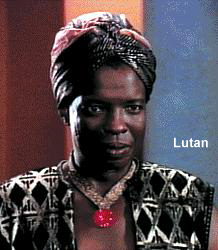
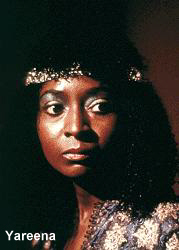 Ligonian;
(left) Dark skinned humans. They lack advanced magics but possess significant
agricultural and Druidical abilities. They hold ritual honor highly and
have a strong and stable social structure. In Ligonian culture the females
posses the land and property but allow the males to rule in their name.
Thus giving women a certain degree of equality in an otherwise patriarchal
society.
Ligonian;
(left) Dark skinned humans. They lack advanced magics but possess significant
agricultural and Druidical abilities. They hold ritual honor highly and
have a strong and stable social structure. In Ligonian culture the females
posses the land and property but allow the males to rule in their name.
Thus giving women a certain degree of equality in an otherwise patriarchal
society.
Mangrel Humans are an evolutionary subset of humanity. Whatever factors precipitated this change are unknown. They are indistinguishable from humanity until they start changing their body parts. They seem to have a natural urge and affinity towards gaining new body parts. They may switch body parts without the need of a Mangrel Cleric, doing so solely by surgery. Unless it is a case of absolute emergency, they tend to carefully choose the parts they will use and may plan for years to obtain the perfect part. They tend to change strictly as a matter of aesthetics, looking for the most beautiful parts. Mangrel Humans are the favored of their God and are the natural leaders of their race.
Mangrels are more commonly known as Mongrels.
 Rutian; (left)
Humans from the lands of Rutia. Very similar to Humans and distinguished
by their hair. Their males are marked by a distinctive white streak and
females usually have red hair. Rutia is politically neutral in most aspects
but it sought Imperial help against an insurgency movement called the Ansata.
Rutian; (left)
Humans from the lands of Rutia. Very similar to Humans and distinguished
by their hair. Their males are marked by a distinctive white streak and
females usually have red hair. Rutia is politically neutral in most aspects
but it sought Imperial help against an insurgency movement called the Ansata.
They have made significant alchemical discoveries and operate commercial
ships with a long history of trading.
 Sebaceans are
human but have a weakness to heat. Warm temperatures that most other lifeforms
can tolerate can be deadly to Sebaceans: delirium sets in, followed by
what they term the "Living Death" -- a comatose state from which there
is no return.
Sebaceans are
human but have a weakness to heat. Warm temperatures that most other lifeforms
can tolerate can be deadly to Sebaceans: delirium sets in, followed by
what they term the "Living Death" -- a comatose state from which there
is no return.
The Peacekeepers are mercenary soldier/warriors. Not content with exercising
dominion over their own people within the Empire, the Peacekeepers have
branched out to many other sectors as well. For a price, they will
serve as the military force for those that lack one, though this arrangement
is usually more advantageous to the Peacekeepers than to their "clients."
Peacekeepers are tenacious fighters with overwhelming weaponry. They
have a talent for, and frequently do, capture large beasts for use in seige
and transport.
Farming and commerce are the principal pursuits of non-Peacekeeper Sebaceans.
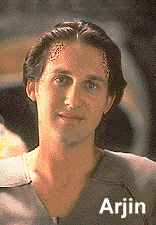 Trills are humans
capable of hosting a small vermiform symbiont within their abdominal cavity.
The process of joining links the minds of both host and symbiont, thus
intermingling the previous experiences from other hosts with the new host
to form a new unique identity. Trills themselves are easily recognized
by the twin columns of spots that run from the forehead all the way down
to the feet. Otherwise, they look completely Human. That and their tendency
to overlap the memory of past lives with the present set Trills apart.
The symbiont roughly resembles a slug and is bred in the Trill caves in
the vast interconnected breeding pools underneath the surface. They are
tended, even pampered, by the Guardians, unjoined Trills who devote their
lives to tending the pools and tracking the symbionts after joining. Symbionts
live for thousands of years, but Trills are considerably shorter-lived.
So symbionts are often transferred from one host to another when the host
dies. The knowledge and experiences of each host is retained by the symbiont,
who share it with a new host. Trill hosts voluntarily join with a symbiont,
but once joined, both Trill and symbiont become biologically interdependent.
After some 83 hours, neither Trill nor symbiont can survive without the
other. The preservation of the symbiont's health is of paramount importance
to the Trill, and if one must be sacrificed to save another, the Trill
will invariably save the symbiont's life.
Trills are humans
capable of hosting a small vermiform symbiont within their abdominal cavity.
The process of joining links the minds of both host and symbiont, thus
intermingling the previous experiences from other hosts with the new host
to form a new unique identity. Trills themselves are easily recognized
by the twin columns of spots that run from the forehead all the way down
to the feet. Otherwise, they look completely Human. That and their tendency
to overlap the memory of past lives with the present set Trills apart.
The symbiont roughly resembles a slug and is bred in the Trill caves in
the vast interconnected breeding pools underneath the surface. They are
tended, even pampered, by the Guardians, unjoined Trills who devote their
lives to tending the pools and tracking the symbionts after joining. Symbionts
live for thousands of years, but Trills are considerably shorter-lived.
So symbionts are often transferred from one host to another when the host
dies. The knowledge and experiences of each host is retained by the symbiont,
who share it with a new host. Trill hosts voluntarily join with a symbiont,
but once joined, both Trill and symbiont become biologically interdependent.
After some 83 hours, neither Trill nor symbiont can survive without the
other. The preservation of the symbiont's health is of paramount importance
to the Trill, and if one must be sacrificed to save another, the Trill
will invariably save the symbiont's life.
Society
Trill society regards a joining with a symbiont as a very high honor.
The Trill Symbiosis Ministry has been the only Trill government agency
mentioned frequently, an indication of its powerful influence. The commission
was set up to determine which Trill could receive the honor of joining,
and tended to the medical needs of the symbionts. Trill hosts are selected
only after rigorous training as an initiate under the close scrutiny of
the Symbiosis trainers. The memories and lifetime of a previous host should
not interfere with the duties and obligations of the new host.This is known
as reassociation, a retrograde link strictly forbidden by the Symbiosis
Ministry. For once every personal obligation is carried on to the next
host, there'd be no end to the debts and pledged from previous lifetimes.
If such a disregard of Trill society occurs, both hosts will be banished
from Trill for life, and the symbiont will die. Since nothing is as paramount
to a Trill as the safety of the symbiont, the risks involved in reassociation
make occurrences few and far between.
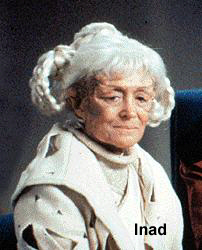
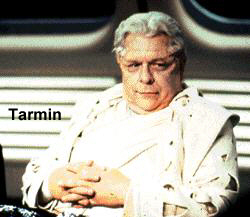 A race of telepaths characterized by skin involutions in the temporal region
of the cranium. Barbaric until being conquered by the Empire two centuries
ago, Ullians have since evolved a modern advanced culture, even though
their use of magic lags far behind modern standards. The Ullians are renowned
historians and are conducting a grand project combining their historical
research with their telepathic skills. They are creating an archive
of the memories of various races. Their memory reading abilities can be
used to commit a form of telepathic rape, although rare, it is dangerous
and severely punished. It is an oddity that while the Ullians can read
the minds of most humanoids, telepaths of other races cannot read Ullians.
A race of telepaths characterized by skin involutions in the temporal region
of the cranium. Barbaric until being conquered by the Empire two centuries
ago, Ullians have since evolved a modern advanced culture, even though
their use of magic lags far behind modern standards. The Ullians are renowned
historians and are conducting a grand project combining their historical
research with their telepathic skills. They are creating an archive
of the memories of various races. Their memory reading abilities can be
used to commit a form of telepathic rape, although rare, it is dangerous
and severely punished. It is an oddity that while the Ullians can read
the minds of most humanoids, telepaths of other races cannot read Ullians.
