
"Who are the Priest-Kings?" I asked.
My father faced me, and he seemed troubled, as if he might have said more than he intended. Neither of us spoke for perhaps a minute.
"Yes," said my father at
last, "I must speak to you of Priest-Kings." He smiled.
---Tarnsman of Gor, 2:28
"My speculation, however,"
said my father, "is that the Priest-Kings are indeed men--men much as we,
or humanoid organisms of some type--who possess a science and technology as far
beyond our normal ken as that of our own twentieth century would be to the
alchemists and astrologers of the medieval universities."
---Tarnsman of Gor, 2:29
My father then explained to me
something of the legends of the Priest-Kings, and I gathered that they seemed to
be true to this degree at least--that the Priest-Kings could destroy or control
whatever they wished, that they were, in effect, the divinities of this world.
It was supposed that they were aware of all that transpired on their planet,
but, if so, I was informed that they seemed, on the whole, to take little note
of it.
---Tarnsman of Gor, 2:30
"There is at least one area, however," said my father, "in which the Priest-Kings do take a most active interest in this world, and that is the area of technology. They limit, selectively, the technology available to us, the Men Below the Mountains. For example, incredibly enough, weapon technology is controlled to the point where the most powerful devices of war are the crossbow and lance. Further, there is no mechanized transportation or communication equipment or detection devices such as the radar and sonar equipment so much in evidence in the military establishments of your world.
"On the other hand," he said,
"you will learn that in lighting, shelter, agricultural techniques, and
medicine, for example, the Mortals, or the Men Below the Mountains, are
relatively advanced."...
---Tarnsman of Gor, 2:31
"The Priest-Kings," said my
father, "maintain the Sacred Place in the Sardar Mountains, a wild vastness
into which no man penetrates. The Sacred Place, to the minds of most men here,
is taboo, perilous. Surely none have returned from those mountains."
---Tarnsman of Gor, 2:29-30
"Occasionally on Gor we destroy a city, selecting it by means of a random selection device. This teaches the lower orders the might of Priest-Kings and encourages them to keep our laws."
"But what if the city has done no wrong?" I asked.
"So much the better," said
Misk, "for the Men below the Mountains are then confused and fear us even
more--but the members of the Caste of Initiates, we have found, will produce an
explanation of why the city was destroyed. They invent one and if it seems
plausible they soon believe it. For example, we allowed them to suppose that it
was through some fault of yours--disrespect for Priest-Kings as I recall--that
your city was destroyed."
---Priest-Kings of Gor, 16:123
It came about late in the month of En'Kara in the year 10,117 from the founding of the city of Ar that I came to the Hall of Priest-Kings in the Sardar Mountains on the planet Gor, our Counter-Earth.
I had arrived four days before on tarnback at the black palisade that encircles the dreaded Sardar, those dark mountains, crowned with ice, consecrated to the Priest-Kings, forbidden to men, to mortals, to all creatures of flesh and blood.
The tarn, my gigantic, hawklike mount,
had been unsaddled and freed, for it could not accompany me into the Sardar.
Once it had tried to carry me over the palisade into the mountains, but never
again would I have essayed that flight. It had been caught in the shield of the
Priest-Kings, invisible, not to be evaded, undoubtedly a field of some sort,
which had so acted on the bird, perhaps affecting the mechanism of the inner
ear, that the creature had become incapable of controlling itself and had fallen
disoriented and confused to the earth below. None of the animals of Gor, as far
as I knew, could enter the Sardar. Only men could enter, and they did not
return.
---Priest-Kings of Gor, 1:7
And so I smelled the passageway and to my nostrils, vague but undeniable, there came an odor that I had never before encountered. It was, as far as I could tell at that time, a simple odor, though later I would learn that it was the complex product of odors yet more simple than itself. I find it impossible to describe this odor, much as one might find it difficult to describe the taste of a citrus fruit to one who had never tasted it or anything much akin to it. It was however slightly acrid, irritating to my nostrils. It reminded me vaguely of the odor of an expended cartridge.
Although there was nothing now with me in the passage it had left its trace.
I knew now that I had not been alone.
I had caught the scent of a
Priest-King.
---Priest-Kings of Gor, 7:56
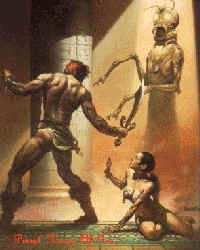
In its way it was very beautiful, golden and tall, looming over me, framed in that massive portal. It was not more than a yard wide but its head nearly touched the top of the portal and so I would judge that, standing as it did, it must have been nearly eighteen feet high.
It had six legs and a great head like a globe of gold with eyes like vast luminous disks. Its two forelegs, poised and alert, were lifted delicately in front of its body. Its jaws opened and closed once. They moved laterally.
From its head there extended two fragile, jointed appendages, long and covered with short quivering strands of golden hair. These two appendages, like eyes, swept the room once and then seemed to focus on me.
They curved toward me like delicate
golden pincers and each of the countless golden strands on those appendages
straightened and pointed toward me like a quivering golden needle.
---Priest-Kings of Gor, 9:75-76
For all its size it moved with a delicate, predatory grace. It was perhaps very light for its bulk, or very strong, perhaps both. It moved with a certain deliberate, stalking movement; its tread was regal and yet it seemed almost dainty, almost fastidious; it was almost as if the creature did not care to soil itself by contact with the floor of the passage.
It walked on four extremely long,
slender, four-jointed stalks that were its supporting legs, and carried its far
more muscular, four-jointed grasping legs, or appendages, extremely high, almost
level with its jaw, and in front of its body. Each of these grasping appendages
terminated in four much smaller, delicate hooklike prehensile appendages, the
tips of which normally touched one another. I would learn later that in the ball
at the end of its forelegs from which the smaller prehensile appendages
extended, there was a curved, bladed, hornlike structure that could spring
forward; this happens spontaneously when the leg's tip is inverted, a motion
which at once exposes the hornlike blade and withdraws the four prehensile
appendages into the protected area beneath it.
---Priest-Kings of Gor, 10:80-81
It was at this time that I first saw
how Priest-Kings breathed, probably because Sarm's respiratory movements were
now more pronounced than they had been hitherto. Muscular contractions in the
abdomen take place with the result that air is sucked into the system through
four small holes on each side of the abdomen, the same holes serving also as
exhalation vents. Usually the breathing cycle, unless one is quite close and
listens carefully, cannot be heard, but in the present case I could hear quite
clearly from a distance of several feet the quick intake of air through the
eight tiny, tubular mouths in Sarm's abdomen, and its almost immediate
expellation through the same apertures.
---Priest-Kings of Gor, 11:88-89"He is a Priest-King," said Misk,
"and has eight brains, modifications of the ganglionic net, whereas a
creature such as yourself, limited by vertebrae, is likely to develop only one
brain."
---Priest-Kings of Gor, 15:120
He moved his forelegs in a strange parallel pattern, touching himself with each leg at three places on the thorax and one behind the eyes. "Here," he said, "is the true source of our power."
I then realized that he had touched
himself at the points of entry taken by the wires which had been infixed in the
young Priest-King's body on the stone table in the secret compartment below
Misk's chamber. Sarm had pointed to his eight brains.
---Priest-Kings of Gor, 18:145
I held the torch high and looked at the Priest-King, who was rather small for a Priest-King, being only about twelve feet long.
What most astonished me was that he had wings, long, slender, beautiful, golden, translucent wings, folded against his back.
... I looked at the long, golden wings of the creature. "Is it a mutation?" I asked.
"Of course not," said Misk.
"Then what is it?" I asked.
"A male," said Misk. He paused for a long time and the antennae regarded the inert figure on the stone table. "It is the first male born in the Nest in eight thousand years."
"Aren't you a male?" I asked.
"No," said Misk, "nor are the others."
"Then you are female," I said.
"No," said Misk, "in the Nest only the Mother is female."
"But surely," I said, "there must be other females."
"Occasionally," said Misk, "an egg occurred which was female but these were ordered destroyed by Sarm. I myself know of no female egg in the Nest, and I know of only one which has occurred in the last six thousand years."
"How long," I asked, "does a Priest-King live?"
"Long ago," said Misk, "Priest-Kings discovered the secrets of cell replacement without pattern deterioration, and accordingly, unless we meet with injury or accident, we will live until we are found by the Golden Beetle."
"How old are you?" I asked.
"I myself was hatched," said
Misk, "before we brought our world into your solar system." He looked
down at me. "That was more than two million years ago," he said.
---Priest-Kings of Gor, 15:117-118
"The Mother was hatched and flew her Nuptial Flight long before the discovery of the stabilization serums," said Misk. "We have managed to retard her aging considerably but eon by eon it has been apparent that our efforts have been less and less successful, and now there are no more eggs."
"I don't understand," I said.
"The Mother is dying," said
Misk.
---Priest-Kings of Gor, 16:130
I am told that the phonemes of the language of Priest-Kings or, better, what in their language would correspond to phonemes in ours, since their "phonemes" have to do with scent and not sound, number seventy-three. Their number is, of course, potentially infinite, as would be the number of possible phonemes in English, but just as we take a subset of sounds to be English sounds and form our utterances from them, so they take a subset of odors as similarly basic to their speech. The number of familiar, common English phonemes, incidentally, is in the neighborhood of fifty.
The morphemes of the language of Priest-Kings, those smallest intelligible information bits, in particular, roots and affixes, are, of course, like the morphemes of English, extremely numerous. The normal morpheme, in their language as in ours, consists of a sequence of phonemes. For example, in English 'bit' is one morpheme but three phonemes, as will appear clear if given some reflection. Similarly in the language of the Priest-Kings, the seventy-three "phonemes" or basic scents are used to form the meaning units of the language, and a single morpheme of Priest-Kings may consist of a complex set of odors.
... I was told, incidentally, that the
language of the Priest-Kings does possess more morphemes than English but I do
not know if the report is truthful or not, for Priest-Kings tend to be somewhat
touchy on the matter of any comparisons, particularly those to their
disadvantage or putative disadvantage, with organisms of what they regard as the
lower orders. On the other hand it may well be the case that, as a matter of
fact, the morpheme set of the language of Priest-Kings is indeed larger than
that of English. I simply do not know....
---Priest-Kings of Gor, 10:79-80
The Nest
"These are the tunnels of the Priest-Kings," it said.
I looked about me and found myself on a high, railed platform, overlooking a vast circular artificial canyon, lined with bridges and terraces. In the depths of this canyon and on the terraces that mounted its sides were innumerable structures, largely geometrical solids--cones, cylinders, lofty cubes, domes, spheres and such--of various sizes, colors and illuminations, many of which were windowed and possessed of numerous floors, some of which even towered to the level of the platform where I stood, some of which soared even higher into the lofty reaches of the vast dome that arched over the canyon like a stone sky.
I stood on the platform, my hands clenched on the railing, staggered by what I saw.
The light of energy bulbs set in the walls and in the dome like stars shed a brilliant light on the entire canyon.
"This," said the Priest-King, still grooming the golden hairs of his antennae, "is the vestibule of our dominion."
From my position on the platform I could see numerous tunnels at many levels leading out of the canyon, perhaps to other such monstrous cavities, filled with more such structures.
I wondered what would be the function
of the structures, probably barracks, factories, storehouses.
---Priest-Kings of Gor, 10:8-821
I did not object to the time I spent with Sarm, however, for he taught me far more of the Nest in a much shorter time than would have otherwise been possible. With him at my side I had access to many areas which would otherwise have been closed to a human.
One of the latter was the power source of the Priest-Kings, the great plant wherein the basic energy is generated for their many works and machines.
"Sometimes this is spoken of as the Home Stone of all Gor," said Sarm, as we walked the long, winding, iron spiral that clung to the side of a vast, transparent blue dome. Within that dome, burning and glowing, emitting a bluish, combustive refulgence, was a huge, crystalline reticulated hemisphere.
... At last we had reached the very apex of the great blue dome and I could see the glowing, bluish, refulgent, reticulated hemisphere far below me.
Surrounding the bluish dome, in a greater concentric dome of stone, I saw walkway upon walkway of paneling and instrumentation. Here and there Priest-Kings moved lightly about, occasionally noting the movements of scent-needles, sometimes delicately adjusting a dial with the nimble, hooklike appendages at the tips of their forelegs.
I supposed the dome to be a reactor of
some sort.
---Priest-Kings of Gor, 18:143-145
"It is said below the mountains that Priest-Kings know all that occurs on Gor."
"Nonsense," said Misk.
"But perhaps I shall show you the Scanning Room someday. We have four
hundred Priest-Kings who operate the scanners, and we are accordingly well
informed. For example, if there is a violation of our weapons laws we usually,
sooner or later, discover it and after determining the coordinates put into
effect the Flame Death Mechanism."
---Priest-Kings of Gor, 16:125
"The reason for observation within
the atmosphere," said Sarm, "is that it is simpler to get more
definition in the signal because of greater proximity to its source. To get
comparable definition in an extra-atmospheric surveillance device would require
more refined equipment."
---Priest-Kings of Gor, 17:135
"You are seeing through the eyes of an Implanted One," said Sarm.
I gasped.
Sarm's antennae curled.
"Yes," he said. "the pupils of his eyes have been replaced with
lenses and a control net and transmitting device have been fused with his brain
tissue. He himself is now unconscious, for the control net is activated. Later
we will allow him to rest, and he will see and hear and think again for
himself."
---Priest-Kings of Gor, 17:136
The Priest-King monitoring the observation cube touched a knob on his control panel.
"Stop!" I cried.
Before my horrified eyes in the
observation cube the man seemed suddenly to vaporize in a sudden blasting flash
of blue fire. The man had disappeared. Another brief incandescent flash
destroyed the primitive tube he had carried. Then once again, aside from the
blackened grass and stone, the scene was peaceful. A small, curious bird darted
to the top of the stone, and then hopped from it to the blackened grass to hunt
for grubs.
---Priest-Kings of Gor, 17:138-139
The Mother
Inching forward I saw, on the raised platform at this end of the room, the Mother.
For a moment I could not believe that it was real or alive.
It was undoubtedly of the Priest-King kind, and it now was unwinged, but the most incredible feature was the fantastic extent of the abdomen. Its head was little larger than that of an ordinary Priest-King, or its thorax, but its trunk was conjoined to an abdomen which if swollen with eggs might have been scarcely smaller than a city bus. But now this monstrous abdomen, depleted and wrinkled, no longer possessing whatever tensility it might once have had, lay collapsed behind the creature like a flattened sack of brownly tarnished golden ancient leather.
Even with the abdomen empty her legs could not support its weight and she lay on the dais with her jointed legs folded beside her.
Her coloring was not that of the normal Priest-King but darker, more brownish, and here and there black stains discolored her thorax and abdomen.
Her antennae seemed unalert and lacked resilience. They lay back over her head.
Her eyes seemed dull and brown.
I wondered if she were blind.
It was a most ancient creature on which I gazed, the Mother of the Nest.
It was hard to imagine her, uncounted
generations ago, with wings of gold in the open air, in the blue sky of Gor,
glistening and turning with her lover borne on the high, glorious, swift winds
of this distant, savage world. How golden she would have been.
---Priest-Kings of Gor, 27:213
Ceremonials of days gone by
"What are the three great holidays?" I asked.
"The Nest Feast Cycle," said Misk, "Tola, Tolam and Tolama."
"What are these feasts?" I asked.
"They are the Anniversary of the
Nuptial Flight," said Misk, "the Feast of the Deposition of the First
Egg and the Celebration of the Hatching of the First Egg."
---Priest-Kings of Gor, 11:87
There, from a great golden bowl, about five feet deep and with a diameter of perhaps twenty feet, setting on a heavy tripod, he would take a bit of whitish liquid, undoubtedly Gur, in his mouth.
He took no more than a taste and the bowl, though the Feast of Tola was well advanced, was still almost brimming. He would then approach the Mother very slowly and lower his head to hers. With great gentleness he would then touch her head with his antennae. She would extend her head to him and then with a delicacy hard to imagine in so large a creature he would transfer a tiny drop of the precious fluid from his mouth to hers. He would then back away and return to his place where he would stand as immobile as before.
He had given Gur to the Mother.
I did not know at the time but Gur is a product originally secreted by large, gray, domesticated, hemispheric arthropods which are, in the morning, taken out to pasture where they feed on special Sim plants, extensive, rambling, tangled vine-like plants with huge, rolling leaves raised under square energy lamps fixed in the ceilings of the broad pasture chambers, and at night are returned to their stable cells where they are milked by Muls. The special Gur used on the Feast of Tola is, in the ancient fashion, kept for weeks in the social stomachs of specially chosen Priest-Kings to mellow and reach the exact flavor and consistency desired, which Priest-Kings are then spoken of as retaining Gur.
I watched as one Priest-King and then
another approached the Mother and repeated the Gur Ceremony.
---Priest-Kings of Gor, 27:214-215
Slaves of Priest-Kings
"I am Mul-Al-Ka," said one, "honored slave of the glorious Priest-Kings."
"I am Mul-Ba-Ta," said the other, "honored slave of the glorious Priest-Kings."
"In the Nest," said Misk,
"the expression 'Mul' is used to designate a human slave."
---Priest-Kings of Gor, 12:94
"Yes," said Sarm, "one was synthesized, beginning with the synthesis of the protein molecules, and was formed molecule by molecule. It is an artificially constructed human being. It is not of much scientific interest but it has considerable curiosity value. It was built over a period of two centuries by Kusk, the Priest-King, as a way of escaping in his leisure hours from the burdens of his serious biological investigations."
I shuddered.
"What of the other?" I asked.
"It too," said Sarm, "is not without interest and is also bestowed upon us by the avocational whims of Kusk, one of the greatest of our Nest."
"Is the other also synthesized?" I asked.
"No," said Sarm, "it is
the product of genetic manipulation, artificial control and alteration of the
hereditary coils in gametes."
---Priest-Kings of Gor, 12:94-95
It is not hard to get used to Mul-Fungus, for it has almost no taste, being an extremely bland, pale, whitish, fibrous vegetablelike matter. I know of no one who is moved much in one direction or the other by its taste. Even the Muls, many of whom have been bred in the Nest, do not particularly like it, nor despise it. It is eaten with much the same lack of attention that we normally breathe air.
Muls feed four times a day. In the first meal, Mul-Fungus is ground and mixed with water, forming a porridge of sorts; for the second meal it is chopped into rough two-inch cubes; for the third meal it is minced with Mul-Pellets and served as a sort of cold hash; the Mul-Pellets are undoubtedly some type of dietary supplement; at the final meal Mul-Fungus is pressed into a large, flat cake and sprinkled with a few grains of salt.
Misk told me, and I believe him, that
Muls had occasionally slain one another for a handful of salt.
---Priest-Kings of Gor, 14:109
Matoks
"What is a Matok?" I asked.
"A creature that is in the Nest
but is not of the Nest," said Misk.
---Priest-Kings of Gor, 12:92
How long,” I asked, “does a Priest-King live?”
“Long ago,” said Misk, “Priest-Kings discovered the secrets of cell replacement without pattern deterioration, and accordingly, unless we meet with injury or accident, we will live until we are found by the Golden Beetle.”
“How old are you?” I asked.
“I myself was hatched,” said Misk, “before we brought our world into your solar system.” He looked down at me. “That was more than two million years ago,” he said.
“Then,” I said, “the Nest will never die.”
“It is dying now,” said Misk. “One by one we succumb to the Pleasures of the Golden Beetle. We grow old and there is little left for us. At one time we were rich and filled with life and in that time our great patterns were formed and in another time our arts flourished and then for a very long time our only passion was scientific curiosity, but now even that lessens, even that lessens.”
“Why do you not slay the Golden Beetles?” I asked.
“It would be wrong,” said Misk.
“But they kill you,” I said.
“It is well for us to die,” said
Misk, “for otherwise the Nest would be eternal and the Nest must not be
eternal, for how could we love it if it were so?”
---Priest-Kings of Gor, 15:118-119
Then to my amazement when the Beetle neared Sarm the Priest-King sank down on his supporting appendages, almost as if he were on his knees, and suddenly plunged his face and antennae into the midst of the waving mane hair of the Golden Beetle.
I watched the pincerlike jaws grip and puncture the thorax of the Priest-King.
More rock dust drifted between me and the pair locked in the embrace of death. More rock tumbled to the dome and bounced clattering to the debris below.
The very globe and walkway seemed to lift and tremble but neither of the creatures locked together above me seemed to take the least notice.
Sarm's antennae lay immersed in the golden hair of the Beetle; his grasping appendages with their sensory hairs caressed the golden hair; even did he take some of the hairs in his mouth and with his tongue try to lick the exudate from them.
“The pleasure,” came from Sarm's translator. “The pleasure, the pleasure.”
I could not shut out from my ears the grim sound of the sucking jaws of the Beetle.
I knew now why it was that the Golden Beetles were permitted to live in the Nest, why it was that Priest-Kings would not slay them, even though it might mean their own lives.
I wondered if the hairs of the Golden Beetle, heavy with the droplets of that narcotic exudate, offered adequate recompense to a Priest-King for the ascetic millennia in which he might have pursued the mysteries of science, if they provided an acceptable culmination to one of those long, long lives devoted to the Nest, to its laws, to duty and the pursuit and manipulation of power.
Priest-Kings, I knew, had few
pleasures, and now I guessed that foremost among them might be death.
---Priest-Kings of Gor, 31:275-276
"What is a Matok?" I asked.
"A creature that is in the Nest
but is not of the Nest," said Misk.
---Priest-Kings of Gor, 12:92
At that moment to my horror a large, perhaps eight feet long and a yard high, multilegged, segmented arthropod scuttled near, its eyes weaving on stalks.
"It's harmless," said the Priest-King.
The arthropod stopped and the eyes leaned toward us and then its pincers clicked twice.
I reached for my sword.
Without turning it scuttled backwards
away, its body plates rustling like plastic armor.
---Priest-Kings of Gor, 10:82
I did not know at the time but Gur is a product originally secreted by large, gray, domesticated, hemispheric arthropods which are, in the morning, taken out to pasture where they feed on special Sim plants, extensive, rambling, tangled vine-like plants with huge, rolling leaves raised under square energy lamps fixed in the ceilings of the broad pasture chambers, and at night are returned to their stable cells where they are milked by Muls. The special Gur used on the Feast of Tola is, in the ancient fashion, kept for weeks in the social stomachs of specially chosen Priest-Kings to mellow and reach the exact flavor and consistency desired, during which time Priest-Kings are then spoken of as retaining Gur.
I watched as one Priest-King and then
another approached the Mother and repeated the Gur Ceremony.
---Priest-Kings of Gor, 27:215
...It was about the size of a
rhinoceros and the first thing I noticed after the glowing eyes were two
multiply hooked, tubular, hollow, pincerlike extension that met at the tips
perhaps a yard beyond its body.They seemed clearly some aberrant mutation of its
jaws. Its antennae, unlike those of the Priest-Kings, were very short. They
curved and were tipped with a fluff of golden hair. Most strangely perhaps were
several long, golden strands, almost a mane, which extended from the creatures
head over its domed golden back and fell almost to the floor behind it. The back
itself seemed divided into two thick casings which might once, ages before, have
been horny wings, but now the tissues had, at the points of touching together,
fused in such a way as to form what was for all practical purposes a thick,
immobile golden shell....
---Priest-Kings of Gor, 24:180
The exudate which forms on the mane
hairs of the Golden Beetle, which had overcome me in the close confines of the
tunnel, apparently has a most intense and, to a human mind, almost
incomprehensibly compelling effect on the unusually sensitive antennae of the
Priest-Kings, luring them helplessly, almost as if hypnotized, to the jaws of
the Beetle, who then penetrates their body with its hollow, pincerlike jaws and
drains it of body fluid.
---Priest-Kings of Gor, 30:257
Toos
I swung the transportation disk in a graceful arc to one side of the tunnel to avoid running into a crablike organism covered with overlapping plating and then swung the disk back in another sweeping arc to avoid slicing into a stalking Priest-King who lifted his antennae quizzically as we shot past.
"The one who was not a
Priest-King," quickly said Mul-Al-Ka, "was a Matok and is called a
Toos and lives on discarded fungus spores."
---Priest-Kings of Gor, 18:142
We had not walked far when we passed a long, wormlike animal, eyeless, with a small red mouth, that inched its way along the corridor, hugging the angle between the wall and the floor.
..."It is a Slime Worm"....
..."It scavenges on the kills of the Golden Beetle"...
---Priest-Kings of Gor, 13:104-105
