

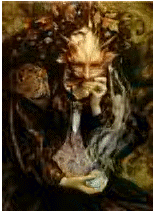
 The High King of the Tuatha de Danann is Fin Bheara, crafty and courageous Faerie Lord, with a gift for the game of Chess, great skill at running the Hunt, and an eye for Beauty. One long tale tells of his kidnapping of the Bride Ethna, the lovely wife of a human King, right on the evening of the Wedding. He is also considered a King of the Dead, dressed all in black, and the owner of a stable of fine ebony horses, who run as swift as the wind and never tire. Occasionally he will lend one to a mortal in need, such as the Kirwans of Galway--of course, he *always* expects a favour in return! The Faerie mound where he live is Knockma, and woe to any mortal who enters and is foolish enough to eat at the Faerie Feast there--he would be trapped forever...
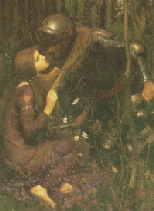 Her haunting places are near wells, and along the banks of streams lined with moss and willows. The Lhiannon Sidhe, whose name means "Fairy Sweetheart", is also considered a protective spirit of certain familys, such as the Fletchers, who would drink a Fairy Cup to her each Christmas.
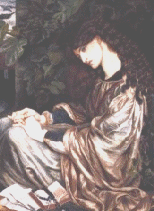
This vampiric Faerie would attach herself to one man, usually someone with a gift for the Arts in some way, and become his Muse. While inspired by his ardent mistress, he would create great works of Song and Ballad and lyrical Poetry, all in a few weeks time, burning himself out while under her tutelage. No other human could see her except the one she had chosen--a potent attraction, and a dangerous one. She was irresistably beautiful, weaving a spell of enchantment that bound her Lover to her with powerful charms. Once seduced by her, the mortal could not bear the touch of another woman, and would pine away for his Faerie love, ruined in body and soul.
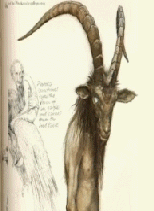 The Phooka was a kind of Bogey-Beast who took various forms, usually a horse, or goat,and was a mischievous spirit that goaded humans to fall into wells, or take a ride on his back. He would appear on lonely roads, standing there shaggy and friendly, a welcome sight for weary travelers: but after the human had climbed on his back, he would take off like a bolt of lightning, rushing headlong through the dark woods, brambles, and soggy moorlands, where he would suddenly STOP, and throw the unfortunate rider over his head into a ditch or thornbush, then gallop away, laughing madly!
There is an old Irish story of a boy, Phadrig, who captured a Phooka by throwing his coat over the beast as it rushed towards him; afterwards it was very tame and would appear, in the form of a ragged old man, with many of it's fellows, in the boy's family field each night to thresh the corn for them. When the boy gave him new clothes to replace the rags, the Phooka took them and, thinking himself too fine to work, disappeared--but not before blessing Phadrig and his family.
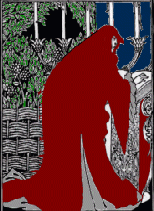 Out on the lonely roads of old Ireland, or riding across the moor under a pale moon, the cry of the Bean Sidhe could pierce the soul with an Old Terror: hers was the wail that called the Prince of Death. The unfortunate one who heard that mournful cry knew that it was time to prepare for his leave-taking from this World. Sometimes she assumed the form of a young unmarried woman, one who had died in childbirth, who sang sweetly to the ill-omened soul of his imminent demise--other times, she appeared in a blood-red robe, down by a river, chilling the air with her wild weeping and washing the grave clothes of the next to die.
Certain Irish families had their own banshee who would alternately bless them or warn them. Some saw her as an old woman, naked from the waist up, washing bloody clothes in the mill stream: if one were brave enough to sneak up and suckle from her breast, he would be blessed with an extra long life.
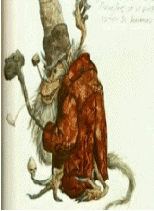 The Fir Darrig, which means "Red Man" is a faerie imminently fond of practical jokes, especially gruesome ones, and usually appears as a rather squat, very wrinkled old man in a ragged red coat and hat, long, coarse grey hair and smoking a blackthorn pipe. He is sometimes thought to have been an unlucky former human who had wandered into the fairy hills by chance, and would often try to give advice to those who were about to make the same mistake.
He loves to startle folks by knocking on their door in the dead of night and asking to warm himself by the fire--it is VERY bad luck to refuse him: the result could be anything from cattle with the Pox, to the finding of a hideous changeling in the baby's crib the next morning. If cozened and given something good to eat (they prefer milk and sweetmeats), then one could find gold on the table, or ask a wish for one's family: to take a Wish, though, is not often wise, as the Fir Darrig's weird sense of humor could turn the words of your wish into something less than desirable.
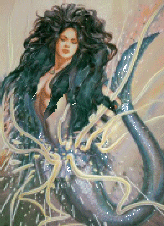 The Merrows are Irish faerie mermaids: gentle and very beautiful. They are a dreaded sight at sea, though, for their presence foretells the advent of great storms. The merrows often have great knowledge of the healing powers of herbs and plants, and can cure most any illness. Because of this, those who live by the ocean can ask a special boon of them for a sick child--they have a fondness for human children. Sometimes, however, if the child is a handsome male, the Merrows would consider the boy to be their own, and seduce him when him reached young manhood. The children of these matches, while slim and fair as their faerie mothers, often had scales covering the skin or fishes tails.
At times, when coming ashore, they appeared as small, white, hornless cattle, lowing in a musical voice. When in the shape of beautiful women, they wear caps with long, red feathers: if you steal these caps, they cannot return to the sea. The male merrows, while jovial and generably amiable, are quite ugly, with pig noses and squinty eyes.
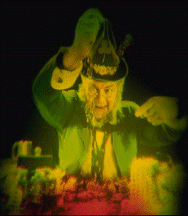
The Lepracaun is probably the most well-recognized of the Irish Faerie Folk, his name said to have been derived from "leith bhrogan", the "one-shoe-maker", because he is generally seen working on a single shoe at a time. Being an Earth spirit, like the Gnome, and solitary by nature, he knows where the Earth's treasures lie hidden. One of his favorite tricks is, having given a hint of the location of the gold or jewels, he genially offers one a pinch of his finest snuff--then blows it into one's face, as he disappears into the woods, laughing maniacally.
Some lepracauns have a taste for Irish whiskey, and could be found in the cellars of prosperous farmers, carousing with the local brownies, dancing a jig or playing a sailor's hornpipe. It is best, at such times, to let them alone to have their fun--rather suffer a sleepless night than a Lepracaun's drunken curse!
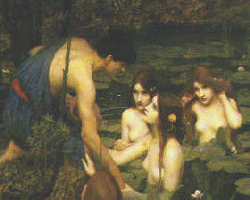 The Roanes are the Gaelic Seal people, the gentlest of all the faerie folk. They are said to have been humans not evil enough for Hell, yet not pure enough to enter Heaven, and so were banished to the Sea. The seal-folk have a natural human form,and live underwater or on lonely skerries, putting on seal-skins to enable them to pass through the waters from one region of air to another. Though generally kind to humans, they will avenge the death of one of their own by raising great storms, and thus sinking the boats of the seal-catchers.
Both male and female Roanes are meltingly beautiful, with large, dark eyes and liquid movements that never fail to catch the attentions of amorous humans. They are not always constant lovers, though, and long for the sea, seeking any chance to return to it. There are many tales of men taking a Roane bride by capturing her on land, and taking possession of her discarded seal-skin.
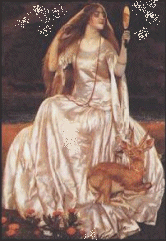
The Glaistig has many different attributes, depending in which part of Ireland-or Scotland-you find her. She is often described as having a beautiful female form, with the legs of a goat. The Glaistig is a Water spirit, always living in close proximity to rivers, waterfalls, and streams. In some incarnations she is like the Banshee, mourning the death of her favourite humans. Her nature is basically benign, and she is very fond of children and old people, and partial to pregnant women. The Glaistig frequently have been seen herding cattle, caring for them secretly at night, and blessing them with abundant milk: for this favor, she is to be given libations of milk and honey.
Faeries, often perverse, will take on unexpected forms--and so she is sometimes seen as a murderous seductress, preying on unwary males who venture near her protected brooks and waterfalls. In this form she is vampiric, like the Lhiannon-Sidhe, but darker, draining the life energies of her human lover, and leaving him pale and lifeless on the shore of her haunted woodland
stream.
The Above Definitions and Pictures were found on the History of Irish Fokelore and Fairy Tales Ring


