Sex-linked Explanation

In terms of the Opaline mutation

What is Opaline?

Opaline is a sex-linked gene. That means that it is carried on the "X" chromosome, only. You learned in Biology (If you remember ;) that one gender needs a "X" and "Y" chromosome, while the other sex needs a "X" and "X" chromosome. In humans, "XX" is female and "XY" is male, BUT budgies are the opposite- "XX" is male and "XY" is female.

Ok, next thing... Opaline is a recessive gene, which means that a non-opaline gene will show up OVER an opaline gene. The non-Opaline gene is what makes the bird appear normal (see pic. above). If an opaline gene + non-opaline gene are together in the same bird, the bird will NOT appear opaline. So, since the male has two "X" chromosomes, it means that he can have either:


-2 opaline genes
-1 opaline gene + 1 non-Opaline gene
-2 non-Opaline genes

The only way he can appear Opaline is if he has 2 Opaline genes (because-as I said above, Opaline is recessive to non-opaline). The female is different though. She only has one "X" chromosome and one "Y". Since Opaline and non-opaline genes aren't carried on the "Y" chromosome, she can only have either:

-1 Opaline gene
-1 non-Opaline gene

So the only way she can be Opaline is to have that 1 Opaline gene. Since there in no non-opaline gene stopping her one opaline gene, she appears opaline.

Onto the breeding. Let "Xo" stand for an Opaline gene and "Xn" stand for a non-opaline gene. The "X" stands for those genes being carried on the "X" chromosome. "Y" will stand for the "Y" chromosome that does not carry any opaline related genes.

We draw a Punnett square to estimate what the babies would look like.

Let us assume we have a male bird that does not appear opaline. He COULD have one opaline gene hidden under the non-Opaline gene, but lets pretend he has no opaline genes. Our female is Opaline because she has one opaline gene on her "X" chromosome. Remember 1 opaline gene + 1 non-opaline= NON-opaline.

This is a Punnett square:
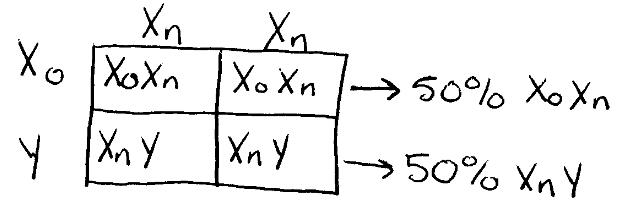
Ok, so the possibilties are:

-50% Xn/Xo These will be males because of the two "X"'s and will not appear opaline because they will have one opaline gene and one non-opaline gene.

-50% Xn/Y These will be females because of the "X" and the "Y" and they will not appear Opaline because the only gene they got was a non-opaline from their daddy.

None of our babies will appear opaline, but the males will have one Opaline gene hidden.



This is why I love sex-linked genes-

Sometimes you can tell which babies will be girls and which will be boys by which babies turn out appearing Opaline.

Here is how:

In my case, Azizi is a boy and he is Opaline. That means he has to have 2 Opaline genes on both his "X" chromosomes because he appears Opaline. Lets pretend I breed him to my female, Amaya, who is NOT an Opaline bird.

Once again, "Xo" will stand for an opaline gene, "Xn" will mean non-opaline, and the "Y" will stand for the "Y" chromsome that the female has that doesn't carry opaline related genes.

Here is my Punnett square:

So this time I get:
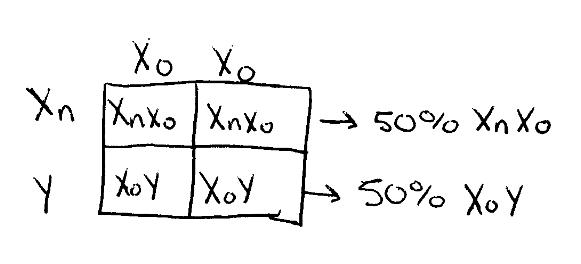
-50% Xn/Xo These are boys because of the two "X" chromsomes, and are not opaline because they have 1 Opaline+ 1 non-opaline gene.

-50% Xo/Y These are girls because of the "X" plus the "Y", and they are Opaline because they carry that 1 Opaline gene.

Since, ONLY the females and ALL the females in this clutch would appear Opaline, I could decide from an early age which babies were girls and which were boys.

All sex-linked genes work in this way. Other sex-linked genes are:

-Ino (albino, lutino)
Red-eyed Lacewing
German Fallow
Cinnamon

And that, my friend, is my long (and probably very boring) rant on sex-linked genes :)

Back Home

Problems? Questions?
Rebelangel138@michalegraves.every1.net