|
VOCALISTS
/ RHYTHM GUITARISTS
LEAD GUITARISTS / BASSISTS / DRUMMER
Lead
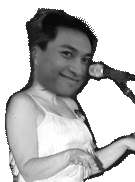
Vocalist, Frontman
(person) or Lead Singer are
the terms used to describe a
vocalist who sings the songs
melody in front of musicians
who
accompany the singer playing the rhythm and
backing music regardless of the type or size of the
band. He or She is the MAIN singer of the band
although there may be other singers who provide
backing and harmony vocals.
Usually (but not always!) the lead vocalist is the main
focus of the audiences attention. This is due
partly to
the fact that the front person is interpretating
the lyrics
which make up the story of the song, partly due
to
the singers charisma
and partly due to the
competence of the performer.
back
to top
A lead guitarist typically
plays solos, riffs and fills.
Solos are improvised or
written passages played with
the accompaniment of the rest
of the band often at the song's
climax. Riffs are usually song
introductions and often repeat for
the duration of the song. Fills
occur during the pauses of the lead singer's parts
between phrases or sections. With the advent of
hard rock and metal, the role of the lead guitarist
became more varied and often virtuosic.Speed-
enhancing techniques such as alternate picking,
sweep picking and tapping, to name but a few, are
some of those used by today's guitarists to maximize
the speed of their solos and/or riffs.
back
to top
A bassist is a musician who plays a double bass or electric bass (also referred to as bass guitar). Certain musical genres tend to be associated with each of these instruments. Since the 1960s, the electric bass is the standard bass instrument for rock and roll, jazz fusion (and occasionally other forms of jazz), heavy metal, country, reggae and pop music. The double bass is the standard bass instrument for classical music and Swing-era and Bebop-era jazz music. However, there are exceptions in both cases. Some 1990s and 2000s rock, pop, and punk rock/psychobilly bands use a double bass, such as Barenaked Ladies, Tiger Army, The Living End, and HorrorPops. Some composers of modern art music use the electric bass in a chamber music setting, and some jazz big bands use electric bass.
back
to top
A drummer is a musician who plays the drums, particularly the drum kit, marching percussion, or hand drums.
The term percussionist means a player on any percussion instrument, but usually refers to a person who plays classical or Latin percussion.
Ideally, a studio drummer is a drummer who can play well in any musical genre (or combination of genres) asked of them. In the studio setting, a drummer will often be given a sheet of music to read with one or two words describing the style. From this basic information, an accomplished drummer will understand the groove and feel of the song. Some of today's most famous studio drummers are renowned for their ability to adapt to any style of music.
back
to top
The role of a rhythm guitar is to provide the pulse or rhythm for a song, and to provide harmony that supports the other instruments or voices, in contrast to the lead guitar, which provides melody. A guitar part can thus be classified as a rhythm guitar part whenever its function is primarily rhythmic or harmonic rather than melodic.
The rhythm guitarist, bass guitarist, and drummer usually constitute the rhythm section in a rock band. A strict distinction between rhythm and lead guitar cannot be made, however, as good rhythm guitar players often incorporate melodic elements into their playing, and lead guitarists are seldom ignorant of rhythm playing, and may use chords or strong rhythmic playing in their solos. A rhythm guitarist supplies the layer of rhythm on top of which the melody is either played using another instrument or sung by a person.
In rock music, the rhythm guitarist is typically expected to play a sequence of chords, called a chord progression, around which the song is constructed. Often this chordal accompaniment is simplified to a cluster of two or three notes, sometimes called a "riff", that is repeated. In metal, this is typically extended to more complex sequences consisting of a combination of chords, single notes and palm muted parts, while the more technical bands often play riffs which may use lead guitar techniques. In jazz or swing music, the rhythm guitarist is also expected to integrate a moving bass or counter-melody in his or her playing.
There is no defining line between a rhythm guitarist and lead guitarist, and if there is only one guitarist in the band, or if the songs require it, the guitarist may have to play lead and rhythm at different times. Thus, the guitarist can play both rhythm and lead—it just depends on the parts that he or she plays in each song, and the capability of that guitarist.
back
to top
SOURCE: |