
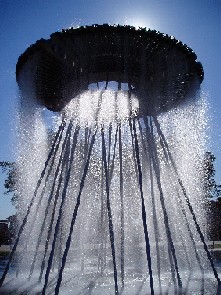
The Olympic Park, the main competition site of the Sydney 2000 Olympic and Paralympic Games, is located 17km west of Sydney at Homebush Bay. Located in the site are custom-made stadiums for athletics, swimming, hockey, baseball and tennis, on top of facilities for golf, taekwondo and table-tennis, not forgetting the main attraction, Stadium Australia. Cafes and restaurants lineup the Olympic Boulevard and the complex is also served by rail with the impressive Olympic Park Station dedicated to it. After dropping our mother off at the nearby DFO factory outlet, my brother and I explored the Olympic Park at our own leisure, trying to fathom a reason for the point of the Overflow--- a huge flat plate supported by numerous slanting legs overflowing with water--- and taking in a guided tour of Telstra Stadium, formerly known as Stadium Australia. Commercial names and advertising boards were not allowed to be displayed in the stadium during the Olympics, but once the event was over one of Australia's largest telecommunications company wasted no time in splashing out millions of dollars to lend their name to the stadium. The "lease" lasts for a decade, if I remember correctly. Stadium tours are presented in a standard package but I'm still inexplicably drawn to them for the exclusive first-hand behind-the-scenes look that they offer. Visitors get to actually walk through underground car parks, sit in dressing rooms (one graced by the presence of Jonas Lomu only days before our tour) and pose for pictures high up in the stands overlooking the immaculately trimmed lawn grass pitch, and even pinch a handful of soil from the hallowed turf at pitch level when the guide is not looking. It is a rite of passage for every sports fan who takes himself too seriously and is a wonderfully gratifying experience. Sad, I know. The showpiece of the Olympic Games, Telstra Stadium in its presently reconfigured reduced capacity state is dedicated mainly to rugby, hosting Rugby Union Test Matches and National Rugby League Matches. The Rugby World Cup will also be held here from October to November, and any fleeting thoughts I entertained of getting my hands on match tickets were extinguished when I realized that I'd be back in Singapore for months before the opening ceremony. At some point, anyone mildly familiar with Australian sport culture will inadvertently find themselves wondering about the differences between rugby and Australian Rules Football. The nuances escape me, but both involve hordes of burly men knocking the stuffing (of the organic variety) out of one another while running around in shorts in chilly weather. I just hope for their own sakes these brave, brave athletes never ever forget to put on their jockstraps. On top of that, Australian Rules Football also has its street credibility boosted immensely by having a competition called the "State of Origins." American Football is not entirely dissimilar to the two, as participants are also inappropriately appareled in outfits that scarcely cover their thighs, but other than the cheerleaders, the athletes are better protected with shoulder padding and helmet. Australians also seem to love their cricket, given the wide coverage accorded to the sport in news and print media. Compared to rugby and Australian Rules Football, you will not find a more striking paradox anywhere else in the world. While the former sports are played throughout winter and often involve bone crunching challenges, cricket is essentially, at the risk of oversimplifying it, a non-contact sport to be enjoyed in the summer. Yet cricketers are protected from head to toe by helmets with face guards, body padding, long sleeved shirts and shin guards that reach all the way up to the knee. Apparently cricketers are dressed in an all-white ensemble so that they can gauge if they are over-exerting themselves should their immaculate outfits ever get a trifle dirty, though to be fair it takes a fair amount of discipline to put up with standing in oppressive heat in a Robocop suit without falling asleep. Incidentally, cricket is also the only sport in the world to be named after an insect. And a small one that chirps at that.
|
 Who could ever forget the dramatic run-up as the successful bidders for the 2000 Olympics were unveiled? Presumably the half-drunk Australians crowded around television sets across pubs all over Sydney whooping with ecstasy (an unfortunate choice of words, I know). Today the giant stadiums built specially for that historic event remain, lying around the Olympic Park in their greatly underutilized state, bleeding thousands of dollars in maintenance costs daily. Among the events the complex hosted recently include the New South Wales Men's Artistic Gymnastic Championships and Wetland restoration and management workshops. In short, it is more Jurassic Park than Olympic Park nowadays.