

Nerve injury can be very complex, complicated, and in-depth. The most common types of nerve injuries in American football are the damage of nerves near the shoulder joint. A nerve commonly injured, the suprascapular nerve, travels through the shoulder and between the collar bone and shoulder blade. This causes pain and weakness in the infraspinatus muscle. This is common in football.
The motions that are thought to have the highest risk of nerve injury are:
adduction across the body (bringing arm in to the body from the side)
flexion (raising the arm forward)
external rotation
Nerve injuries are caused by three mechanisms:
Traction- associated with fracture or dislocation
Laceration- an opening in the skin, cutting nerves
Pinching
Signs of Nerve Injury
Sensory Loss
Motor Deficit
Pain and Swelling
What is a "Stinger?"
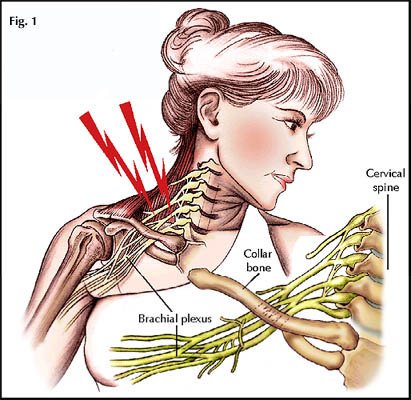 |
A stinger or burner is an
intensely painful nerve injury. The nerves that give feeling to the arms and
hands originate from the spinal cord. As these nerves leave the neck, they
weave together then branch as they pass under the clavicle (collar bone) on
the way to the shoulder.
Nerve injury often happens when the athlete makes a hard hit using his shoulder. The direct blow to the top of the shoulder drives it down and causes the neck to bend toward the opposite side. This motion severely stretches or compresses the nerves and triggers an intense discharge of electricity. For a few seconds, the electricity shoots down the nerves to the tip of the fingers. After this intense electrical discharge, the nerves' motor fibers that allow movement in the arm do not function the way they're supposed to. The dysfunction is evident by weakness in the arm. Symptoms also include sensations of tingling and of burning or stinging pain in the arm and hand. The extent of the damage varies considerably. The pain usually lasts only a few minutes, but the weakness can last weeks, months, or years. Rarely, the injury may cause permanent damage. Treatment of a stinger or burner usually begins as soon as the player runs off the field with the limp arm hanging by his side. An athletic trainer will suspect that the athlete has a spinal cord injury and sees the condition as a medical emergency with full spinal precautions.
|
