Ligament Tears
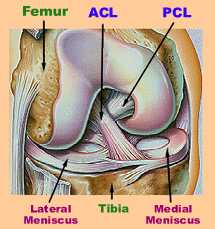
(A view of the posterior side of the knee joint)
There are many ligaments throughout the body but statistics show that the knee ligaments are the most commonly injured in American football. More specifically, the ACL is the most commonly injured ligament in the body. The number of ACL injuries have steadily increased over the past few decades. This injury has received a great deal of attention from orthopedic surgeons over the past 15 years and very successful operations to reconstruct the torn ACL have been invented.
The ACL controls how far forward the tibia moves in relation to the femur. If the tibia moves too far the ACL can rupture. The ACL is also the first ligament that becomes tight when the knee is straight. If the knee is forced past this point (also called hyperextended) the ACL can also be torn. This tearing of the ligament results in the loud pop and the feeling of instability in the knee. The ACL may not be the only ligament injured when the knee is twisted violently, such as in a clipping injury iin football. (a hit in the back) It is not uncommon to see both the medial collateral ligament (MCL) and the ACL injured.
Because football requires the foot to be planted and the body to change direction rapidly it carries a high incidence of injury. The threat of body contact combined with changing direction makes football a sport that has alot of knee injuries. The ACL injury usually occurs when the knee is forcefully twisted, or hyper-extended. Many patients recall hearing a loud pop when the ligament tears, and feel the knee give away.
The symptoms following a tear of the ACL are not always the same in different people. Usually, there is swelling of the knee within a short time following the injury. This is due to bleeding into the knee joint from torn blood vessels in the damaged ligament. The instability caused by the torn ligament leads to a feeling of insecurity and giving way of the knee, especially when trying to change direction on the knee. The knee may feel like it wants to bend too far backwards. The pain and swelling from the initial injury will usually be gone after 2 to 4 weeks, but the instability remains. The symptom of instability, and the inability for the patient to trust the knee for support is what requires treatment. The length of treatment is different for each person.
Treatment
Initial treatment for ACL injury includes crutches and rest until the swelling resolves. Once, the initial pain and swelling begins to resolve, physical therapy will probably be initiated to regain as much of the normal range of motion as possible. One of the problems that tearing the ACL causes, is that small nerve endings in the ligament are torn as well. These nerves are there to give the brain information about where the body is and what it is to do. The joints rely on these nerves to fine tune the muscles' actions that allow the joint to function properly. A good physical therapy program can help restore these problems as much as possible. Physical Therapy is almost always needed.
Cartilage Tears
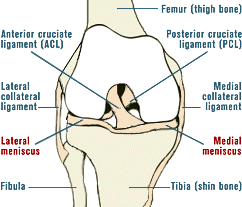
(an anterior view of the knee joint)
In American football cartilage tears are most prevalent in the knee. The knee joint contains two types of cartilage: meniscus and articular. Meniscus cartilage is located between the femur and tibia. It serves to cushion and lessen friction at the junction of those two bones, as well as distribute the load and shock of walking and running and provide lubrication for the knee joint. The knee has two sections of meniscus. Articular cartilage is the slick, durable substance that covers the ends of the femur and tibia and allows the two bones two glide against each other without grinding. Meniscus is much more likely to be torn while playing football because it's the first line of defense in absorbing trauma in the knee.
Causes
A cartilage tear most commonly occurs with the knee bent or flexed as part of a twisting, torquing injury. This happens often in football. Often times athletes will have meniscus tears and not even know it.
Symptoms
With a cartilage tear the athlete will usually feel something tear. The knee may give away and immediately swells, and there'll be acute pain and difficulty in walking. The ongoing symtpoms include pain along the side of the knee where the meniscus is torn when he twists or flexes his knee or when there's a combination of flexing and twisting. There will also be instability as well in which a piece of cartilage actually moves in the joint and gives him the feeling that his knee is going to give away.The athlete also might hear a clicking sound when the knee moves, but it isn't as common as the sensation that something just gave in the knee.
Treatment
Treatment is the same as other injuries, where the injury will need Rest, Ice, Compression, and Elevation (R.I.C.E.) Length of recovery varies.