
The History of Thrissur | The Cultural Capital of Kerala
Access
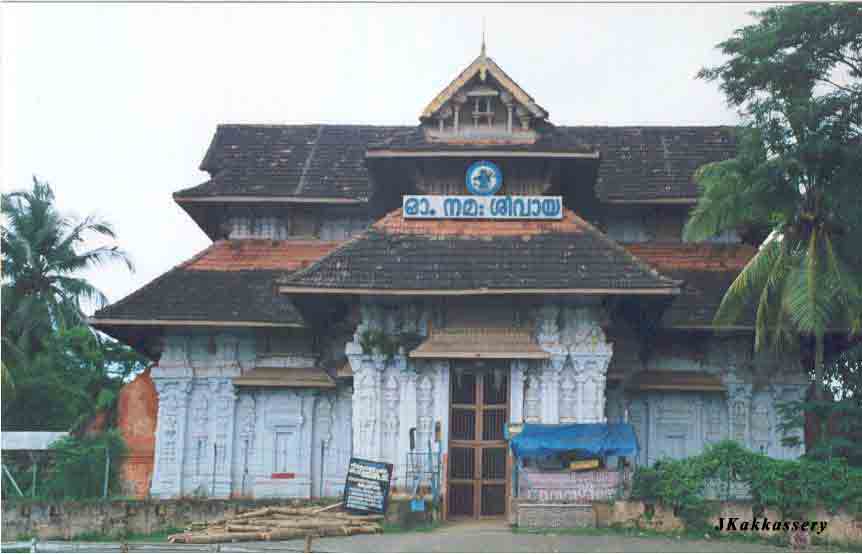
The word 'Trichur' is the anglicized form of the Malayalam name of the town 'Thri-Siva-Perur', meaning the town of Lord Siva. The name is appropriate, for Trichur derives its main glory from Vadakunnathan Temple, (Vadakunnathan, Lord of the North, is a name of Siva) that dominates the topography of the town.Trichur is of hoary fame, and the origin of Vadakkunnathan Temple is ascribed to Parasurama, the legendary hero who is said to have reclaimed Kerala from the sea by a miraculous feat. In historical times it was a suburb of Musiris (present Cranganore) the capital of the ancient Chera Empire, an international Emporium where most of the ancient trading nationals of the world had their settlements. From very early times Trichur has been a centre of learning and, with the decline of Buddism and Jainism and the establishment of the supremacy of Brahminism during the revival of Hinduisum, Trichur became an important centre of Sanskrit learning. The great Sankara Acharya had taught Advaita here. After his travels in different regions of India he is believed to have come back and settled in Trichur and died here. Sankara Acharya's disciples Hastamalaka, Thotaka. Padmapada and Sudhachara established in the town four Maddams, namely the Northern Madham, the Middle Madham, the ln-Between Madham and the Southern Madham respectively, all of which are extant except the In-Between one.
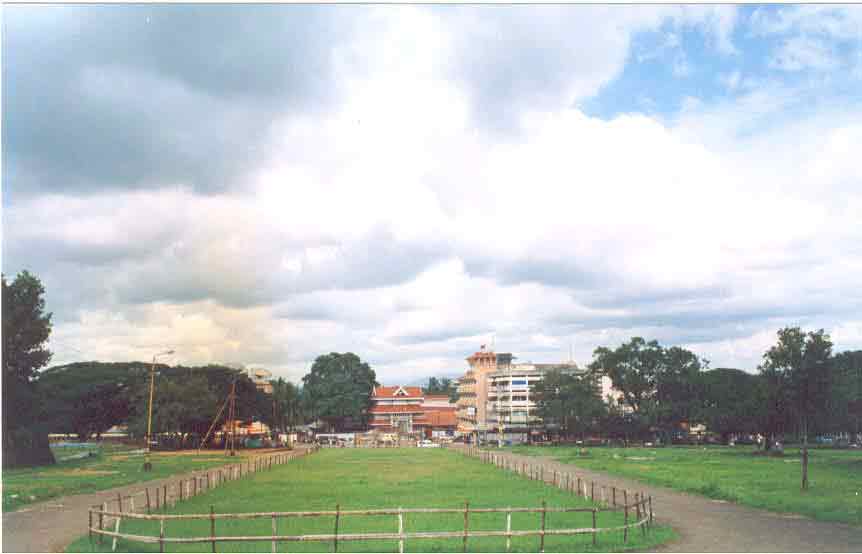
In the political convulsion that rent Kerala after the disruption of the Second Chera Empire, Trichur too, like many cities and towns of Kerala, suffered a set back. Things had come to such a pass that Vadakkunnathan Temple itself was neglected and a teak forest grew around it. It is interesting to note that the present extensive temple ground, about 63 acres in area, is even now called Thekin Kad (Teak Forest) though there is not a single teak tree in or near the temple ground.
The by-gone glory of the town was revived by Sakthan Thampuran, the enlightened Maharajah of Cochin (1790-1805), This was the time when the struggle for empire by the European powers and their incessant wars for the supremacy of Kerala coast made the traditional residence of the Cochin rulers at Thripunithura, near Cochin, unsafe, and Sakthan Thampuran decided to shift his residence to Trichur because of its salubrious climate and comparative safety from the depredations of the naval powers of the West. He had the teak forest cleared, revived the cultural traditions of the town, and built it up as a commercial centre too. It was, in fact, Sakthan Thampuran who settled several Syrian Christian families in the town from their business centres in adjoining areas, and these astute business men with their traditional flair for trade soon built up Trichur into the most flourishing centre of internal trade in Kerala. Their financial acumen has been mainly responsible for founding and building up the Kuri system of financing which has now become an all-India institution, and for making Trichur the most important banking centre in Kerala. The town is also famous for its gold and jewellery business.
The Trichur area today is
the inheritor of this glorious tradition in art and culture and Trichur is today
termed officially and otherwise the CULTURAL CAPITAL of Kerala. All the famous
cultural institutions and organisations of the state are located here, such as
the Kerala Sahitya Academy, The Kerala Sangeetha Nataka Academy, The Kerala
Lalitkala Academy, the Kerala Kala Mandalam, the Trichur Museum, the
Archaeological Museum, etc.
Trichur was perhaps the first district of Kerala to achieve actual 100 %
literacy. Some of the best educational institutions in the State are in Trichur,
led by the first Catholic College of Kerala viz. the diocesan St. Thomas'
College, Trichur. Trichur also led in women's education with its plethora of
colleges and schools run mostly by the Church and now also by others.
LITERARY AND CULTURAL SOCIETIES IN THRISSUR
Kerala Sahitya Academy: The Kerala Sahitya Academy was established on August 15, 1956. It aims at the development of Malayalam Language and Literature and works in co-operation with the Kerala Sahitya Academy in New Delhi. There is a good library attached to the Academy consisting of two sections - the General Section and the Research section.
Kerala Sangeetha Nataka Academy: It is also located in Trichur town and was established on April 12, 1938. Its aim is to foster and develop Kerala Dance, Drama and Music and to promote through them the cultural unity of Kerala It works in close collaboration with the Kendra Sangeetha Nataka Academy in New Delhi for the enrichment of Indian culture. A regional theatre is constructed in Trichur with all modern facilities.
Kerala Lalithakala Academy: This was established in 1962. The aim of the Academy is to promote the sculture, painting, plastic and visual arts.
School of Drama: This was established at Aranattukara in the year 1977. The institution conducts a three year course in Bachelor of Theatre Arts, Direction, Acting, Children's Theatre etc., are the subjects which are being taught here.
Institute of Fine Arts: This is located in Trichur town and imparts training in Arts, printing, Sculpture, Engraving etc. Formerly this institution was known as Government Occupational Institute.
Kerala Kalamandalam: Kerala Kalamandalam at Cheruthuruthy was founded in 1930 by Mahakavi Vallathol. Its main objective is to revive, preserve and develop the ancient and traditional art form of Kerala particularly the Kathakali.
(Courtesy; PRD, Kerala Govt.)
