

|
Goddess and God, Lady and Lord,
|
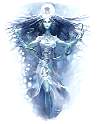 The Greeks and the Romans
The ancient Greeks and Romans have made a great impact on life as we know it today. This includes the Greek and Roman pantheons of Gods and Goddesses that they have left for us. Although the two seem quite the same (and in some cases they are the same), there are differences between the two cultures.
|
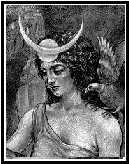 Then there are the Romans. They are famous for many things, among them being the Roman Senate, the roads they paved, and their underground network for water that they built in their major cities. Jupiter and Juno, the king and queen of the Gods, were the rulers of the pantheon. They were joined by other Gods and Goddesses such as Mars (god of war and young men), Quirinus (god of military during peace times), Diana (goddess of the moon, pictured on the right), Venus (goddess of love and lovers), Neptune (god of the waters), Apollo (same as the Greek, in Roman mythology his sister is Diana), Ceres (goddess of grain and of mothers), Cupid (love god and son of Venus), Janus (god of beginnings), Minerva (goddess of wisdom and the arts), Vulcan (equivalent to Hephaestus, married to Venus), Vesta (goddess of hearth and home), and many other gods and goddesses.
|
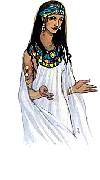 The Egyptians
The Ancient Egyptians believed that their Royal family was descended from the Gods. The Emperor was considered to be a direct descendant of Re, the sun god. The creator of all things was either Re, Amun, Ptah, Khnum or Aten, depending on which version of the myth was currently in use. The heavens were represented by Hathor, Bat, and Horus. Osiris was an earth god as was Ptah. The annual flooding of the Nile was Hapi. Storms, evil and confusion were Seth. His counterpart was Ma'at, who represented balance, justice and truth. The moon was Thoth and Khonsu. Re took on many forms, and transcended most of the borders that contained the other gods. The actual shape of the sun, the disk (or, aten), was deified into another god, Aten. Isis was the mother of Horus and consort of Osiris. She became worshipped through the entire Roman Empire in later years. |
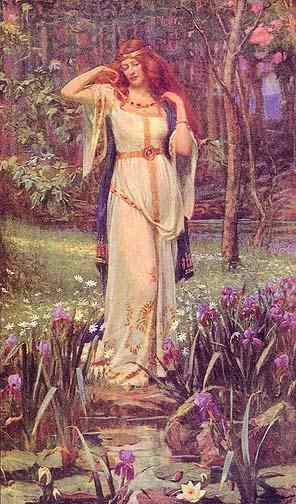 The Norse
The Norse were said to be warlike; this is true, however they were no more warlike than any of the other peoples alive at that time. Many things are said to have been descended from the Norse. Their gods were called the Aesir (there were also other gods known as the Vanir - Freyr (also spelled Frey), Freyja, and Njord were all Vanir gods that were recieved in trade for Odin's brother Hoenir, after the War between the Aesir and Vanir gods), and they lived in a place known as Asgard. The Norse believed that the world was set up to be as a tree, called Yggdrasil (the World Tree). Asgard was high in the topmost branches of Yggdrasil and above; it was connected to Midgard (the earth) by the bridge Bifrost (guarded by the god Heimdall). There are other realms as well (the Nine Worlds). Hel (sometimes called Nidavellir) is ruled by the death goddess Hel, and Freyr is the ruler of Alfheim (home of the Alfs - light elves). The others are Niflheim (the world of cold and darkness, at the base of Yggdrasil: Nidhogg the serpent lives here, where he chews on Yggdrasil's roots), Vanaheim (home of the Vanir), Jotunheim (the frozen land where Woden placed the Jotuns [evil giant creatures] after the Creation of the World), Svartalfheim (home of the dark elves), and Muspelheim (home of the fire giants).
|
|


|
