HAPPY HOLLIDAYS!!!! YOU'RE ALMOST THERE!!!
First thing's first, eh? The ever important, and I DO mean important Course Policies and Guidlines. Follow this link for an outline of said Course Policies and Guidelines.
It is critically important that you read, carefully, the information contained therein.
Required Texts:
Beaty, Jerome, Alison Booth and J. Paul Hunter, eds. The Norton Introduction to Literature, Shorter 8th ed., New York: Norton, 2002.
Diana Hacker. Rules for Writers. Boston.: Bedford/St. Martin's, 2000.Sadler, Randall, Amanda Brobbel, and Leta McGaffey Sharp, eds. A Student's Guide to First-Year Composition, 23rd ed., Boston: Pearson Custom Publishing, 2002.
Follow this link for a breakdown of my grade calculation rubrick

For a list of class handouts and overheads, follow this link

Follow this link for a list of past journal assignments
Week One:
August 26- Syllabus Introduction. Goals for the course. HW: Daily Writing (DW) 1: Write a letter to me about yourself. Tell me who you are and what you hope to achieve as a future scholar. What are your likes and dislikes? What do you hope to accomplish by taking this course? How do you view yourself as a reader and writer? Buy Books.
August 28- Continue poem analysis and group work. Unit 1 introduction. HW: Read chapters 2, 4, and 8 in you Student Guide to First Year-Composition. Also, compose a poem surrounding the two lines you analyzed in class and write a journal entry, at least one page in length describing why you wrote what you wrote.
August 30- Continue poem. Introduction to thesis statements. In class writing Journal #3 HW: Take the Sylvia Plath poem with you. Make a mini-outline of a hypothetical paper that you might write about this poem. What would your thesis be? What pieces of eveidence from the text would you use to support that thesis? What counter-evidence might there be? Bring to class with you on Wednesday and be prepared to talk about it in class.
Week Two:
September 2- Labor Day. No class.
September 4- Writing as Inquiry. How to work your way from an idea to an academic thesis statement. Mechanics: Thesis statements and essay one assignment introduction. Journal HW: With the Sylvia Plath poem, make a list of the "good" elements of the poem and the "bad" elements of the poem. Who is associated with each element: the narator? Who else is part of the poem? Is there a second referent? Then, write a page in your journal connecting this new evidence with the outline/thesis you made for class today.
September 6- Organization workshops. Careful explanation, titles and introductions. HW: in your journal, continue the suduction scene we wote in class. You may either begin your own, or you may continue ours. Either way, write two pages of prose, not just notes.
Week three:
September 9- Close reading, begin primary texts that you will be able to use for your own paper. Read "The Zebra Storyteller", pg 2 NA. In-class: wite for 5 minutes accoding to one of these prompts: 1. what is the function of a storyteller? 2. What role does the imagination play in this story? HW: Read pages 2-4 in you NA. Journal assignment #6: Write 2 pages of reader response to what you have read on pages 2-4. Also, read "The Flea" NA 664.
September 11- Poetry and short stories. Analysis versus summary. Annotation. Please download essay #1 assignment and bring it with you to class. Textual Anlaysis Essay Assignment. HW: Read "Araby" and "Boys and Girls" in your NA. In your journal, respond to the texts using the concepts and vocabulary that we have been using in general class discussion.
September 13- Close reading cont. /continue "the Flea" HW: think about the lack of time and place in the Flea and why it might be impotant, ney, critical to the poem.
Week four:
September 16- Close reading, short story discussion. HW: take one of the questions I raised in class and write a journal entry trying to answer it. Point in your journal towards the evidence in the story that helps you answe those questions.
September 18- Form Peer groups. HW: Write first draft of essay 1. Due in class tomorrow. Bring one copy of your draft for each member of your peer group AND ONE COPY FOR ME. No exceptions will be made. See course policy statement.
September 20- Draft DUE. Peer Workshopping. Writing strategies and DRAFT of textual analysis essay DUE. In class workshopping and conferencing. HW: Read peer essays and write responses for each member of your peer group. Please download and print the peer review guideline sheet. Print one copy per peer-group member, fill it out, and be prepared to discuss your comments Monday in class. You will be expected to bring all peer essays and your response to each with you to class. There will be NO exceptions. Also note, last day to drop class with a "W".
Week Five:
September 23- Continued workshopping and in-class writing. HAnd back peer editing. Get into groups by story and try to further your analysis. HW: Look at the comments you received from your peers today, make a list of questions the you have for your editors. Then, keep writing!!!!
September 25- In class peer editing. You will receive my comments as well, today.
September 27- Revision draft of Essay 1 DUE at the beginning of class. Will discuss mechanics, etc for final drafts.
Week Six:
September 30- Essay 1 DUE at the beginning of class. Must include, in a folder (manilla or otherwise), your Final draft, Rough draft (checked by me), Peer editing including drafts and comments in full. All elements must be included in this folder in order to receive full credit for the essay. Begin unit two, Text-in-context. HW: Please download and read Essay Two assignment. Follow this link for a set of Essay Two examples Also, write at least one page in your journal connecting the article by Eddie Adams to the photograph I showed you today. How does this new peice of context affect/effect your reading of either the photograph or the photographer? Do your thoughts change regarding either one with this new information?
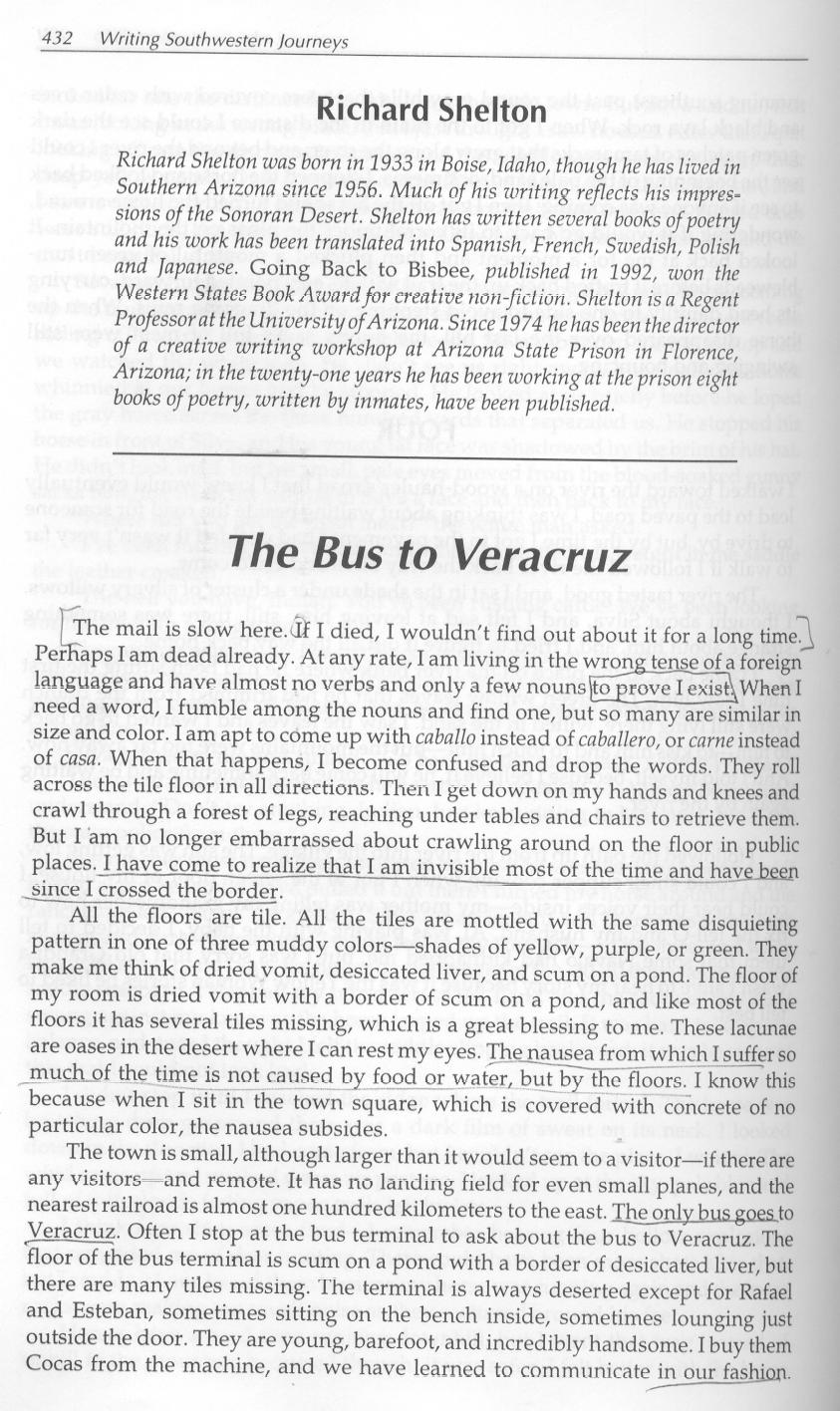
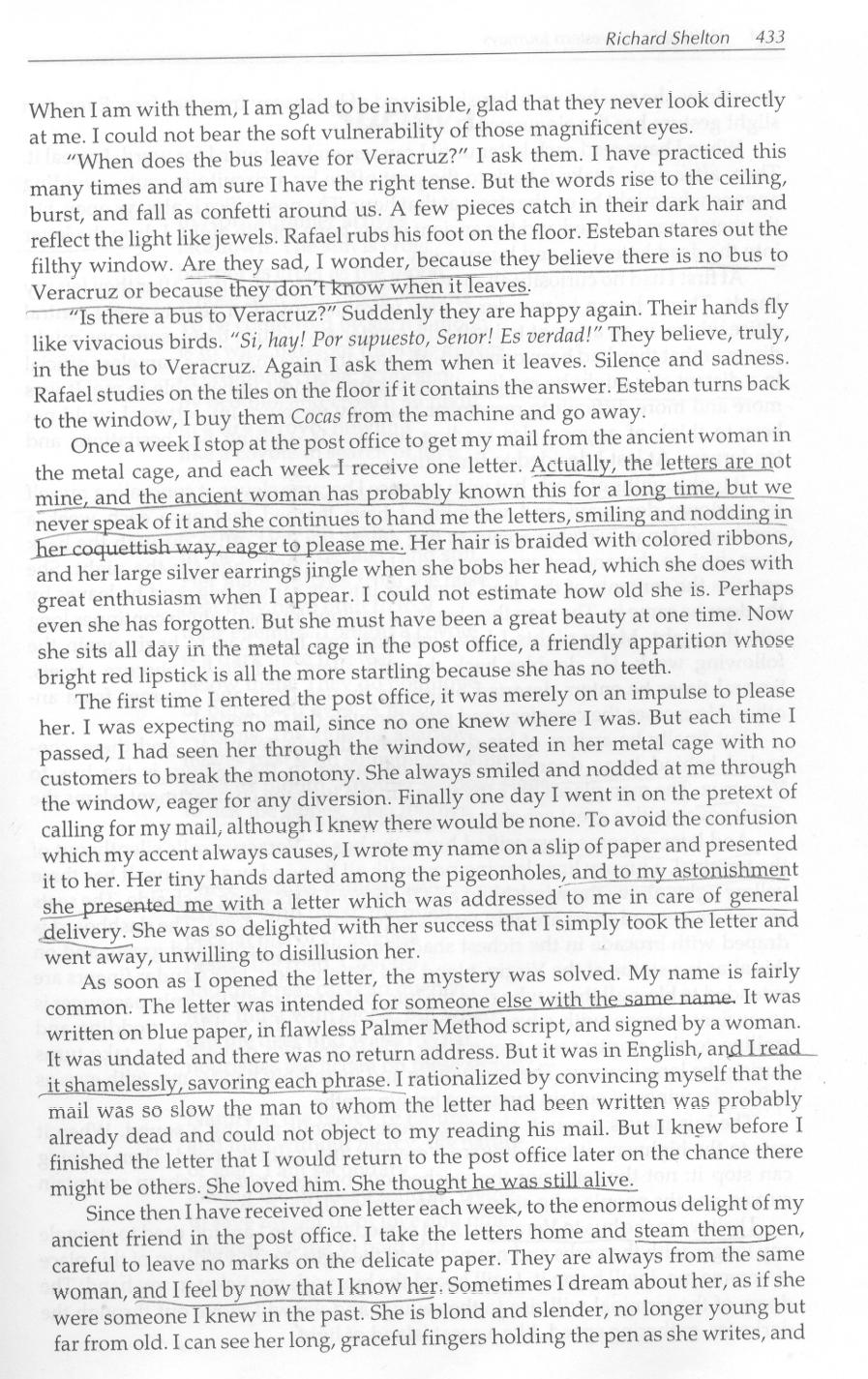
October 2- Continue introduction to unit 2. Workshop on analysis of a visual text w/ handout, continued discussion of Eddie Adams photograph. HW: Download and Read Shelton,"Bus to Veracruz." page 1 page 2 page 3 Journal entry: Respond carefully to the text. What puzzles you? Find a passage to focus on and write a page "thinking it out." You can do a web, cluster, outline, whatever suits you, in addition, but your journal itself must focus on a passage and demonstrate some close reading.
October 4- class cancelled. Save today's work for monday
Week Seven:October 7- Discuss Shelton. HW: read How to tell a tue War Story" by Tim O'Brien. To be handed out in class today. Journal Assignment: find a passage in the text and read it closely. What patterns do you see? what confuses you, etc. Also, how might you use the Adams photograph as context to help you read this text?
October 9- Discuss O'Brien.
October 11-In class writing and workshopping. HW: Outline of essay two. Due in class Monday.
Week Eight:
October 14- In class writing and workshopping from your outlines. HW: Write first draft of essay 2, at least two pages in length. Due in class Wednesday.
October 16- Library Research Day. How to Search effectively for contextual information. HW: Library Research Tutorial. Absolutely required. The results of this search will be e-mailed to me automatically.
October 18- Voice Separation in your essay. BRING 3 DIFFERENT COLORED PENS TO CLASS!!! Note Bena: Last day to drop with a "W"
Week Nine:
October 21- Paired Presentations Begin.
October 23- Presentation continued.
October 25- Final day of presentations.
Week Ten:
October 28- Conference Draft of Essay Two DUE. Bring in one copy per peer group member as well as one for me. HW: Read and edit/annotate peer drafts. Arrive ON TIME to your assigned conference time in CCIT 236, cubicle I. Missing a conference will result in an absence.
October 30- Classes Cancelled for conferences. Please see course policy statement for conference requirements and guidlines. You will be expected to show up on time and fully prepared to discuss your essay. HW: Post Conference Memo.
November 1- Class Cancelled for Conferences.
Week Eleven:
November 4- Class Cancelled for Conferences.
November 6- Peer editing in-class. Please download and print the peer review guideline sheet. Print one copy per peer-group member, fill it out FULLY, and be prepared to discuss your comments Wednesday in class. You will be expected to bring all peer essays and your response to each with you to class. There will be NO exceptions. Revision Draft DUE. the revision draft will contain changes made as a result of your conference with me. drafts must show significant progress in critical thinking and organization.
November 8- Essay Two due at the beginning of class. Must include, in a folder with pockets (manilla or otherwise), your Final draft, Rough draft (checked by me), Peer editing including drafts and comments in full. All elements must be included in this folder in order to receive full credit for the essay.
Week twelve:
November 11- No Class. Veteren's Day.
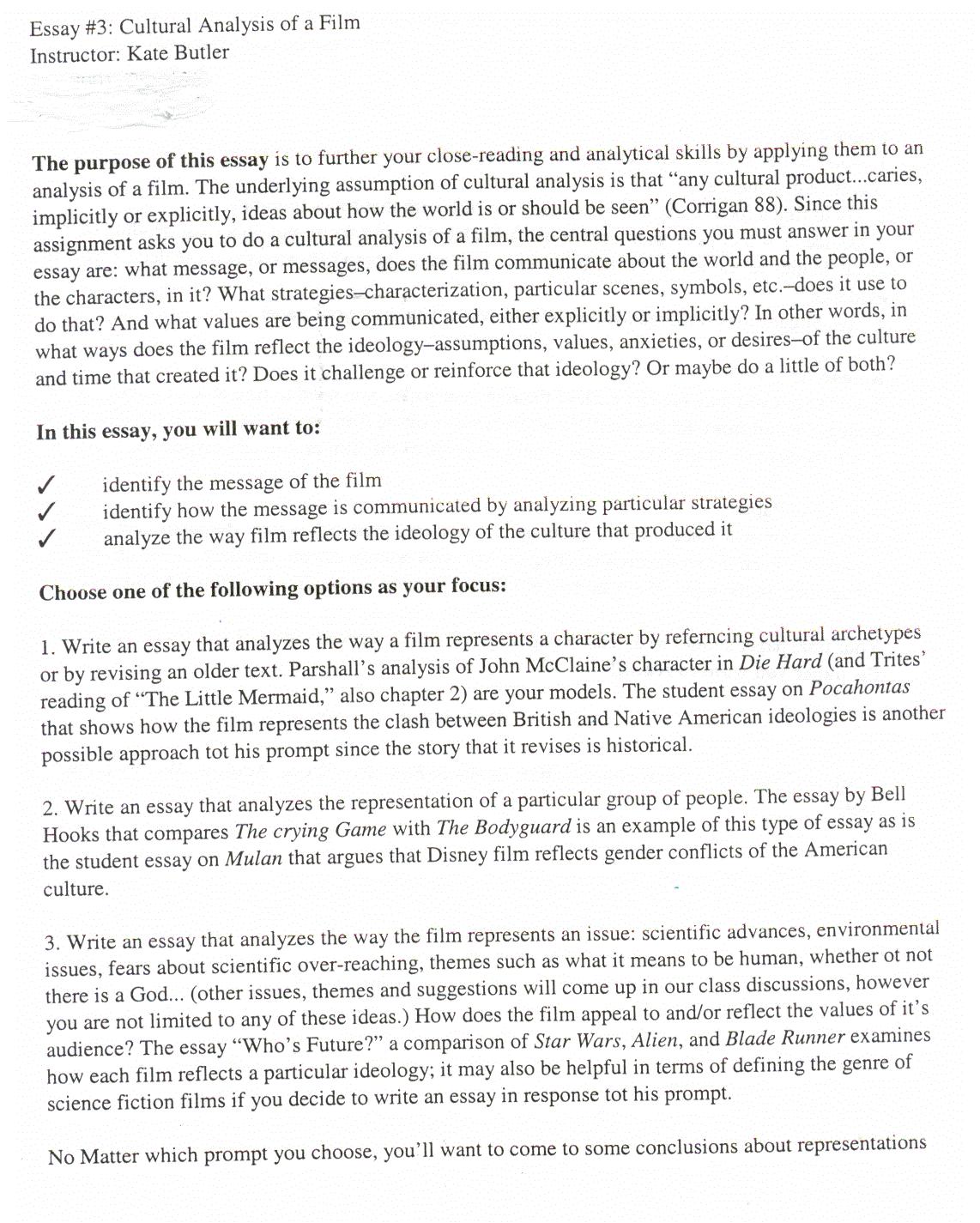
November 13- Begin unit three. Power Point/lecture. HW: Please download and print Essay Three page 1 Essay Three page 2 assignment. The only changes to this assignment are that you will not be required to use outside sources, but you may, and that the length of the essay should be 4-5 pages.
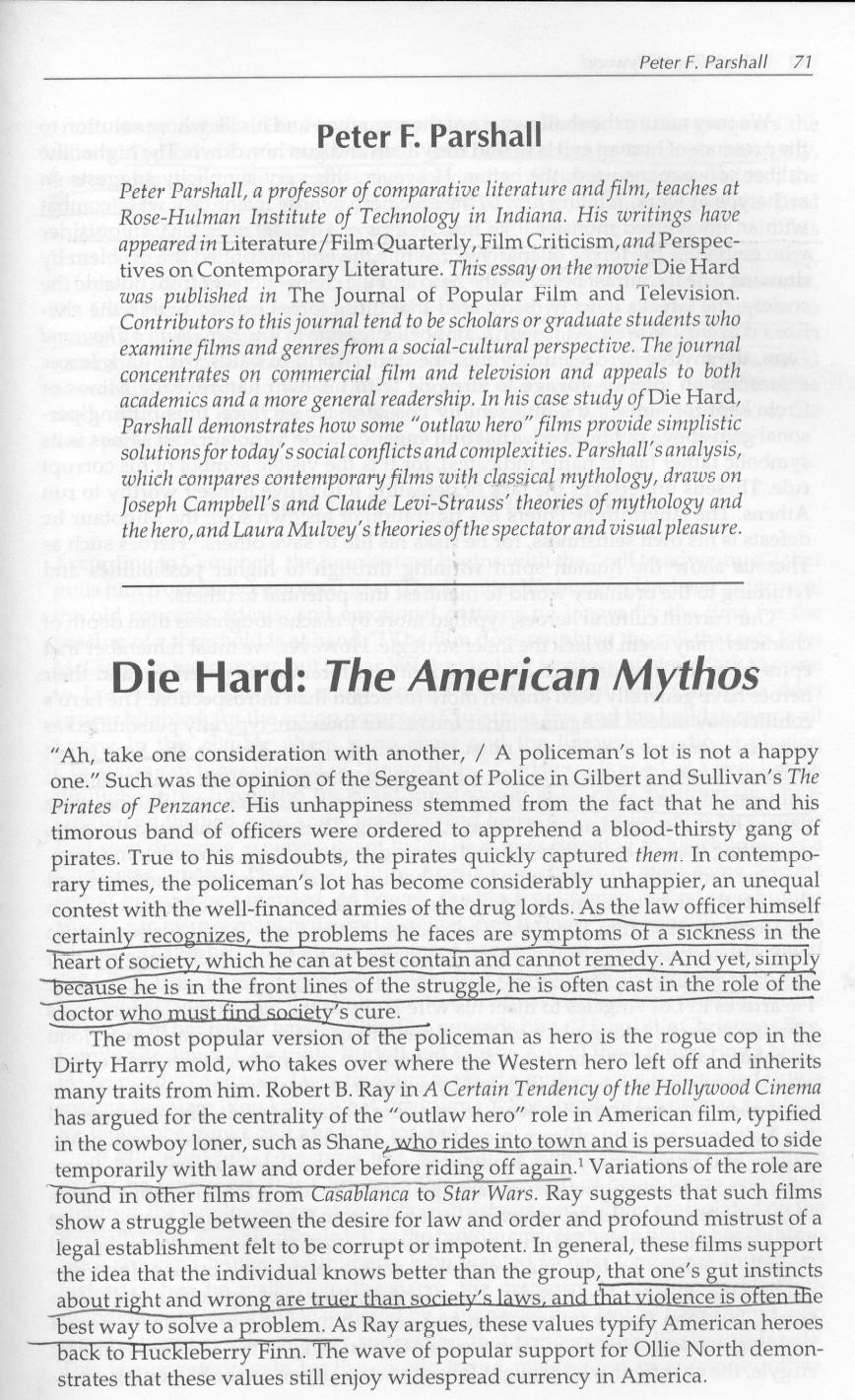
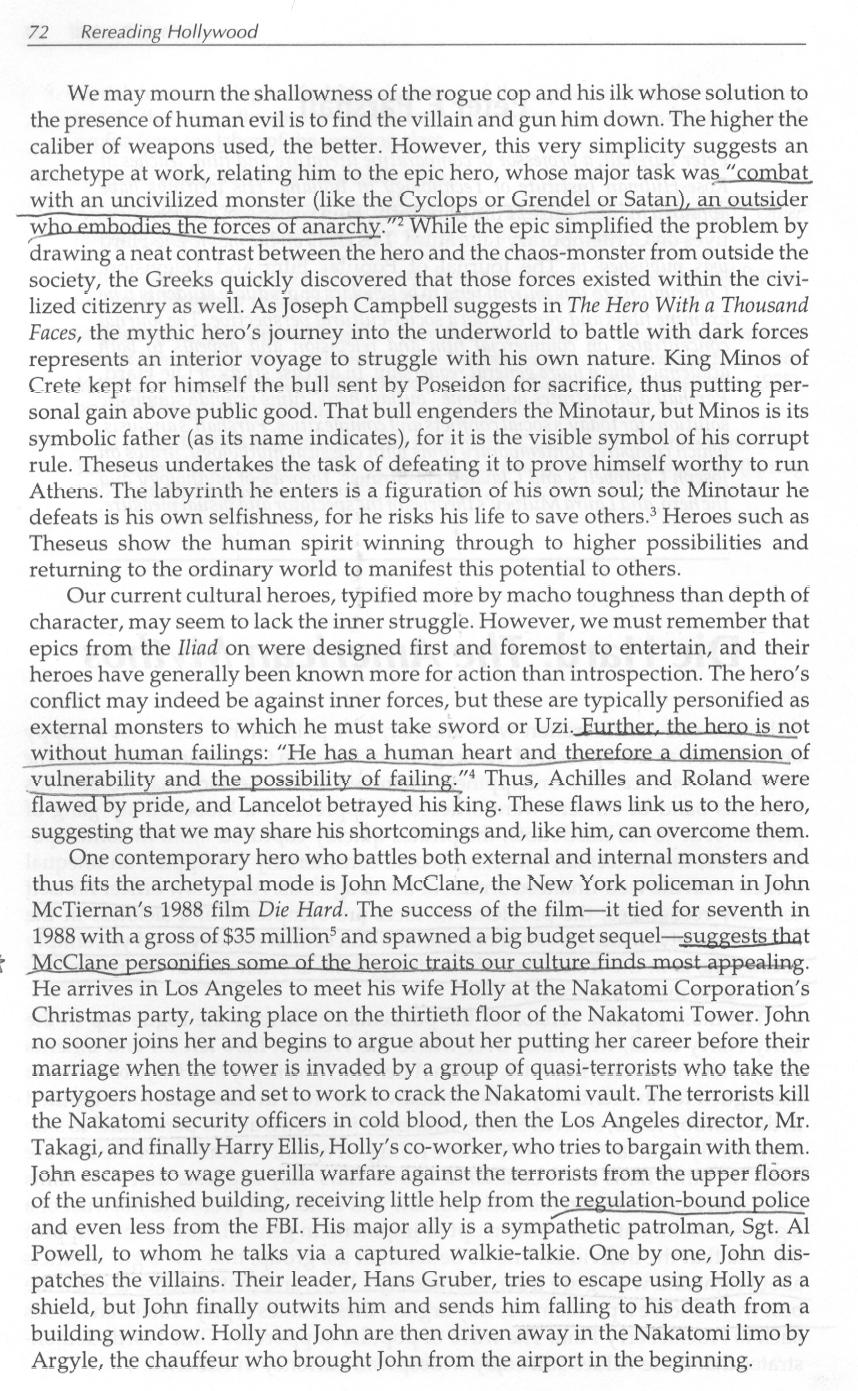
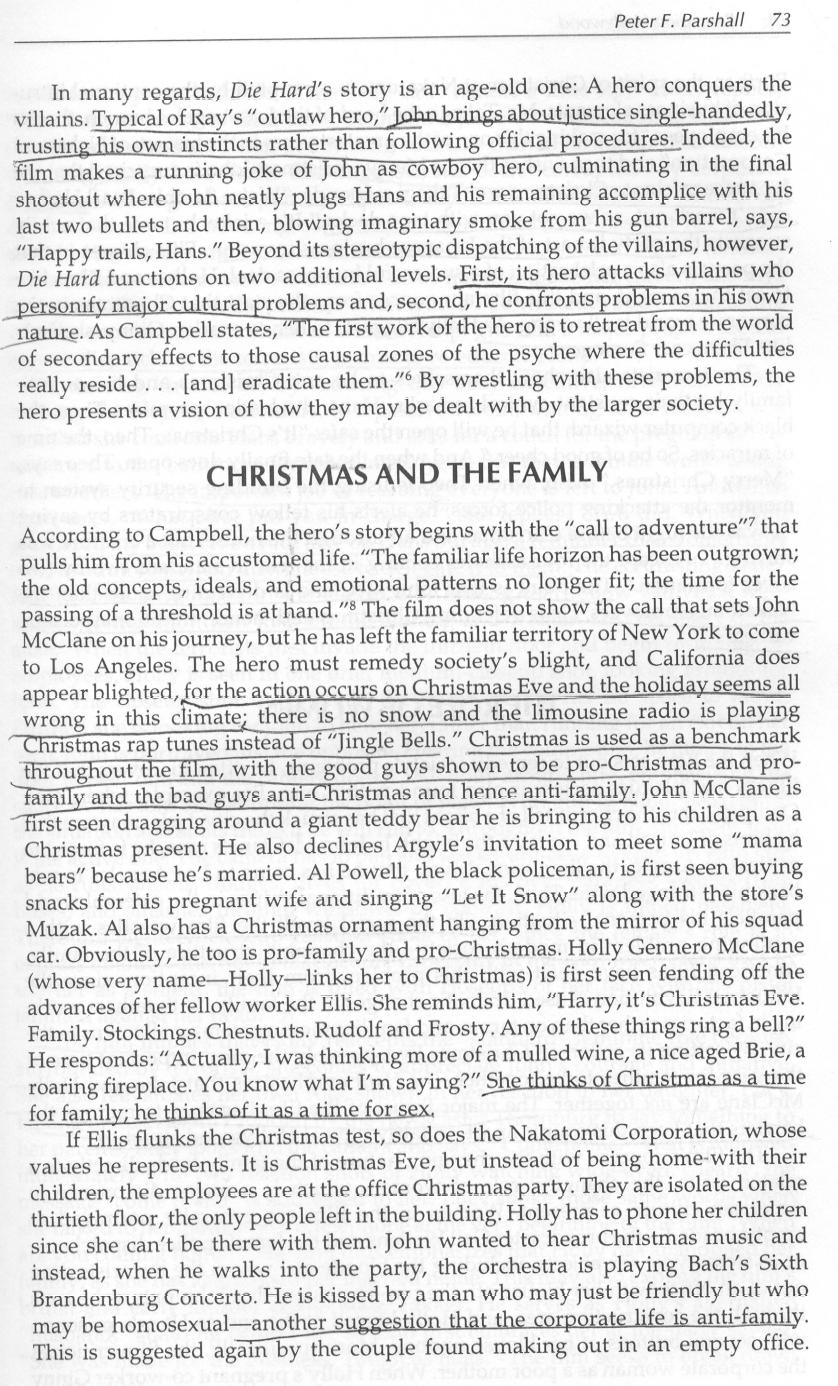
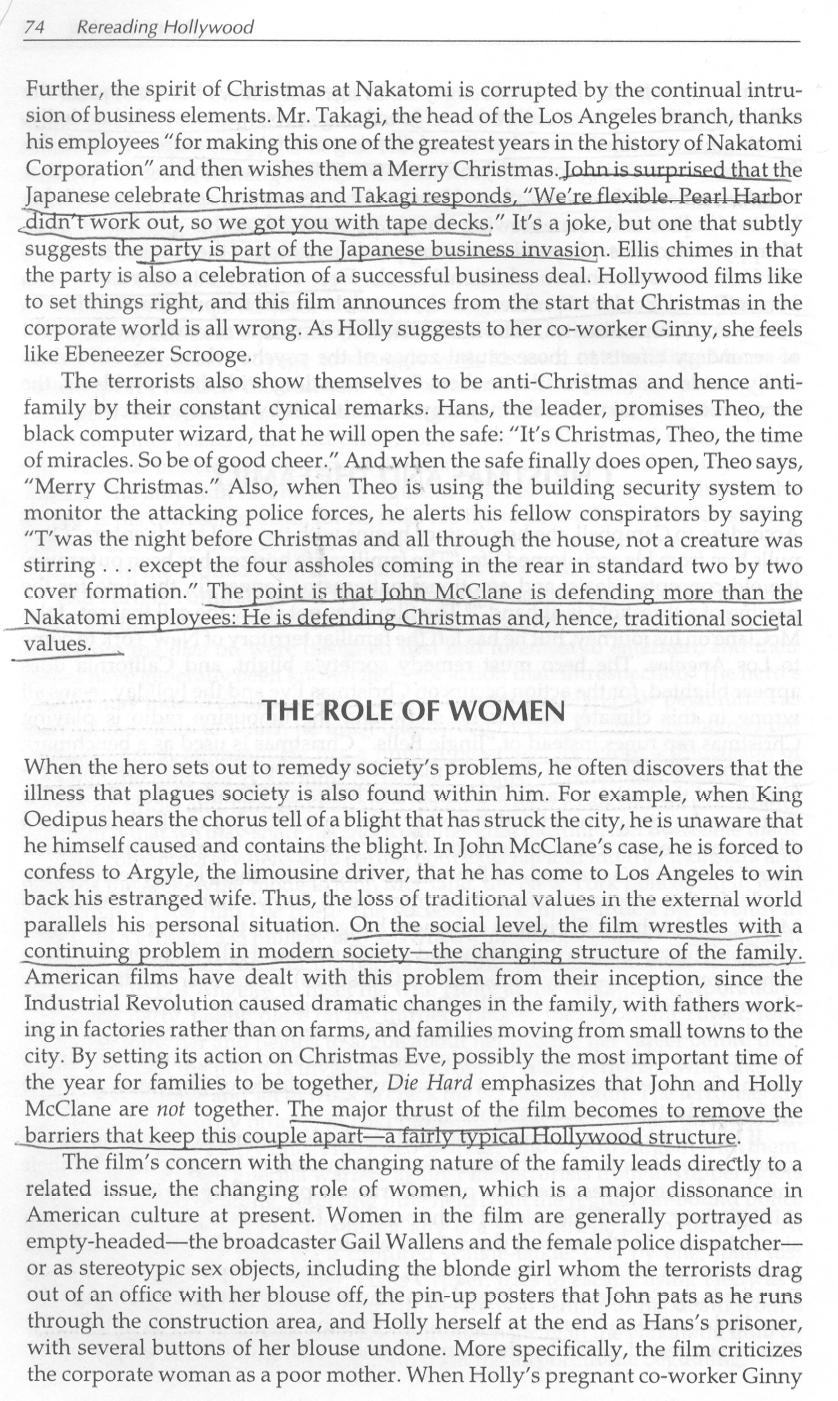
November 15- Film Analysis, cont. Watch Die Hard. Mini-model of how film analysis works. For a little additional help on how an agrument might be formed using this film, check out Peter Parshall's essay. There are four pages, but this is a shortened version. Don't panic if there seems to be more page 1 page 2 page 3 page 4
Week Thirteen:
November 18- Watch The Bodyguard, or at least part of it. Read accompanying essay (to be handed out in class) by bell hooks. HW: Journal assignment. Make a reverse outline of both the Parshall essay and the hooks essay. This must be in roman numeral outline form, quote the thesis(s) of the essay and outline the main point and construction of each paragraph. Due in class on Wednesday.
November 20- Organization for Film analysis.HW: First draft due in class tomorrow. Print out 4 copies of your essay and four copies of peer-review questions. Bring to class for in-class peer editing and workshopping.
November 22- First draft due. In-class peer workshopping.
Week Fourteen:
November 25- Revision draft DUE
November 27- Optional in-class conferences. I realize that everyone wants to go home for the hollidays. However, I am staying in town. If anyone would like to meet with me durring this time, please let me know and we will meet in my office. Otherwise, have a happy Thanksgiving!
November 29- No Class. Thanksgiving.
Week Fifteen:
December 2- Last minute workshopping on essay 3.
December 4- Essay 3 DUE. I just want the essay this time, nothing more. Begin Final exam prep. HW: Prepare Responses to final exam study questions to bring to class.
December 6- Final prep cont. Will check journals today. Make sure they are complete and in class. You must have the journal here on this day in order to receive full credit for it.
Week Sixteen:
December 9- Group presentations on Study Questions.
December 11- Last Day of Class.Writing the final. Strategies, thesis, organization.
December 13- FINAL EXAM. CHEM room 111. 8-10a.m. BRING BLUE BOOKS. 8x11 size. Plan on double-spacing your writing and writing on only one side of each page.