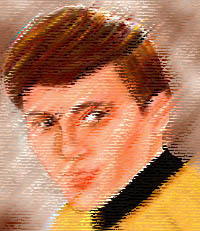
Specific Tips on the Character of Chekov My brother and I have been having a running argument for a while now about Chekov. "How can you like him?" Jack will say. "He's only a stereotypical wet-behind-the-ears raw recruit character from the traditional military drama genre." "If that was true," I reply stubbornly, "then I wouldn't like him." I'll spare you the further details of the debate -- the arguments on why interest generating inconsistencies in the character were only the result of sloppy writing and the fact that the twenty-two year old ensign was portrayed by a thirty year old actor and so forth -- but I bring Jack's perception of the character up to make an important point. Whether Chekov fits the mold of a classic fiction archetype or not, for the writer of fan fiction to approach the character as merely the embodiment of a stereotype leads to uninventive and uninteresting writing. If you're going to write fan fiction centering on any particular character, you must have an appreciation of what sets that character apart as a unique individual. Chekov, when written as just another wide-eyed hero-worshipping novice, is indistinguishable from Wesley Crusher, Harry Kim, or any of the hundreds of other "Ensigns of the Week" we've seen during the run of Star Trek. To hopefully stem the never-ending tide of insipid Ensign Clones, consider the following short list of ways that Chekov differs from the vintage "raw recruit" stereotype: Chekov is Russian.
Take the opportunity to investigate Russian culture. How do attitudes and customs differ? Incorporate your findings into your work. Have fun with the differences. The traditional way that Star Trek writers have exploited Chekov's cultural uniqueness is the tried and true "Russian Inwention" joke. You are free to come up with your own variation on the gag, but bear in mind that this is a very, very old, old, old joke now --- and it wasn't exactly a gutbuster when the first person thought of it. Being Russian also means that Chekov's speech patterns differ from the other characters. I do not write Chekov's dialogue in dialect -- no "Vat vas dat, Keptin?" For one thing, dialect is difficult for the reader to decipher. One or two lines can be charming, but wading through pages and pages of "I tink ve're going to haf to wivisect dat nooclear wessel" gets annoying. The second reason I don't write Chekov in dialect is that phonetically spelling out a character's speech has traditionally been a method Western authors use to mark a character as culturally inferior. A character not capable of mastering Standard English is implicitly assumed in our ethnocentric society to be less intelligent and sophisticated than characters whose dialects are left to the reader's imagination. Without writing in dialect, Chekov's accent can be indicated by the fact that he often opts not to use contractions and sometimes adds extra verbs to his sentences. He uses idiomatic English phrases very sparingly. And although the writers of Star Trek have seldom taken advantage of the fact, it seems reasonable to expect that in moments of extreme emotion Chekov might revert to his native tongue. In my opinion, the best way to draw attention to the character's accent is to occasionally have other characters notice and comment on it and leave the rest for the reader to imagine. Chekov is not a schlemiel.
Chekov's tendency to demonstrate his grasp on the obvious -- the sort of comments that elicit those, "Yes, we're all aware of that, Mr. Chekov" responses -- also speaks to the character's self confidence. He believes he's the only one who has noticed some important thing. I think the character's confidence is one of his most endearing characteristics. He is young and relatively small in stature, but seems blithely unaware of these facts. He once offered James T. "Lady-Killer" Kirk help in advising a female officer about her sex life. He gleefully launches himself into the midsections of aliens twice his size when the opportunity presents itself. Chekov's boldness and daring in the face of insurmountable odds make him an enjoyable and exciting character to write. Chekov is not that naive.
Chekov is not incapacitated by his awe for his superiors. I'm not arguing that Chekov doesn't have the utmost respect for Kirk and Spock. I think he does. But he clearly sees them as role models to be consciously emulated -- not gods to be fearfully worshipped. He feel comfortable enough around them to make jokes and volunteer his opinions.
Remember, if a writer has Chekov devote too much time to praising Kirk or Spock and denigrating his own self-worth, the reader is going to begin to wonder why the writer didn't choose to just write a story about Kirk or Spock and just leave poor little Ensign Wanna-be out of the picture entirely. There are many other things that can be said about Chekov, his personality, his feelings about his career, and his relationship with his colleagues, (Elizabeth Rigel has written a particularly thorough and insightful analysis of the character) however, I'll leave the rest for you to discover as you read, think, and write. That is, in the end, what fan writing is all about, isn't it? Take a character we think we know well and find a way to tell us something new and interesting about him or her. Don't be satisfied to write Ensign Clone's generic adventures with Mr. Predictable and Captain Stereotype. Find what is unique in the character and in yourself. Use fan fiction as the most potent channel of expression it can possibly be. Go boldly where no dumb-downed, franchise-loving, cliché-quoting, hack writer has gone before!
|