

Recently, science fiction author Julia Ecklar (one half of the writing team that makes up "L.A. Graf") was kind enough to do the following e-mail interview in which she discusses her perspectives on the character of Chekov and provides some tantalizing glimpses of upcoming L.A. Graf projects.
(This interview took place between February 25, 1998 and March 6, 1998)
Teegar Taylor: Unlike the majority of writers of Bantam and Pocketbooks' Star Trek series, novels by L.A. Graf often spotlight characters from ST:TOS's "second tier". What qualities have drawn you (personally or as a writing team) to Sulu, Chekov, and Uhura as primary protagonists over the more conventional choices of Kirk, Spock, and McCoy?
 |
Julia Ecklar: There are a couple reasons why we focus on the other characters. Probably the most influential is simply that they've had so much less written about them. There's a lot of room left to play with, a lot of things left to "discover" and invent. As a writer, that's very appealing, if only because you get a lot fewer letters from fans saying things like, "But in Book #241, they said that Kirk felt THIS way..." <grin> |
Also, it was always the secondary characters who really personified what Star Trek proclaimed to be all about--diversity, cooperation, the unification of Humans from all sorts of different backgrounds. We don't hold that against the original--it isn't easy to be cutting edge on television nowadays; it must have been incredibly hard in the 1960s. But Kirk and McCoy are both white American males; Spock is officially an alien, but he's also white and has no accent (essentially striking the viewer as a "safe" white American male). We liked the fact that almost ALL the secondary characters (Sulu, Chekov, Uhura, Scotty, M'Benga, Kyle) were actually, OBVIOUSLY something other than white Americans. Even Chapel is female, at least. We try to continue that theme with the secondary characters we choose for our novels. I think we have more females per capita than any other author's Trek books (especially in traditional male roles such as scientists and security), and I can promise you that we're the only authors to have either Moari or Sherpas in the books! <grin>
TT: I've always enjoyed the diverse cast of supporting characters that are typically present in the L.A. Graf books. Even the most minor characters seem to have fully-developed, interesting, and unusual backgrounds. Now, of course, these minor characters don't tend to have very long lifespans -- particularly if they end up on a certain young Russian lieutenant's security team....
JE: Well, that isn't really something you can blame on us--it's Star Trek tradition! You bring along additional security personnel so that you have someone to kill during the course of the book. <grin> Having Chekov be their commanding officer just means that we now must give them names and personalities, since we have to assume that Chekov actually KNOWS these guys.
TT: Chekov (to the delight of many readers of this website) plays pivotal roles in several of the ST:TOS novels you have written. What qualities of this character do you as a > writer find most appealing? What do you perceive to be his primary motivations and goals?
| JE: This might be a good place to remind your readers that L.A. Graf is a colony creature--consisting of both myself (Julia Ecklar) and another author named Karen Rose Cercone. One of the ways we achieve harmony in writing our novels is by "adopting" characters--we each choose a collection of main characters whose point of view we will always write, whose storylines we will be responsible for. Karen Rose writes Sulu and Uhura, and I write Kirk and Chekov. |  |
So while we both like all the characters we work with, and both have a particular fondness for Chekov (as well as particular fondness for Sulu, Uhura, and the others), you've actually sort of lucked out by finding me for this interview, since Chekov is, in a sense, "my" character.
I think the quality I find most appealing about Chekov is his honesty. That's more than just an issue of telling the truth, its an honesty in how he reacts, who he respects, how he focuses on what he feels is important. His word is worth something--if a security officer promises to defend you unto death, you have to believe he will do that. If a Starfleet officer swears to uphold everything that's good and true about the Federation, no matter what the circumstances, he has to possess the honesty and strength of moral character to truly believe in what he has promised.
That honesty, I think, leads directly into your second question regarding his motivations. He's an intensely loyal character, to his duty, his friends, his ideals. Other elements of his personality by necessity really stem from that--bravery, tenacity (or, as Sulu would insist, stubbornness), and his ability to fixate on the details of a situation. It's the kind of thing that makes you valuable in a strictly detail-oriented position like ship's navigator, but also makes you priceless in something like security, where the surprises are less predictable and more dangerous.
I like intense characters. I like being able to stress a character and get back this incredible energy that comes from resisting a situation that threatens whatever it is the character believes in. Because of that, I think it was a wise choice to move Chekov's character into security, because he is so intensely loyal and dedicated and security is such a great opportunity to expose him to stress. Characters are no fun until they're put under pressure. What greater pressure is there than being responsibility for the safety of everybody around you?
TT: Nicely stated. And you've managed to anticipate my next question. L.A. Graf is one of the few writers to focus on Chekov's tenure in the Enterprise's Security department. Most writers, professional or fan (including myself), who feature Chekov usually deal with the years he was an ensign or the time period covered in the movies from Wrath of Khan onwards.
JE: Actually, the L.A. Graf book that's coming out in May (War Dragons) takes place a few months after the events in Wrath of Khan, so it was my first chance to really play with the character from that particular timeframe. Talk about a lot of intense stuff to deal with!
We've got a really great resource in this character, in that we've essentially seen him (off and on) since he was 22 and fairly new to Starfleet up through being a forty-year-old first officer on board a different starship. I find it a lot of fun to have the option of dancing around within that timeline, playing with how a person grows and matures over that length of time. I think one of the things I really liked about writing Traitor Winds was not only the chance to go back and write the character as a younger, less-experienced (and less confident) security officer, but also the chance to write one of those crux points that help move a character between the two vastly different careers of navigation and security.
TT: I was initially quite puzzled to see Chekov had transferred to Security in the first Star Trek movie. Physically, he wasn't the type we'd seen previously in that department. It wasn't until I read the L.A. Graf books that bring out the temperamental characteristics you've just mentioned that the move began to work for me. Chekov as the classic beefy, soon-to-be-phaser-fodder redshirt didn't make sense to me. Chekov as loyal defender and dogged investigator does. I think we got to see some of these aspects of the character when Chekov played a "Dr. Watson" to Spock's "Sherlock Holmes" during the investigation of the murders in Star Trek VI: The Undiscovered Country.
 |
JE: Of course, you weren't alone in the "Huh?" effect of finding Chekov in security in the first film. That was part of the motivation for writing "Traitor Winds," too--to have the chance to explain why somebody would make such a drastic career change (not to mention a career change into a job with such a high mortality rate!). |
Now, I/we had been writing Chekov in security for a couple years before Traitor Winds came along, which entailed a lot of working out in my own head what kind of person this kid must have grown up into in order to do this job. So what you saw on the pages was a lot of me exploring what we knew about Chekov from the Original Series, and trying to extrapolate that into the blank spots left by the movies (let's face it, we never actually SEE Chekov getting to be security chief on film anywhere--except for maybe Undiscovered Country, as you mentioned).
I've had some non-Chekov fans indicate that they just never pictured the navigator from the series being the sort of tough, fearless guy L.A. Graf depicts as security chief. My argument to them is that I'm not the one who chose to move the character into that position--as writers, we just have to work with what Paramount gives us. Once you've moved the character into security, though, you've got to do a certain amount of "Well, the character MUST have this or that personality trait, otherwise (a) Starfleet is really, really stupid for putting him here, or (b) he'd be dead inside a week." So if there are some character traits we punch up more than perhaps the original series did, it's only in an effort to make the situation given us "work." I'd like to think we don't completely ignore the original character, though--we try to be writing the same character, just at a different time in his career.
TT: The intensity you mention that makes Chekov a good dramatic character I think also gives him the potential to be quite a comic character at times as well. Do you find this to be true?
| JE: Oh, God, yes--he's the world's most perfect straight man! So serious! I think a lot of the fun L.A. Graf has had with Chekov and Sulu has been built around the idea that Sulu is this much more carefree, laid-back guy from California, and Chekov is this thoughtful, serious Russian type. | 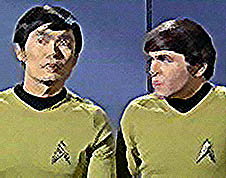 |
TT: Recently, a visitor to the site suggested that I post an account of Chekov's childhood and adolescence since there is no "canonical" version of these years. Since I'm rather hesitant to publish my perspective as the "default gospel," I'm currently working on a project to collect several fictive accounts of "The Adventures of Little Pavel" from some of the writers who have contributed fan fiction to this page. I'll ask you the same questions I'm asking them -- Have you speculated on the events that shaped Chekov as a child? How do you picture his parents and his relationship to them? When and why do you imagine he made the decision to enter Star Fleet Academy?
JE: To a certain extent, I think you always have random images of a character's past, if only so you can draw on them with offhand descriptions and comments during your writing. By being able to say, "He remembered once as a kid..." you give the character a depth of reality that just isn't there when you only acknowledge the meager background shown on film.
Thinking back, I realize that I make a lot of references to his mother, but never to his father. So I think I must have this unconscious image of his father not being in the picture--dead, or gone for whatever reason. I've always assumed he was a good kid, the kind of carries the trash down to the end of the street for the old lady next door, the kind that always called to let his mother know where he was. He was bright, serious, good at school, and the sort of kid everybody always just assumed was going to make something of himself.
Obviously, he's always had a tendency to get a bit hot-headed, and that probably occasionally got him into trouble (coupled with always being told afterward, "Pavel, you should know better!"). In Traitor Winds, we make reference to him knowing how to play hockey. That was from me, after I found out that kids in Russia (and Canada, for that matter, plus a lot of other near-arctic countries) play hockey the way kids play baseball in the U.S.--everybody does it at least for a little while, and there are little league hockey teams all over the place. I always thought a physically demanding sport that also required a lot of fast action and fast thinking would have been a good way for him to channel off energy.
As far as going into Starfleet--Why does anybody? You're a smart kid, there's this opportunity staring you in the face to go do the most interesting, challenging, and wonderful things you've ever dreamed of. Who wouldn't go?
TT: Me -- but then again, I have an unreasoning fear of flying and/or having ceti eels put in my ears...
JE: Ah, but when you're an 18-yr.-old boy, it never occurs to you that something like that will ever happen. You're indestructible! You'll be a hero (just like everybody in Starfleet), and thus able to overcome anything. By the time you're older and know better, you're hooked on Starfleet and the people you've met there, and there's no hope of escape. <grin>
TT: You mentioned your upcoming novel War Dragons earlier. Can you tell us a little more about it? When can we expect it to be on the bookstore shelves?
JE: War Dragons is the first book in a 6 book series called The Captain's Table. Essentially, it tells the story of Sulu's first real mission as captain of the Excelsior, which (of course) also involves the Enterprise and Captain Kirk. There ends up being some nice subtext about the relationships of captains with their first officers, which is made interesting by the fact that Paramount allowed us to make Chekov Sulu's exec. We got to write the two captains (Kirk and Sulu) in first person, which was a great deal of fun. It meant I couldn't do Chekov's point of view for the book, but I made up for it by having some great stuff going on with him in Kirk's point-of-view sections.
War Dragons should hit bookstores around May 12th.
TT: Do you have any specific plans at present for future novels featuring Chekov?
JE: Well, um, yes and no. Right now, L.A. Graf is slated to do some special DS9 books which will tie-in to a DS9 CD-ROM computer game that's being developed. We're kind of hoping to get permission to name a starship after Chekov, but can't very well fit him into the picture much beyond that. <grin>
We'd like to do some more "Captain Sulu" era stuff, with life "after Kirk" for many of the secondary characters. While we've been assured that we're welcome to tackle the subject (our editor is very gracious about letting us have fun with "our" characters), we're currently booked far enough into the future that nothing particular is being suggested just yet.
Other than that, we've been approached by Pocket with the honor of perhaps later handling something very delicate regarding Chekov's character that we probably aren't at liberty to discuss. But we're hoping to have the chance to do that (if it gets done), because we quite jealously feel that we've earned the right to have first crack at anything important that's done with the character. <grin>
TT: Well now, that's just enough information to drive the average Chekov fan completely insane. <grin>
JE: I know, but it's also about all we can say. Sorry!
TT: Thank you so much for taking the time to do this interview. It's a genuine pleasure to hear someone discuss the character of Chekov with such eloquence and insight. I know I can speak for the readers of this page when I say I look forward to reading War Dragons and wish you (personally and collectively) the best of luck with your upcoming projects!
Click here to visit Julia Ecklar's website.
