
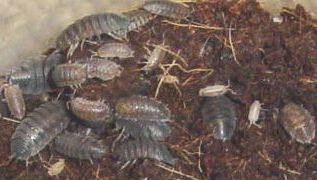
Isopods are easy to rear, and fascinating to watch. However there are certain needs these animals have that will make them comfortable, and allow them to breed continuously year-round. To house the isopods, any clear walled container will be sufficient, (deli containers, plastic bins or shoe boxes, etc.) and the lid is necessary. I say clear walled, assuming you'd want to monitor them from time to time. In the lid, you can drill a series of holes for ventilation, but I also drill a few on the upper sides of the container for cross ventilation. For substrate, there are many options. The three that work the best from my experimentation, are peat, coconut husk or sphagnum moss. Either will do, or you can combine the three. If using sphagnum moss, they'll quickly create their own territories, and settle in quickly. If using peat or coconut, they'll build their own quarters as small caves or tunnels. I tend to use the latter for older animals, and sphagnum works great for the young. This substrate must be kept damp, but not too wet. A spray mister works well for this requirement. If you add too much water, you'll notice your isopods crawling to the surface and trying to climb out of your enclosure. Just remember where they live, and try to duplicate that environment. You can add things like moistened wood, leaves, branches etc., but remember that anything you bring into your culture could contaminate it and cause diseases or outbreaks of parasites. I've come across quite a few...especially when bringing in new field collected animals. For this reason, the new additions are quarantined to their own culture container, until the diseased individuals have recovered or died off. The only other major requirement is food. Some options that work for a period of time are veggies, fish flakes, oatmeal and carrots. While these foods are pretty good, there still may be some deficiencies. Of these commonly found food items, the fish flakes would probably be the best, but of course none of them should be fed as the sole diet for your isopods. One thing you might notice is that these animals sometimes eat their own feces. It's been noted that there are certain minerals and other necessary elements that they ingest from their feces, and this is a very common behavior. Since they're decomposers, there isn't too much need to change the substrate too often. If kept properly, your cultures will be damp, have very little odor other than moist peat or sphagnum, and your isopods will be active and breeding continuously.
