Flags, identity and the thinking ability of the citizens
FLAGS AND THINKING
The skill of thinking is often related to the skill of choosing concepts and to the skill of using a holistic view which enables one to get the main points right.
So, in a flag there should be a holistic picture of something with natural boundaries and without contradictions. This is often a question of the atmosphere of the things in the flag, like for example whether the stars in flags are round and pleasant looking or horny and somewhat ugly looking. Round stars suggest natural divisions in the world, like the entities of the world naturally are. That is good for thinking. On the contrary, unharmonical solutions suggest the use of contradictions which is harmful to the possibilities of success in anything. That’s why I wonder from where the five-pointed star tradition comes from and why it is still followed. Even for an army it would be more benefical to keep one’s own side intact and not in contradictions. So I would suggest round stars for armies too. And especially for civilian purposes, since the round stars promise a happier and more successful life. The lack of contradictions is also good for optimising the nation’s forces in the modern competition and for allying with others.
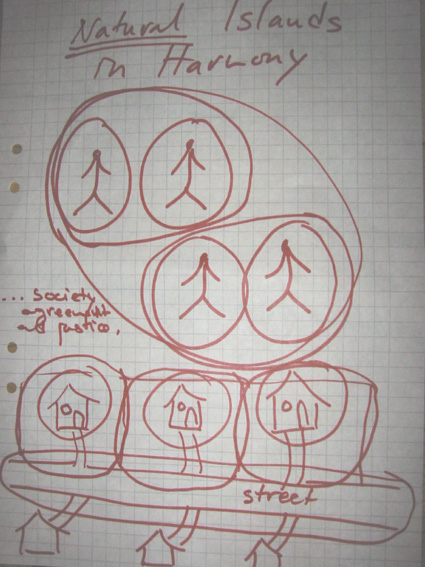
A holistic view in a flag appears a question of the style of drawing, or then it can be added to the symbolics, like to the cross which covers the whole flag/world or to the crescent moon which shows like objective thinking with a holistic view the shape of the whole world even though everything isn’t known, everything isn’t at light at the same time. Or to the symbolics of my suggestion about the animal in an island of its natural living environment. Referring to a whole nature landscape is good: it gives an enermous amount of practise in holistic thinking by exercising the shape recognition ability!
So round stars in flags like small suns are benefical to have, but sometimes if the suns are big, the amount of the experienced reality and of feelings becomes overwhelming. How to stay objective then and how to make divisions to natural concepts when the whole landscape is at sunlight at the same time? Clear differencies like that of the red and green colour are clearly seen to be different. Likewise are the atmospheric tones of one’s experience clearly different. By paying more attention to atmospheres one should be able to stay objective while living a full life. An atmosphere of a landscape is a structured holistic view of the landscape with the meaningfulnesss of the things in it taken into account from the point of view of life – in other words it is as good objective thinking with a holistic view as possible. The atmospheris tone of a thing tells the role of such things in the world, gives a philosophical perspective which can also be thought of as a dynamical perspective with the values of harmony and health taken well into account with a holistic view of life anf the world at large.
So the atmosphere of a flag matters a lot. An atmosphere is a holistic view with structure. People take the atmosphere oin the flag and try to rhyme things with it. So they take the atmospheric structure in the flag and use that in the world. Like in the flag of Swaziland for example there is an aesthetical atmosphere with a clear sense of structure and rhythm like in good quality academical thinking and in natural objective perception, so the flag should train one in good quality thinking just by admiring its style. Besides the perspectives of the arts are often profound: it is good to have some such wisdom in the flag too. Such doesn’t disturb objectivity at all, but instead supports it extremely well.
I might add, even though it might offend some men, that war rhymes with destruction, so rhyming with military looks typically produces the effect that a part of what one does fails since destruction rhymes with failure. Instead one should think of war as a purely defencive operation to defend health, happiness and maybe the good of the world at large i.e. good moral. Then the end result would rhyme with success. But in symbolics that means no arms (like in the flag of Swaziland for example) but instead somehing healthy, like for example a healthy happy animal on an island formed by its living requirements.
Hannele Tervola, Finland, Eurooean Union
Links
Thinking with a holistic view
Contradictions in flags
Natural areas in thinking
A nature landscape trains to complexity in thinking

Email: KaisaHanneleTervola@webinfo.fi