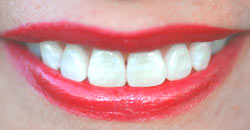
Most people know that the teeth are the hardest and strongest part of the body. There's more than meets the eye, though. Teeth are actually a living part of your body that has blood vessels and nerves. If you used to judge your teeth like a book by its cover, then you're in for one big surprise. Teeth anatomy is a lot more complicated than you ever thought. Excellent crowns and bridges were made by the Etruscans in the 7th cent. B.C. At about that time, teeth were being extracted in Asia Minor as a cure for bodily ills and diseases. Skills achieved by the Etruscans, Phoenicians, Egyptians, Greeks, and Romans were largely lost during the Middle Ages, when barbers and roving bands of charlatans practiced unskilled dentistry at marketplaces and fairs. Abulcasis, a Spanish Moor, was one of the few in his time who studied dental surgery. New developments include the implantation of artificial teeth or binding posts into the gums or jawbone; antibiotic fiber for periodontal disease; root canal surgery, a procedure that ameliorates pain while permitting teeth to remain in place; and nearly painless lasers to repair dental cavities, usually making local anesthesia unnecessary.
Dentures, also known as false teeth, are the primary topic in this section of our site. Here, you can learn how the procedure is performed, what dentures cost and the advantages and disadvantages of having them. The setting up dentures procedure begins with a wax bite impression of your mouth that will give your dentist exacting measurements. A try-on appointment will fine tunes color, shape, and custom-fit. After your final dentures are fabricated, they will be placed and informed of their required care. The main component of dentures is acrylic resin molded over the top of various combinations and paterns of metal. In oreder to use dentures all of the teeth in the top or bottom or both top and bottom of the mouth are removed. It is recomended that after the removal of the necessary teeth that the patient wait at least a month to have the dentures fit to the mouth. The waiting period allows for proper healing in the mouth to take place.
This section of our cosmetic dentistry information site provides you with some background into dental veneers, both composite veneers and porcelain veneers. Dental veneers, sometimes called tooth veneers, can be used to correct both color and shape problems. There are several corrections that you can make to the color of your teeth as well as the shape of your teeth! Some of the causes of tooth discoloration are staining, aging, chemical damage, disease, medication, and genetics. Dental Veneers (Tooth Veneers) are used to correct both the color and the shape of teeth. Dental veneers can be made from porcelain or from resin composite materials. Porcelain veneers resist stains better than resin veneers and better mimic the light reflecting properties of natural teeth. Resin veneers are thinner and require removal of less of the tooth surface before placement. You will need to discuss the best choice of veneer material for you with your dentist. While no alternative to veneers will create the exact same effect, there are some popular procedures that may seem worthwhile. Crowns, while more expensive, also act to cover the tooth with a protective coating. For individuals who simply want to brighten their teeth, many clinics now offer tooth bleaching, though this is a much less permanent procedure.
Basically, bonding will cover any natural flaws applying a thin coating of a plastic material on the front surface of your teeth. After this, your cosmetic dentist will apply a bonding material and sculpt, color and shape it to provide a pleasing result. A high-intensity light then hardens the plastic, and the surface is finely polished. A very mild etching solution is applied to your teeth to create very small crevices in the tooth's enamel structure. These small crevices provide a slightly rough surface permitting a durable resin to bond materials to your teeth. The resin is then placed on your tooth and high-intensity light cures the resins onto your tooth's surface - with each individual layer of resin hardening in just minutes. When the last coat has been applied to your tooth, the bonded material is then sculpted to fit your tooth and finely polished. You are good candidate for tooth bonding, if you have close, small gaps between your front teeth, or if you have chipped or cracked teeth, you may be a candidate for bonding. Bonding is also used for patients who have discolored teeth, uneven teeth, gum recession or tooth decay. Bonding material is porous, so smokers will find that their bonding will yellow. If you think you are a candidate for bonding, discuss it with your dentist.
You maybe candidate for dental bridges, if you have missing teeth and have good oral hygiene practices, you should discuss this procedure with your cosmetic dentist. If spaces are left unfilled, they may cause the surrounding teeth to drift out of position. Additionally, spaces from missing teeth can cause your other teeth and your gums to become far more susceptible to tooth decay and gum disease. If you a space from a missing tooth, a bridge will be custom made to fill in the space with a false tooth. The false tooth is attached by the bridge to the two other teeth around the space - bridging them together. The dentist will then make an impression, which will serve as the model from which the bridge, false tooth and crowns will be made by a dental laboratory. A temporary bridge will be placed for you to wear while your bridge is being made until your next visit. This temporary bridge will serve to protect your teeth and gums.
For individuals who have chipped, cracked or irregularly shaped teeth, dental contouring and reshaping can be just the ticket for a more beautiful smile. Tooth reshaping, or tooth sculpting, is a safe and conservative way to improve your smile. Teeth may become weaker if large amounts of enamel are removed, tooth reshaping should be limited to minor changes or combined with veneers or bonding for the best smile. Dental reshaping and contouring is a procedure to correct crooked teeth, chipped teeth, cracked teeth or even overlapping teeth in just one session. This procedure is even a substitute for braces under certain circumstances. This is also a procedure of subtle changes. A few millimeters of reduction and a few millimeters of tooth-colored can create a beautiful smile when performed by a cosmetic dentist, with no discomfort to you. Tooth reshaping, or dental contouring, is commonly used to alter the length, shape or position of your teeth.
The classic metal orthodontic braces are the most familiar method of teeth straightening. Consisting of a bracket glued to the front of each tooth and a metal wire connecting them, orthodontic braces usually require several years of wear for effective teeth straightening. They can be uncomfortable, expensive, and embarrassing for older patients. However, they are still the most effective method of teeth straightening and can correct overbites and underbites as well as individual teeth alignment. Lingual braces are similar to classic orthodontic braces but are attached to the backside of the teeth, rather than the front. Although they still have many of the problems of standard braces, they are not visible and may be chosen by adults who do not wish for visible braces. Lingual braces are more expensive than standard braces but the fastest method of "invisible" teeth straightening.

Definitions used on this pageDental fillings
- Dental fillings are inserted as restorations in the treatment of dental cavities, after drilling out the cavities.
Dental implants
- Dental implants are surgically fixed substitutes for roots of missing teeth. Embedded in the jawbone, they act as anchors for a replacement tooth, also known as a crown, or a full set of replacement teeth.
Dentures
- Removable complete dentures are full-mouth false teeth, which are used when a patient has no teeth left on either the mandibular arch, the maxillary arch, or both.
Veneer
- A layer of tooth-colored material, usually porcelain or acrylic resin, attached to and covering the surface of a metal crown or natural tooth structure.
Anesthesia
- Total or partial loss of sensation, especially tactile sensibility, induced by disease, injury, acupuncture, or an anesthetic, such as chloroform or nitrous oxide.
- Local or general insensibility to pain with or without the loss of consciousness, induced by an anesthetic.
- A drug, administered for medical or surgical purposes, that induces partial or total loss of sensation and may be topical, local, regional, or general, depending on the method of administration and area of the body affected.
Bridge
- A dental bridge is a prosthesis used in place of missing teeth and may be removable or permanently attached.
Dental cavities
- The formation of cavities in the teeth by the action of bacteria; tooth decay.
- Also known colloquially as tooth decay.
Dental crown
- Full-coverage restoration (sometimes incorrectly called a cap) is a prosthetic tooth designed by a dentist and usually created by a lab technician.
Porcelain
- A hard, white, translucent ceramic made by firing a pure clay and then glazing it with variously colored fusible materials.
Stomatology
- The medical study of the mouth and its diseases.
Tooth bleaching
- Also known as tooth whitening.
|


