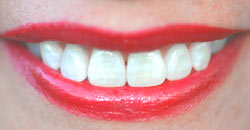
Your teeth Most people know that the teeth are the hardest and strongest part of the body. There's more than meets the eye, though. Teeth are actually a living part of your body that has blood vessels and nerves. If you used to judge your teeth like a book by its cover, then you're in for one big surprise. Teeth anatomy is a lot more complicated than you ever thought. The visible part of a tooth, otherwise known as the crown, is only a small portion of the living system. The crown is made up of enamel, the hardest substance found within the body. It is bone that has been enriched with large percentages of calcium. That's why people who drink lots of milk or take calcium supplements have strong bones and teeth. The enamel is thickest at the crown, and thinnest near the roots of the teeth. The permanent teeth are the second set of teeth that will last the rest of your life. They tend to be more yellow (and not just because of coffee) and are extremely hard. The final set of teeth is made up of 32 teeth, or 16 on each jaw. There are two central incisors for biting, two lateral incisors for biting, two canines for tearing and cutting, four premolars for chewing, and six molars for chewing.
Dental dentures Dentures are removable replacements for missing teeth typically made out of an acrylic resin which at times incorporate porcelain or metal for additional structural support. There are two main types of dentures. Both Complete Dentures and Partial Dentures are finely crafted, custom-fitted. If you properly maintain your dentures they will appear natural and provide a perfect smile. Additionally, dentures help strengthen muscles controlling your expressions that require the support of your teeth, rid you of pronunciation problems caused by missing teeth and aid with chewing. If you've lost, or are losing, all of your teeth a Complete Denture is something to discuss with your cosmetic dentist. If some of your teeth remain and are healthy, a partial denture may be your way to a great smile.
Tooth crown procedure As we age, many of us find ourselves with teeth that are no longer structurally sound. Root canals, lost fillings, decay below a filling, chipping and cracking of the enamel are all things that can lead to large scale defects in a tooth's surface. When the entire surface of the tooth is a problem, but the root system is intact, a crown might be just what the dentist orders. Grinding your teeth, an improper bite, age, fillings and tooth decay can all be contributing factors in the wearing down, cracking or breakage of your teeth. Dental crowns cover the entire visible surface of your affected tooth and add strength, durability and tooth stability. In other instances, crowns are used to replace a actual missing tooth. These crowns are anchored to the teeth on either side, with a bridge section connecting the two crowns. Instead of bridges, single tooth dental implants may be used that eliminate the need for supporting the crowns. In some cases your cosmetic dentist may choose to use a Flipper instead of a temporary crown. A Flipper is a false tooth to temporarily take the place of a missing tooth before the permanent crown is placed. A Flipper can be attached via either a wire or a plastic piece that fits in the roof of your mouth. Flippers are meant to be a temporary solution while awaiting the permanent crown.
DefinitionsDental fillings
- Dental fillings are inserted as restorations in the treatment of dental cavities, after drilling out the cavities.
Dental implants
- Dental implants are surgically fixed substitutes for roots of missing teeth. Embedded in the jawbone, they act as anchors for a replacement tooth, also known as a crown, or a full set of replacement teeth.
Dentures
- Removable complete dentures are full-mouth false teeth, which are used when a patient has no teeth left on either the mandibular arch, the maxillary arch, or both.
Veneer
- A layer of tooth-colored material, usually porcelain or acrylic resin, attached to and covering the surface of a metal crown or natural tooth structure.
Anesthesia
- Total or partial loss of sensation, especially tactile sensibility, induced by disease, injury, acupuncture, or an anesthetic, such as chloroform or nitrous oxide.
- Local or general insensibility to pain with or without the loss of consciousness, induced by an anesthetic.
- A drug, administered for medical or surgical purposes, that induces partial or total loss of sensation and may be topical, local, regional, or general, depending on the method of administration and area of the body affected.
Bridge
- A dental bridge is a prosthesis used in place of missing teeth and may be removable or permanently attached.
Dental cavities
- The formation of cavities in the teeth by the action of bacteria; tooth decay.
- Also known colloquially as tooth decay.
Dental crown
- Full-coverage restoration (sometimes incorrectly called a cap) is a prosthetic tooth designed by a dentist and usually created by a lab technician.
Porcelain
- A hard, white, translucent ceramic made by firing a pure clay and then glazing it with variously colored fusible materials.
Stomatology
- The medical study of the mouth and its diseases.
Tooth bleaching
- Also known as tooth whitening.
|


