Sgt. Hermon William Tozer by Evolution
The
following story is not just about a man I feel but about a generation.
This
man had been badly wounded and had done more then his fair share but wanted to
do so much more.
He joined the budding new Royal Flying Corp when it was a brand new way of fighting a war, a war in the air which also led to the start of strategic bombing. The battlefield had changed from soldiers versus soldier to where the civilian population became a legitimate target.
The
Germans had started it with the Zeppelins but make no mistake about it - if they
had not the allies would have done the same sooner or later anyway. When you hear we started it as revenge, that was just
propaganda and there sure was a lot of that in the war. Conveniently the Germans
started it and this is why I feel this story should be told - to us flight
simmers.
We
do it for fun and I strongly hope we never forget those who did so without any
choice.
...
Sergeant
Hermon William Tozer
57318
110TH SQDN Royal Flying Corp

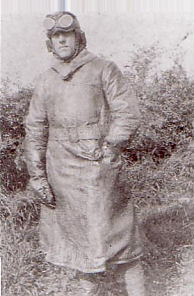
Hermon
is standing, taken in early 1915.
Sergeant Hermon Tozer was born on the 27th
December 1895, at Bedminster. He
was the second of 12 children.
At the outbreak of War in 1914, Hermon volunteered for Army
service and joined the 5th (service) battalion of the Connaught
Rangers, part of the 29th Infantry Brigade, 10th (Irish) Division.
The Battalion was mobilized at Basingstoke, Hampshire for active
service in Gallipoli. Most of
the unit sailed from Davenport on board the SS Bornu on the 8th of
July 1915, and the remainder from Liverpool aboard the SS Mauritania the next
day. The Battalion came together in bivouacs at Madros on
the Greek Island of Lemnos and sailed to Gallipoli aboard the SS Clacton,
landing at Anzac Cove, at 3AM on the 6th of August. They moved forward under heavy shellfire, to be
attached to the 3rd Australian Brigade in the frontline on a hill
called “The Pimple”. The
Rangers had to clear the Trenches of dead before they could take up the
positions allotted to them. They
were soon engaged in an attack on the Turkish positions at “Lone Pine”,
before being withdrawn back to Anzac Cove on the 10th of August.
On the 21st of August, following a number of
fierce actions, the Battalion made a determined attack on the Turkish
strongpoint at “Hill 60” on the Aghyl Dere Ridge. The Battalion War diary states the leading waves of
Rangers were cut down by very heavy machine gun and rifle fire, but the
Battalion pressed home the attack and captured the first line of enemy trenches.
There C.O, Lt-Colonel Jourdain, reported that not a single
man had fallen back down the slopes of the hill, and later lines of dead men
could be seen: “each man with his
rifle beside him, as if on parade”.
Despite heavy enemy-counter attacks throughout the night and
the next day, the Battalion held their positions on the hilltop until relieved
late on the evening of the 22nd by Australian Infantry.
The Battalion was involved in very heavy fighting in the area
against enemy troops “Six times there number” until on the 29th
August the exhausted remnant of the Rangers was moved to reserve positions,
where they still suffered casualties, until on the 29th September
1915, they sailed aboard the SS Abbas from Anzac Cove to Mudros.

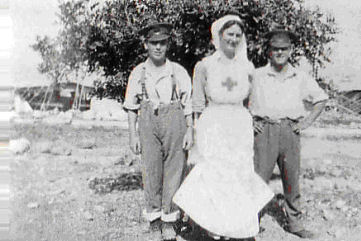
(Standing right from nurse)
The Battalion’s casualties during service at Gallipoli were 591 (220 killed, 371 wounded). Hermon received a leg wound during this time and was transferred from a CCS on one of the offshore islands to a base Hospital, probably on Malta. Hermons wound was considered a “Blighty one” and was returned to Britain for further treatment and rehabilitation and home leave.
Hermon had recovered by May 1917, and he joined the Royal
Flying Corps, and was accepted for flight training at Denham, near Uxbridge.

After qualifying as a
Sergeant pilot, No. 57318, he joined 110 Squadron, at Rendcombe, Glouctershire
on the 1st of November 1917.
They were later based at Sedgefield, near Kingslynn, and it was here that
Hermon escaped unscathed when a BE2e trainer aircraft he was landing tipped onto
its nose on the runway.
On the 1st of April 1918 the RAF was created, and
110 squadron was equipped with the first batch of the new de Havilland DH 9A
aircraft, which were sponsored by the Nizam of Hyderabad.
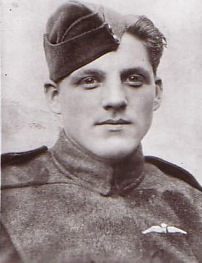 After tactical training at
No.1 School of Navigation and Bomb Dropping at Stonehenge, Hermon flew with the
Squadron to Bettoncourt in France on Friday the 13th of August 1918.
After tactical training at
No.1 School of Navigation and Bomb Dropping at Stonehenge, Hermon flew with the
Squadron to Bettoncourt in France on Friday the 13th of August 1918.
(They were part of the independent force, a RAF unit based at aerodromes near Nancy, in order to conduct strategic bombing of Germany in retaliation for German bombing of Britain Hermon was soon flying long distance daylight bombing on industrial targets along the Rhine Valley. The aircrews did not have parachutes, and although they had a crude form of electric heating in there trousers, there upper clothing did not afford much protection when flying in open cockpits at heights often over 20,000 feet. Icing sometimes caused engine failure, but a greater threat was from the swarms of German Fighter aircraft they met when approaching their target area at a lower height, carrying a bomb load of 660Lbs)
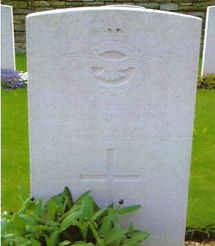 Sadly, Hermon and his
observer/air gunner, Sergeant William Platt, were killed when there DH 9A
aircraft (serial no E8422) was shot down on the 25th September 1918,
while on a bombing raid on factories and rail targets at Frankfurt, 120 miles
from there base. The Germans
buried them side-by-side, in Saaralbe Military Cemetery, (B14, B15), now in the
Moselle department of France, but formally in Germany.
Sadly, Hermon and his
observer/air gunner, Sergeant William Platt, were killed when there DH 9A
aircraft (serial no E8422) was shot down on the 25th September 1918,
while on a bombing raid on factories and rail targets at Frankfurt, 120 miles
from there base. The Germans
buried them side-by-side, in Saaralbe Military Cemetery, (B14, B15), now in the
Moselle department of France, but formally in Germany.