

The North West Mounted Police 1874 - 1904
Canadian Confederation in 1867 brought the region of the North West under control of the Dominion of Canada. The subsequent departure of the Hudson's Bay Company, which had maintained relative stability in the region during the previous two hundred years, resulted in the introduction of a destructive new threat the American whiskey trade.
On May 3, 1873, Sir John A. MacDonald introduced a Bill into Parliament which sought to bring order to the frontier, encourage settlement, and establish Canadian authority in the North West Territories. The Bill was passed seventeen days later, creating the North West Mounted Police. Two contingents, totaling close to four hundred men were recruited and trained, uniting at Fort Dufferin, Manitoba in June, 1874
On July 8, 1874, 275 officers and men of the North West Mounted Police, along with 142 draught oxen, 93 head of cattle, 310 horses, 114 Red River carts, 73 wagons two nine-pounder field guns, two mortars, mowing machines, portable forges and field kitchens, began their trek from Fort Dufferin, Manitoba to establish order in the Canadian west. Following the Boundary Trail, the Force traveled into the territory now known as the Canadian province of Saskatchewan, where a contingent was dispatched North West to establish a post near Fort Edmonton. The bulk of the Force continued west, however, and became increasingly aware of their inadequate supplies and the predicaments of life on the Canadian prairies.
 Over the two months into their expedition, the Force finally reached the Milk River Ridge, where they encamped and awaited provisions contracted by French and Macleod in Fort Benton, Montana. With winter's furious approach, French parted company from Macleod and a guide, Jerry Potts, was obtained to assist Macleod in quickly establishing a presence in the southern territory. Potts led Macleod and the remaining Force members to the notorious whisky post, Fort Whoop-Up.
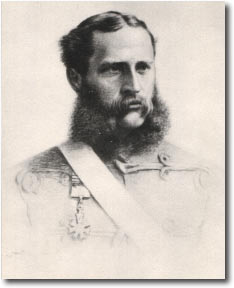
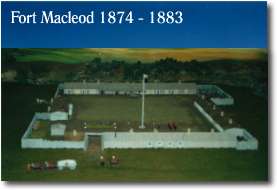
When the North West Mounted Police arrived at Fort Whoop-Up, they found the post abandoned except for one lone caretaker, and they were able to build their permanent post before winter. This post, built on an island on the Old Man River west of Fort Whoop-Up, was named Fort Macleod after the Force's Assistant Commissioner, James Farqueson Macleod (Photo on Right)
.
In addition to fighting the whiskey trade, the North West Mounted Police came to secure peaceful relations with the First Nations people of the Canadian Plains. Treaties were signed with both the Cree and Blackfoot, in 1876 and 1877.
Four thousand working men poured into the Canadian West between 1882 and 1885 to build the Canadian Pacific Railway. The Mounted police stationed a few of its 500 members at each construction camp to keep illegal liquor, horse stealing, and strikes to a minimum. The Mounted Police also calmed the First Nations people who feared the changes the railway the "iron horse" would bring. Thanks to the North West Mounted Police, amazingly few serious crimes were committed during construction.
The completion of the railroad in 1885 resulted in a watershed of new settlement into western Canada. As a result, a system of patrols and outposts was established to deal with the influx of new settlers.
The desire by the Canadian government and the North West Mounted Police to establish peaceful settlement of the Canadian West was disrupted in 1885. Frustrated by the lack of responsiveness to their complaints, some Metis and First Nations people reacted violently against authority, leading to what has become known as the North West Rebellion. The first shots of this uprising were fired at Duck Lake, on March 26, 1885. The newly completed Canadian Pacific Railway transported a military force, under the direction of Major-General Middleton, which put an end to the rebellion.
The Klondike Gold Rush in the Yukon created a new challenge for the Mounted Police. While the Mounted Police created a presence in the territory in 1895, the NWMP contingent in the Yukon grew from 19 men to 285 at the height of the Gold Rush in 1898 to ensure that law and order was maintained.
The Royal North-West Mounted Police 1905 - 1919
In 1904, King Edward VII bestowed the pre-fix "Royal" upon the North West Mounted Police in recognition of their service during the South African War (1899 to 1902). Yet despite all of their success, a debate waged over the Force's future. The rapid development of the West challenged the role of the Mounted Police as a frontier force.
Critical to maintaining the Mounted Police's future were issues of internal security and civil order. Early in the Firs t World War, the Royal North West Mounted police were retained at home to enforce the War Measure s Act. Under the Act, 1200 persons of questionable loyalty were investigated by the RNWMP and nearly 400 were interned in camps in Brandon, Ontario and Lethbridge, Alberta. Following the war attention was increasingly drawn to civil and labour unrest. In May, 1919, social pressures peaked in the Winnipeg General Strike and the RNWMP were sent to restore order. Thereafter, it was determined that circumstances demanded the availability of a federal arm of authority and that the RNWMP had performed this role with reliability beyond the capacity of all other civil and provincial police forces. In late 1919 rumors of the disbandment of the RNWMP were silenced and a national police force emerged.
The Royal Canadian Mounted Police 1920 to present
In 1920, the Royal North West Mounted Police absorbed the Dominion Police Force, creating the Royal Canadian Mounted Police. With the shift in title, headquarters were moved from Regina to Ottawa, and the strength of the Force was increased to 2500 members. Police services were extended throughout Canada, while the Force took on the responsibility for intelligence and security duties in addition to its normal police and crime prevention work.
During the 1920s and 1930s, changes in the RCMP were made in key areas, reflecting trends toward higher educational and training standards, as well as increasing modernization. New sections were created, including Air and Marine Divisions, and a Crime Detection Lab was opened in 1937. With the outbreak of World War II, the RCMP formed the 1st Provost Company for overseas service. Meanwhile, the discovery in 1945 of a Russian spy ring in Canada expanded the RCMP's intelligence and security roles, until these duties were taken over by the civil Canadian Security Intelligence Service in 1984.
Between 1928 and 1950, in addition to their federal duties, the RCMP took on policing contracts in all provinces except Ontario and Quebec, while continuing to provide the only form of police service in the Yukon and Northwest Territories.
1973 marked the centennial celebration of the formation of the NWMP. One hundred years strong, the Force continued to expand, reflecting the growth and increasing diversity in Canada. In 1974, the RCMP admitted its first woman constable, requiring the same training and duties of women as men. Response to various ethnic communities has also increased, with emphasis on cultural diversity within the Force, and approval in 1990 of the wearing of turbans among orthodox Sikh members.
The modern RCMP Academy in Regina trains specialist personnel, including the Native Special Constable and has continued to provide advanced training courses in many areas. Now including over 20,000 members and serving close to 30 million Canadians, the Royal Canadian Mounted Police is recognized as one of the most effective police forces in the world.