|
 |
General Information:
Area:
449,964 sq km (173,732 sq
miles).
Population:
8,975,670 (official
estimate 2003).
Population Density:
19.9 per sq km.
Capital:
Stockholm.
Population: 761,721 (2003).
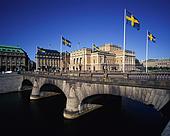 Pricing for this trip starts at $1,150.00 (us dollars), for a 3 day 4
night stay.
Pricing for this trip starts at $1,150.00 (us dollars), for a 3 day 4
night stay.
GEOGRAPHY:
Sweden is bordered by
Norway to the west and Finland to the northeast, with a long Baltic
coast to the east and south. Approximately half the country is forested
and most of the many thousands of lakes are situated in the southern
central area. The largest lake is Vänern, with an area of 5540 sq km
(2140 sq miles). Swedish Lapland to the north is mountainous and extends
into the Arctic Circle.
Government:
Constitutional monarchy. Gained independence from
Denmark in 1523. Head of State: King Carl XVI since 1973. Head
of Government: Prime Minister Göran Persson since 1996.
Language:
Swedish. Lapp is spoken by the Sámi population in
the north; there are also Finnish-speaking minorities. English is taught
as the first foreign language from the age of nine.
Religion:
Around 86 per cent of the population belong to
the Church of Sweden (Evangelical Lutheran), separated from the state in
January 2000; other Protestant minorities constitute the majority of the
remainder.
Time:
GMT + 1 (GMT + 2 from last Sunday in March to
Saturday before last Sunday in October).
Electricity:
230 volts, three-phase AC, 50Hz. Two-pin
continental plugs are used.
Communication:
Telephone:
Full IDD is available. Country code: 46. Outgoing
international code: 00. Coin-operated pay phones no longer exist and
they are all now card-operated. Cards are readily available from kiosks
and newsagents and instructions in English are displayed in most booths.
Credit card phones (indicated by a ‘CCC’ sign) are widely available.
Mobile telephone:
GSM 900/1800 and 3G networks are available. Main
network providers include: Comviq (website:
www.comviq.se),
Telia AB (website:
www.teliamobile.se) and Vodafone (website:
www.vodafone.se).
Coverage is available across most of the country.
Fax:
An excellent service is widely available
throughout the country.
Internet:
Main ISPs include Dataphone (website:
www.dataphone.net)
and Svenska Internet Centralen (website:
www.sic.se). Internet
cafes exist in all main urban areas but are scarcer outside of these
areas.
Telegram:
Telegrams can be sent from most hotels and post
offices.
Post:
Post office hours: Usually open during normal
shopping hours (Mon-Fri 0800-2200, Sat 0900-1500). Some branches may be
closed Saturday during July. Post boxes are yellow. Stamps and aerograms
are on sale at post offices and also at most bookstalls and stationers.
Airmail within Europe takes three to four days. Poste Restante
facilities are widely available in post offices.
Press:
The provinces have their own newspapers which are
widely read in their respective regions; the major dailies are confined
largely to the capital and include such titles as Aftonbladet,
Dagens Nyheter, Expressen and Svenska Dagbladet. Many
papers are financed by political parties but independence and freedom of
the press is firmly maintained. All papers are in Swedish.
Radio:
BBC World Service (website:
www.bbc.co.uk/worldservice) and Voice of America (website:
www.voa.gov) can be
received. From time to time the frequencies change and the most
up-to-date can be found online.
|


