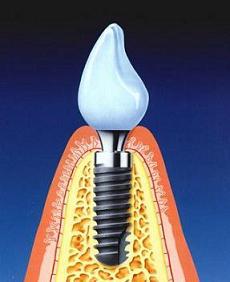
The visible part of a tooth, otherwise known as the crown, is only a small portion of the living system. The crown is made up of enamel, the hardest substance found within the body. It is bone that has been enriched with large percentages of calcium. That's why people who drink lots of milk or take calcium supplements have strong bones and teeth. The enamel is thickest at the crown, and thinnest near the roots of the teeth. Excellent crowns and bridges were made by the Etruscans in the 7th cent. B.C. At about that time, teeth were being extracted in Asia Minor as a cure for bodily ills and diseases. Skills achieved by the Etruscans, Phoenicians, Egyptians, Greeks, and Romans were largely lost during the Middle Ages, when barbers and roving bands of charlatans practiced unskilled dentistry at marketplaces and fairs. Abulcasis, a Spanish Moor, was one of the few in his time who studied dental surgery. Your teeth are by far one of the most important things you use every day. Many people end up neglecting their teeth with improper oral hygiene. You should take care of them by brushing at least twice a day, flossing once per day, and going for regular dental checkups at least twice per year.
A special dental material is then used to open up the pores of your tooth's dentin and roughens up the surface of the exposed enamel. This achieves better and stronger bond. The bond resin is applied to stick the composite to your tooth. This material is made of the same dental resin as the composite however it is much more fluid. This layer is then hardened and cured with a very bright light. Composite resin fillings are applied in thin layers, and slowly built up to form the complete filling. A bright dental light will harden each layer before the next is applied. Once your filling is completed, your dentist will use a special paper, articulating paper, to adjust the height of your dental filling and that your bite remains correct. Your tooth is then polished. If over half of your molar tooth's biting surface is decayed an inlay or onlay may be a better option than a filling. These options are basically for when more than a filling is needed but less than a crown will do. An inlay is placed in between the cusps of the tooth, whereas an only will cover one or more of the cusps. They can be made of a gold alloy, porcelain or tooth-colored resin and are cemented into place.
Dentures are removable replacements for missing teeth typically made out of an acrylic resin which at times incorporate porcelain or metal for additional structural support. If you've lost, or are losing, all of your teeth a Complete Denture is something to discuss with your cosmetic dentist. If some of your teeth remain and are healthy, a partial denture may be your way to a great smile. The setting up dentures procedure begins with a wax bite impression of your mouth that will give your dentist exacting measurements. A try-on appointment will fine tunes color, shape, and custom-fit. After your final dentures are fabricated, they will be placed and informed of their required care.
There are several corrections that you can make to the color of your teeth as well as the shape of your teeth! Some of the causes of tooth discoloration are staining, aging, chemical damage, disease, medication, and genetics. Dental Veneers (Tooth Veneers) are used to correct both the color and the shape of teeth. Dental veneers (sometimes called porcelain veneers or dental porcelain laminates) are wafer-thin, custom-made shells of tooth-colored materials designed to cover the front surface of teeth. These shells are bonded to the front of the teeth changing their color, shape, size or length and resulting in an improved appearance. Dental veneers can be made from porcelain or from resin composite materials. Porcelain veneers resist stains better than resin veneers and better mimic the light reflecting properties of natural teeth. Resin veneers are thinner and require removal of less of the tooth surface before placement. You will need to discuss the best choice of veneer material for you with your dentist. Veneers, porcelain or plastic, are placed over the front teeth to change color shape of the teeth. Veneers are ideal for teeth that are too small, too big, or have uneven surfaces. It is very common for people to have imperfect teeth, either oddly shaped teeth, chipped teeth, crooked teeth, teeth with small holes in them, or an inappropriate sized tooth or teeth that have an odd appearance. Veneers solve such irregularities and create a durable and pleasing smile.
The dental bonding procedure utilizes a composite resin and is used for a variety of structural as well as cosmetic purposes. One can draw a parallel between dental bonding materials and a sculptor's clay. By using dental composite resin bonding your dentist can restore chipped or broken teeth, fill in gaps and reshape or recolor your smile. Basically, bonding will cover any natural flaws applying a thin coating of a plastic material on the front surface of your teeth. After this, your cosmetic dentist will apply a bonding material and sculpt, color and shape it to provide a pleasing result. A high-intensity light then hardens the plastic, and the surface is finely polished.
For individuals who have chipped, cracked or irregularly shaped teeth, dental contouring and reshaping can be just the ticket for a more beautiful smile. Tooth reshaping, or tooth sculpting, is a safe and conservative way to improve your smile. Teeth may become weaker if large amounts of enamel are removed, tooth reshaping should be limited to minor changes or combined with veneers or bonding for the best smile. Dental reshaping and contouring is a procedure to correct crooked teeth, chipped teeth, cracked teeth or even overlapping teeth in just one session. This procedure is even a substitute for braces under certain circumstances. This is also a procedure of subtle changes. A few millimeters of reduction and a few millimeters of tooth-colored can create a beautiful smile when performed by a cosmetic dentist, with no discomfort to you. Tooth reshaping, or dental contouring, is commonly used to alter the length, shape or position of your teeth.
As we age, many of us find ourselves with teeth that are no longer structurally sound. Root canals, lost fillings, decay below a filling, chipping and cracking of the enamel are all things that can lead to large scale defects in a tooth's surface. When the entire surface of the tooth is a problem, but the root system is intact, a crown might be just what the dentist orders. In other instances, crowns are used to replace a actual missing tooth. These crowns are anchored to the teeth on either side, with a bridge section connecting the two crowns. Instead of bridges, single tooth dental implants may be used that eliminate the need for supporting the crowns. Be sure to discuss with your cosmetic dentist that the cement color used for your permanent crown will be the same as used for your temporary crown. A try in paste is used for this purpose. The color of the cement does affect the overall color of a porcelain crown, so this needs to be discussed long before your temporary crown is placed.
Lingual braces are similar to classic orthodontic braces but are attached to the backside of the teeth, rather than the front. Although they still have many of the problems of standard braces, they are not visible and may be chosen by adults who do not wish for visible braces. Lingual braces are more expensive than standard braces but the fastest method of "invisible" teeth straightening. Invisalign is one of the newest methods of teeth straightening and is extremely popular with adults. Consisting of a clear mold that is nearly invisible when worn, Invisalign uses a series of molds that gradually push the teeth into the desired shape. Invisalign does not cost significantly more than standard orthodontic braces, but cannot correct an overbite or underbite and is only a good choice for minor straightening. Invisalign is not as effective on major problems, which may require standard braces. The most common method of teeth straightening remains standard orthodontic braces. Archwires, springs, and rubberbands apply pressure to the individual teeth by means of brackets that are glued onto their surface. Regular visits are required to the orthodontist in order to tighten wires as needed and make other adjustments. At each visit, the wires will be tightened slightly to renew pressure and push them toward their intended position. Additional wires, rubberbands, and headgear may be prescribed to help move the teeth into their ideal position as quickly as possible. When the teeth have all been repositioned, the brackets will be removed and a retainer must be worn to prevent relapse for some period of time.

Definition explainingDental fillings
- Dental fillings are inserted as restorations in the treatment of dental cavities, after drilling out the cavities.
Dental implants
- Dental implants are surgically fixed substitutes for roots of missing teeth. Embedded in the jawbone, they act as anchors for a replacement tooth, also known as a crown, or a full set of replacement teeth.
Dentures
- Removable complete dentures are full-mouth false teeth, which are used when a patient has no teeth left on either the mandibular arch, the maxillary arch, or both.
Veneer
- A layer of tooth-colored material, usually porcelain or acrylic resin, attached to and covering the surface of a metal crown or natural tooth structure.
Anesthesia
- Total or partial loss of sensation, especially tactile sensibility, induced by disease, injury, acupuncture, or an anesthetic, such as chloroform or nitrous oxide.
- Local or general insensibility to pain with or without the loss of consciousness, induced by an anesthetic.
- A drug, administered for medical or surgical purposes, that induces partial or total loss of sensation and may be topical, local, regional, or general, depending on the method of administration and area of the body affected.
Bridge
- A dental bridge is a prosthesis used in place of missing teeth and may be removable or permanently attached.
Dental cavities
- The formation of cavities in the teeth by the action of bacteria; tooth decay.
- Also known colloquially as tooth decay.
Dental crown
- Full-coverage restoration (sometimes incorrectly called a cap) is a prosthetic tooth designed by a dentist and usually created by a lab technician.
Porcelain
- A hard, white, translucent ceramic made by firing a pure clay and then glazing it with variously colored fusible materials.
Stomatology
- The medical study of the mouth and its diseases.
Tooth bleaching
- Also known as tooth whitening.
|




