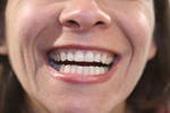
Teeth as sparkle your smile Most people know that the teeth are the hardest and strongest part of the body. There's more than meets the eye, though. Teeth are actually a living part of your body that has blood vessels and nerves. If you used to judge your teeth like a book by its cover, then you're in for one big surprise. Teeth anatomy is a lot more complicated than you ever thought. Throughout your life you end up having 2 completely different sets of teeth. The initial set is the baby teeth (deciduous teeth) that eventually fall out. They are whiter, softer, and less sturdy than adult teeth. Hence, they tend to wear out much faster than permanent teeth, but they also fall out to make room for them. Making sure that there's enough space in the vacancy caused by a lost baby tooth is important for healthy adult teeth. New developments include the implantation of artificial teeth or binding posts into the gums or jawbone; antibiotic fiber for periodontal disease; root canal surgery, a procedure that ameliorates pain while permitting teeth to remain in place; and nearly painless lasers to repair dental cavities, usually making local anesthesia unnecessary.
Dental reshaping For individuals who have chipped, cracked or irregularly shaped teeth, dental contouring and reshaping can be just the ticket for a more beautiful smile. The dental contouring procedure can even be a substitute for braces under certain circumstances. It is also a procedure of subtle changes. A few millimeters of reduction and a few millimeters of tooth-colored laminate can create a beautiful smile when performed by a cosmetic dentist, with no discomfort to you. Tooth reshaping, or dental contouring, is commonly used to alter the length, shape or position of your teeth. Tooth reshaping, or tooth sculpting, is a safe and conservative way to improve your smile. Teeth may become weaker if large amounts of enamel are removed, tooth reshaping should be limited to minor changes or combined with veneers or bonding for the best smile. Dental reshaping and contouring is a procedure to correct crooked teeth, chipped teeth, cracked teeth or even overlapping teeth in just one session. This procedure is even a substitute for braces under certain circumstances. This is also a procedure of subtle changes. A few millimeters of reduction and a few millimeters of tooth-colored can create a beautiful smile when performed by a cosmetic dentist, with no discomfort to you. Tooth reshaping, or dental contouring, is commonly used to alter the length, shape or position of your teeth.
Cosmetic dental bonding The dental bonding procedure utilizes a composite resin and is used for a variety of structural as well as cosmetic purposes. One can draw a parallel between dental bonding materials and a sculptor's clay. By using dental composite resin bonding your dentist can restore chipped or broken teeth, fill in gaps and reshape or recolor your smile. You are good candidate for tooth bonding, if you have close, small gaps between your front teeth, or if you have chipped or cracked teeth, you may be a candidate for bonding. Bonding is also used for patients who have discolored teeth, uneven teeth, gum recession or tooth decay. Bonding material is porous, so smokers will find that their bonding will yellow. If you think you are a candidate for bonding, discuss it with your dentist.
Dental implants Implants are great for replacing missing teeth. It is important that you have enough bone in the area of the missing teeth for the implants to be attached to. Implants are not only used to replace one tooth, but rather people missing most, if not all, of their teeth benefit greatly as well. Implants are increasingly being used to replace certain types of bridges and removable partial dentures. If you have a small dental bridge or partial dentures (removable type), implants will be a welcome alternative. Implants are an alternative to a fixed bridge. The implant will last a lifetime, but the crown on top of it will last ten to fifteen years. The implant procedure is a surgical placement of the implant or implants in your jaw bone which requires a three to six month healing period before the implant restoration to replace the missing tooth or teeth. During this healing time, the bone grows in and around the titanium implant creating a very strong support. Dental implants can be rejected. Usually they are replaced with another implant of a slightly larger size. The rejection or "failure" rate is minimal, only 1 to 2% of all implant procedures. You must go without wearing your dentures for one day to two weeks after an implant placement. After the implant has "taken" and you have sufficiently healed, a very natural crown is placed on the implant. If you're missing one tooth or all of your teeth, implants may well be for you. So long as you have enough bone in the area of the missing tooth to facilitate the anchorage of the implants, this procedure can yield terrific results. If you don't have enough bone for this purpose, a bone graft may be necessary. A procedure of building up the bone is known as Bone Grafting. Bone grafting is common with dental implants. The bone that is used is one of three types. The preferred bone to use is taken from other areas of your mouth or collected in a suction device as the drilling of the sites for dental implants occurs. Sometimes bone is taken from areas such as a hip (this requires an orthopedic surgeon and an operating room). The third source for needed bone is a synthetic type. This is the least preferred type of bone to be used for this procedure.
Dental cavities Most of us have had amalgam fillings (silver) or gold filling restorations. Some amalgam fillings were what we have called mercury fillings, as some amalgam fillings contained mercury. Metal fillings were effective, but very conspicuous and tended to blacken in color over time. There are no known health risks of receiving composite fillings. If such a filling is not going to be enough to protect your damaged tooth, or if your tooth enamel is thin and will easily fracture, or if your tooth has had a root canal that weakened your tooth condition, your tooth may require additional protection such as a crown. If over half of your molar tooth's biting surface is decayed an inlay or onlay may be a better option than a filling. These options are basically for when more than a filling is needed but less than a crown will do. An inlay is placed in between the cusps of the tooth, whereas an only will cover one or more of the cusps. They can be made of a gold alloy, porcelain or tooth-colored resin and are cemented into place.
Dentures Dentures, also known as false teeth, are the primary topic in this section of our site. Here, you can learn how the procedure is performed, what dentures cost and the advantages and disadvantages of having them. This procedure should be thoroughly discussed with your dentist as there are several personal and medical factors to take into consideration. You may instead be a candidate for dental bridges and dental implants as optional procedures. The main component of dentures is acrylic resin molded over the top of various combinations and paterns of metal. In oreder to use dentures all of the teeth in the top or bottom or both top and bottom of the mouth are removed. It is recomended that after the removal of the necessary teeth that the patient wait at least a month to have the dentures fit to the mouth. The waiting period allows for proper healing in the mouth to take place.
Porcelain and composite veneers This section of our cosmetic dentistry information site provides you with some background into dental veneers, both composite veneers and porcelain veneers. Dental veneers, sometimes called tooth veneers, can be used to correct both color and shape problems. There are several corrections that you can make to the color of your teeth as well as the shape of your teeth! Some of the causes of tooth discoloration are staining, aging, chemical damage, disease, medication, and genetics. Dental Veneers (Tooth Veneers) are used to correct both the color and the shape of teeth. Veneers, porcelain or plastic, are placed over the front teeth to change color shape of the teeth. Veneers are ideal for teeth that are too small, too big, or have uneven surfaces. It is very common for people to have imperfect teeth, either oddly shaped teeth, chipped teeth, crooked teeth, teeth with small holes in them, or an inappropriate sized tooth or teeth that have an odd appearance. Veneers solve such irregularities and create a durable and pleasing smile.
Types of teeth whitening Teeth whitening can be accomplished many different ways. Considered a cosmetic procedure, teeth whitening has become very popular in recent years with the development of various methods that range from drugstore products to dental visits. The simplest type of teeth whitening is the use of products that can be picked up from the drugstore. These products, which use a very mild bleaching solution, usually require extended use over a period of several weeks. They may be brushed on, squeezed into one-size-fits-all trays, applied as strips, or used in conjunction with normal toothpaste and mouthwash. While these products are very popular, their mildness makes them less effective. Mild side effects are to be expected with any teeth whitening procedure, and may range from slight discomfort to sensitivity to hot and cold. While serious side effects are extremely rare, any extended sensations of pain should immediately be reported to a dentist. Irritation to the gums and mouth tissues should also be watched for and reported if persistent.
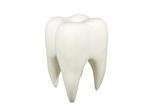
Terms explainingDental fillings
- Dental fillings are inserted as restorations in the treatment of dental cavities, after drilling out the cavities.
Dental implants
- Dental implants are surgically fixed substitutes for roots of missing teeth. Embedded in the jawbone, they act as anchors for a replacement tooth, also known as a crown, or a full set of replacement teeth.
Dentures
- Removable complete dentures are full-mouth false teeth, which are used when a patient has no teeth left on either the mandibular arch, the maxillary arch, or both.
Veneer
- A layer of tooth-colored material, usually porcelain or acrylic resin, attached to and covering the surface of a metal crown or natural tooth structure.
Anesthesia
- Total or partial loss of sensation, especially tactile sensibility, induced by disease, injury, acupuncture, or an anesthetic, such as chloroform or nitrous oxide.
- Local or general insensibility to pain with or without the loss of consciousness, induced by an anesthetic.
- A drug, administered for medical or surgical purposes, that induces partial or total loss of sensation and may be topical, local, regional, or general, depending on the method of administration and area of the body affected.
Bridge
- A dental bridge is a prosthesis used in place of missing teeth and may be removable or permanently attached.
Dental cavities
- The formation of cavities in the teeth by the action of bacteria; tooth decay.
- Also known colloquially as tooth decay.
Dental crown
- Full-coverage restoration (sometimes incorrectly called a cap) is a prosthetic tooth designed by a dentist and usually created by a lab technician.
Porcelain
- A hard, white, translucent ceramic made by firing a pure clay and then glazing it with variously colored fusible materials.
Stomatology
- The medical study of the mouth and its diseases.
Tooth bleaching
- Also known as tooth whitening.
|

