



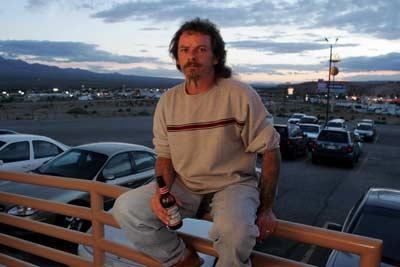
| Charles Otero | Kevin Bright | Steven Relford |
Charlie Otero has waited 31 years for justice in the killings of his parents and two siblings. He can handle a few more months. Dennis Rader's trial date is set for June 27, but lawyers in the case say that because of the time it will take to prepare, they don't expect it to start until fall -- at the earliest. "Whenever the trial starts will be soon enough," Otero told The Eagle on Wednesday. Otero, who speaks for his family on Wichita's BTK serial killer case, is looking forward to the time between now and the trial. "It gives me a chance to put all this on the back shelf and get on with my life for a little while, without the stigma of BTK arising every day or two," he said. "I appreciate and look forward to that." Otero said that being in Sedgwick County Distric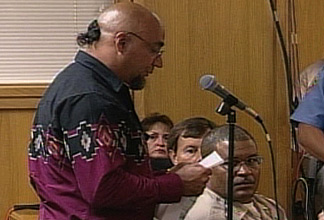 t Court during Rader's arraignment on Tuesday was a very tense moment, one with more emotion than he cared to describe. Steve Relford, whose mother was killed by BTK in 1977, said Wednesday that he made brief eye contact with Rader in the courtroom. "I really can't make a statement about how I felt because it might get me in trouble." Had he acted on his feelings, he said, "I'd be sitting where he is right now." He finds it hard to reconcile his feelings toward the serial killer who took his mother's life 28 years ago with the man who is now charged with his crimes. "I expected some psycho-looking dude," Relford said. "He looked very upstanding and respectable." More than a dozen relatives of BTK victims sat through the arraignment. They saw Rader stand silent when asked to enter pleas to 10 counts of first-degree murder. They watched as District Judge Greg Waller entered a plea of not guilty. "It was very difficult to just sit there and not do nothing," Relford said. "I just wanted to jump up and rip his damn head off. It was very difficult." Holding back was too difficult for Otero's younger brother, Danny. After District Attorney Nola Foulston told Rader, 60, that she intended to seek a sentence that would prevent him from having a parole hearing for 40 years, Danny Otero cried out: "You won't last that long." Foulston said after the hearing that she would tell family members to refrain from such comments in the future. "We have court decorum," Foulston said. "We have rules. We ask individuals not to make comments inside the courtroom. And anyone who does, we ask them to not to do that again, or we ask -- before the judge does -- to not be in the courtroom. Because the judge will take them out. "Foulston said, however, that she understood how high emotions ran for family members, and how difficult it is to follow what can be a painfully slow pursuit of justice. Victims advocates are available to help walk family members through the sometimes difficult process of postponed hearings, del
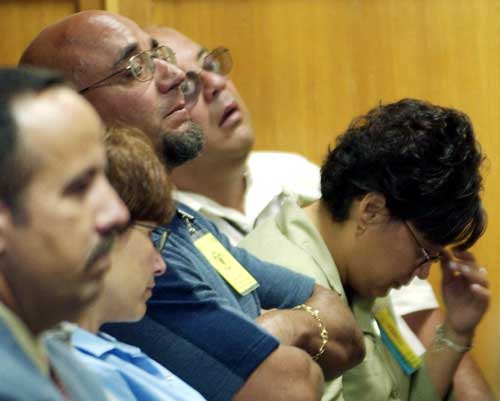 ayed rulings and contentious motions as a case makes its way to trial. "I tell them to be patient," Foulston said of the victims' families. "I tell them that their day will come. And I tell them there are certain things that can happen. I can't sugarcoat anything." Otero said he was grateful that Foulston's office helped him get to Wichita. His parole requirements would normally require him to stay in New Mexico. He also said meeting other relatives of BTK victims was good for him. "It was very heartening and good for my spirit," he said. Some of the most haunting information coming out Wednesday involved the Otero murders. The four members of the Otero family were BTK's first victims. The most disturbing details were heard even by the surviving siblings for the first time. Details of Julie Otero's fight to save her little boy were among the first heard in open court. At only nine years old Joseph Otero Junior was BTK's youngest victim. It was his sister Josephine that brought Rader to the Otero home. Still, Rader took great pleasure when he took the little boy's life. An investigator says a chair was brought in from the other room so Rader could watch him die. Chilling facts never before heard - at least to the public. The Otero children knew whoever killed Joey took time to watch him die. What hurt more was hearing Rader talk about Joey as nothing more than entertainment. Danny Otero says, "my little brother was my best friend. That stabbed me right in the heart . That was the moment ,one of two moments that got me." The other moment Danny referred to was perhaps Rader's most evil act.. It was done to the little girl that first caught Rader's eye, the girl Rader looked at as a woman but treated like she wasn't even human. Investigators say Rader told them she was screaming for her mama and he mimicked the little girl's voice. After 11 year old Josephine Otero witnessed her mother, father, and brother's murder, she was strangled until she lost consciousness. Rader walked her down the basement stairs. She soon learned she would not walk back up them. He told her she was going to heaven just like the rest of her family. We've known since the beginning the body of Josephine Otero was found hanging in the basement. What no one knew, including the Oteros, was what torture she endured before she died. She was able at some point to keep her toes on floor, keeping her alive as long as her strength lasted. As she fought for breath, she finally weakened and died. The Oteros say they weren't expecting that at all and that was worse than everything put together. And if what Rader did to the Oteros before he took their lives wasn't enough, he wrote about his plans for the family after their murder. He talked about his fantasies and planned how his victims would serve him in the after life. It is arrogance and ignorance exemplified in a way it seems only Rader can achieve. But after all he's taken from these three siblings, they made the decision long ago he didn't get anymore from them. They say they'll go home, have a separate life, a good life whatever happened long ago. If the graphic testimony wasn't tough enough, late Weds. afternoon Charlie Otero's teenage son was hit by a car while he was out riding his bike.It is the boy's 17th birthday he's in critical condition in a Wisconsin hospital.
back to top
Kevin Bright, then 19, was with his sister, Katherine, 21, when she returned to her home on an April afternoon. Police say BTK was hiding in a bedroom closet. Not expecting Kevin to be with his sister, BTK must have had to alter his careful plan. Nevertheless, the story of planning and control of that day is chilling. For thirty years, it’s been a story Kevin Bright has never agreed to tell, except to police. Last week, he tells KAKE News his story from a location he doesn’t want disclosed.
“He just told us to stop and hold it right there,” says Bright. “He had me tie up my sister and then he tied me up, in separate bedrooms.” The man told them he was wanted in California and just needed money and a car. Kevin quickly figured out that was a lie. “He just kept going back and forth from where she was, to where I was,” Bright says. “He was gentle and he took control. It was like he’d done it before. He wasn’t worried about anything that I could tell. He was methodical, is what I’d say. “He didn’t push me down, didn’t slap me around. He laid me down on the bedroom floor, and I remember he put a pillow under my head,” says Bright. The killer left Kevin, and then came back. “He came in, leaned down on the floor and had a stocking. He started strangling me again. He wasn’t going to shoot me, he was going to strangle me,” says Bright. But it was BTK’s own gun that may have saved Bright from being strangled. Bright managed to grab the killer’s 22-caliber pistol. “That’s when I jumped up and broke loose and got a hold of him, got a hold of the gun. “He should have been laying there dead, because I got a hold of the gun and the trigger and pulled it twice and it didn’t go off. He pulled it away from me and that’s when he shot me the first time. I just went on the floor. So, he thought I was dead, I guess and left me alone for a while. “I just laid there and he went into the other room,” says Bright. Bright was shot twice in the head and face, but still frantically looked around the room for a weapon to hit the killer with. He found only a coat hanger. “So, I thought the best thing to do was maybe get out and look for help. So, I got up and went to the door and opened it and went outside,” says Bright. Bright quickly found help from two men on the street. But by that time, BTK was gone and his sister, Katherine, was dying. “I figured he probably heard me going and probably left out the back door at the same time,” explains Bright. Bright says, “I thought he was sure of himself and he had been in that situation before and he new how to control people. “At one time he just asked me, ‘Haven’t I seen you at the university?’ I had nothing to do with the university, so I said, ‘No,’” says Bright. “He used a knotted up stocking, is what he used” to tie me up, Bright says. Bright describes BTK as around 25- or 30-years-old, stalk, about 5’ 10” and 180 pounds. He says he had a slightly darker complexion and a black moustache. He possibly had dark eyes, although they were hard to see, because he had a black stocking cap almost covering his eyes. Contrary to recently published reports, he was not wearing an orange shirt and orange jacket. “And, a camouflage jacket, that’s what I remember,” explains Bright. Over the years, he also remembers a piece of jewelry BTK was wearing. Bright says, “The only thing I can think of is a watch. He was wearing a silver watch.” Bright says it was like a plan he was executing and “he knew what he was doing.” “Even though I surprised him I was with my sister, he was in control from the time it started until I got out of there,” says Bright. Thirty-years later, Bright is a Christian who prays that his sister’s killer will be saved. “The Lord, I know he saved me that day for some purpose,” says Bright “I always remember her smile, always had a great smile. She was kind to people. She liked to be with people and she was just a good person. I miss her,” says Bright, of her sister. Bright has offered to talk to police about his memories of that day. For now, he’s studying to be a minister and enjoying a simple life with his wife.
back to top
"I let the BTK in my house." Those are the words of Steve Relford who, when he was just 5 years old, unknowingly let the wanted killer into his home on March 17, 1977. His mother, Shirley Vian, 24, was then bound and killed as he watched -- locked in a bathroom with his two siblings. Nearly 28 years later, he is still haunted by what happened. When he thinks about that day, Relford sees "my mot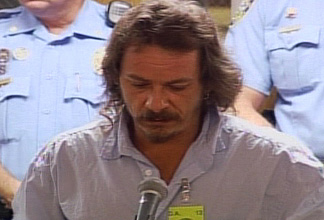 her laying face down with a plastic bag over her head, a rope tied around her neck, all the fingers in her hand broken, her hands taped behind her back. That's what I remember." In an interview with CNN's Paula Zahn on Monday, Relford said after the arrest of 59-year-old Dennis Rader -- a compliance officer for suburban Park City whom authorities allege is BTK -- he returned to the home for the first time. He went there "just to reassure in my mind and re-picture Dennis Rader's face -- and I did." "It was very difficult, very hard to deal with, but I had to do it for me and my mother -- to satisfy my own curiosity, if I remembered what I thought I remembered. And I did." He added, "There is no doubt in my mind. Dennis Rader is the BTK, as far as I'm concerned." Rader, a scoutmaster who is president of his Lutheran church congregation, has not made a public statement. Wichita Police Chief Norman Williams told CNN Rader does not yet have an attorney. "He'll probably have one appointed to him" Williams said on "Larry King Live." Rader has a court hearing scheduled for Tuesday, when he will be charged with 10 murders over three decades, authorities said. Relford's nightmare began the afternoon of March 17, 1977, when his mother, who was not feeling well, sent him to the store to get her some soup. As the young boy was returning, he was approached by a man on the street who showed him a picture of a woman and her young child and asked if he knew them. "I told him, 'No, sir.' "He said, 'Are you sure? Look at it again.' "I told him, 'No, sir.' I didn't know who it was." The man then went to a neighbor's house and Relford went home. A few minutes later, there was a knock at the door, and Relford raced his brother to answer it. Relford ope
 ned the door. Once inside, the man "immediately starts pulling blinds, turns off the TV, reaches in his shoulder holster and pulls out a pistol," Relford said. His mother then stepped out of her bedroom door. "About that time, the phone rang," Relford said. "I asked Mom, 'Do you want me to answer it?' 'No, leave it alone,' he said. And I asked mom. She said, 'No, leave it alone. Do as he says.' "So, I did." The man then told her to start putting toys and blankets in the bathroom for Relford, his brother and sister. "After that, he took a rope, tied one of the doors shut -- the doorknob tied to the sink. He pushed a bed up against the other door, stripped my mother, taped her hands behind her back, a plastic bag over her head and rope tied around her neck." Relford said he was standing on the bathtub, peeking over the top of the door to see what was happening to his mother. His brother and sister, who were locked in the bathroom with him, were "tripping out." At one point, Relford said he shouted to the man that he was going to "untie the rope from underneath the sink." "He told me if I did, he'd blow my [expletive] head off." Three decades later, Relford said he feels relieved following Rader's arrest, but only somewhat. "The reason I say that is because he is not convicted," he said. Asked if he knows who was in the picture that the killer showed him, Relford said it was his mother and himself -- something he learned about six years later, when he saw the same photo in his grandparents' home. "I told my grandparents, 'That's the picture that that man showed me,'" he said. Relford said he would like to ask Rader how he got that picture and "what possessed him to kill my mother and these other innocent folks out here. He had no right." "It made me rebel against everything I ever believed in," he said. Relford has struggled with drug and alcohol use -- which he called a result of the heinous crime. "I would never have been like this if my mother was living," he said.
back to top


