17th Philippine Chemistry Congress
May 23-25, 2001
Cagayan de Oro CityABSTRACTS: ORGANIC CHEMISTRY
OP1
CHIRAL LEWIS ACID CATALYZED AQUEOUS DIELS-ALDER REACTION: A NOVEL SYNTHETIC APPROACH
Susan D.R. Arco1, Jonathan T. Miranda2, Catherine M. Vedar1
1Institute of Chemistry, University of the Philippines, Diliman
2Natural Sciences Research Institute, University of the Philippines, Ditiman
A preliminary study was conducted to determine the asymmetric induction ability of chiral C2-symmetric Lewis acids for aqueous Diels-Alder reaction. The model chiral Lewis acid is a complex between zinc chloride and 1,2:5,6-di-O-isopropylidene-D-mannitol. This catalyst was in situ generated and incorporated in the aqueous Diels-Alder reaction between isoprene and methyl acrylate.
The circular dichroism spectra of the isolated Diels-Aider adduct indicates non- racemization of the reaction which strongly suggests that the Chiral Lewis Acid Catalyst (CLAC) is indeed influential in promoting asymmetry.
OP2
SYNTHESIS OF TERPENES VIA AQUEOUS DIELS-ALDER REACTION
Susan D.R. Arco1, Jonathan T. Miranda2, Julius L. Leaño1 and Marjorie U. Villanueva1
1Institute of Chemistry, University of the Philippines, Diliman
2Natural Science Research Institute, University of the Philippines, Diliman
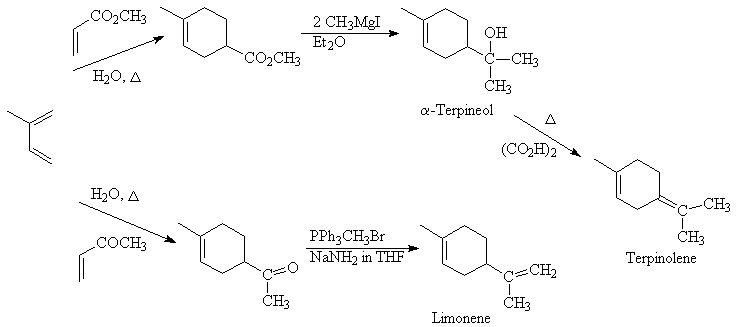
As part of our project involving the development of synthetic protocols utilizing aqueous reaction conditions, a variety of naturally occurring terpenes have been synthesized in our laboratory. Limonene, a -terpineol, and terpinolene were indirectly prepared via aqueous Diels-Alder reaction. The Diels-Alder reactions were carried out in water alone as medium without Lewis acid catalysis to afford the intermediates that are subsequently transformed to the target compounds by conventional means (see scheme below).
Our results present a cleaner alternative to the conventional means of preparing the target compounds. The products are characterized by 'H NMR, IR and mass spectroscopy.
OP3
SYNTHESIS OF ARTEMESIA ALCOHOL AND TERPENE ALCOHOL PRECURSORS VIA AQUEOUS BARBIER-TYPE REACTION
Susan D.R. Arco1, Jonathan T. Miranda2 and Anna Patricia Baile1
1Institute of Chemistry, University of the Philippines, Diliman
2Narural Science Research Institute, University of the Philippines, Diliman
The homoallylic alcohols artemesia alcohol, 1,5-nonadien-4-ol and 2-methyl-2,6-decadien-5-ol were synthesized via aqueous Barbier-type reaction. Artemesia alcohol was prepared by reacting 3-methyl-2-butenal with prenyl bromide in the presence of tin metal powder as the metal mediator in water. The two other products were obtained by reacting allyl bromide and prenyl bromide, respectively, with trans-2-hexenal. The allylation reactions were performed using stannous chloride as source of metal mediator and catalytic amount of cupric chloride in dichloromethane-water (1:1 v/v). These one-pot syntheses were moderately high yielding. The reaction conditions were optimized with respect to temperature and amount of water. The identities of the purified products were established by 'H NMR, IR and mass spectroscopy.
OP4
Studies on the Lipase-Catalyzed Resolution of an Amino Butanol Derivative
Mary Ann A. Endoma1 and Maria Celeste R. Tria2
1Institute of Chemistry, University of the Philippines, Diliman
2Natural Sciences Research Institute, University of the Philippines, Diliman
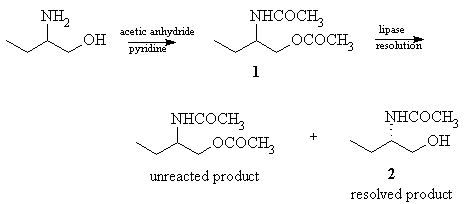
The amido ester compound 1 was prepared by reacting amino butanol with excess acetic anhydride in pyridine. It was subjected to lipase-catalyzed hydrolysis using three different enzyme preparations (Candida rugosa, porcine pancreatic lipase and wheat germ) to screen for the lipase that gives the highest enantiomeric excess. The optical activity of the product was assessed by comparing the optical rotation of the product 2 with those reported in the literature. The resolved product 2 has potential applications in the preparation of optically pure ethambutol, an anti-tuberculosis drug.
OP5
Synthesis of Vancomycin-N-ethylcytosine Derivative
Portia Mahal G. Sabido1 and Mary Jane L. Felipe2
1Institute of Chemistry, University of the Philippines, Diliman
2Natural Sciences Research Institute, University of the Philippines, Diliman
Vancomycin is an effective drug in the treatment of methicillin-resistant Staphylococcus aureus. However, the emergence of bacterial pathogens resistant to vancomycin has been seen posing a serious threat to health. This has paved the way in the development of vancomycin derivatives which have enhanced activity against vancomycin resistant enterococci One such derivative is the dimerization of vancomycin via covalent linkage. This study is aimed at synthesizing vancomycin dimers formed by self-assembly of hydrogen bonding groups. Here the synthesis of vancomycin-cytosine-N-ethyl derivative is being presented. The N-ethyl derivative of cytosine has been prepared from cytosine and coupled to vancomycin using 2-(1-hydroxybenzotriazol-1-yl)-1,1,3,3-tetramethyluroniumhexafluorophosphate (HBTU). This derivative serves as a precursor in the dimerization study of vancomycin through hydrogen bonding.
OP6
Routes Toward the Synthesis of rac-2-Aminopropanal Diethyl Acetal
Hendrich A. Chiong1, Titos A. O. Quibuyen2
1Institute of Chemistry University of the Philippines, Diliman
1Department of Chemistry, Ateneo de Manila University, Loyola Heights, Quezon City
As part of our efforts to prepare a chiral biisoquinoline ligand as Lewis acid catalysts in a Diels-Alder reaction, we proposed this design of the novel chiral atropisonier. Retrosynthetic analysis of 6,7-dimethoxy-3-methylisoquinoline identified the title compound as the logical starting material. Its commercial unavailability as well as the challenge to prepare it from simpler molecules presented us with an opportunity to investigate several synthetic routes towards its construction.
In general, very little has been reported regarding the preparation of a -aminoaldehydes. A number of multi-step strategies were devised and evaluated. In this report, the result of this investigation is presented.