17th Philippine Chemistry Congress
May 23-25, 2001
Cagayan de Oro CityABSTRACTS: INORGANIC CHEMISTRY
TS3 I1
Electrodeposited Polypyrrole Nanostructures in Random-Ordered Anodic Aluminum Oxide Nanoscale Arrays
Daniel Q. Quitonano1, Jaworski C. Capricho1, Leon M. Payawan, Jr.1 and M. Cynthia Goh2
1Advanced Physical Chemistry Research Laboratory, Institute of Chemistry
University of the Philippines, Diliman
2Department of Chemistry, University of Toronto, Ontario, Canada
Aluminum oxide films grown in strong acid electrolytes possess very regular, nearly parallel and highly anisotropic structures. Polypyrrole (PPy) nanostructures were fabricated by electrochemical deposition polymerization on a porous aluminum oxide substrate. The method employed produced uniform nanoscale arrays of 20 m m, in pore length, lp and pore diameter, dp of less than 30 nm from an aluminum template anodized in a 1.20 M H2SO4 electrolyte solution. The polypyrrole nanowires were electrochemically deposited from a 1.0 m M aqueous pyrrole monomer solution with an applied AC potential of 0.6 V. The nanowire arrays were characterized by Scanning Electron Microscopy (SEM). This novel technique may be used as a general method of producing nanowire structures through electrochemical methods.
TS3 I2
HYDROTHERMAL SYNTHESIS AND CHARACTERIZATION OF AN AKAGANEITE-TYPE FROM OXIDE OCTAHEDRAL MOLECULAR SIEVES (FeOx-OMS) BY DIRECT DISSOLUTION AND TRANSFORMATION OF LAYERED PRECURSOR TO 2x2 TUNNEL STRUCTURE
Elaine Nicolas-Tolentino and Pamela Alfornon
De La Salle University, Taft Ave., Manila
Iron oxide octahedral molecular sieve with 2x2 tunnel, designated as FeOx-OMS (2x2) was successfully synthesized through hydrothermal method. FeOx-OMS (2x2) has high degree of purity and higher stability than those of previously reported akaganeite-type materials. The X-ray powder diffraction (XRD) pattern shows peaks that are characteristic of pure akaganeite-system. Based on its (thermogravimetric analysis) TGA profile, it is thermally stable up to 255oC and at 402oC, a new phase is formed which is a mixture of hematite0magnetite based on its XRD pattern. The scanning electron microscopy (SEM) result shows a needle-like morphology that is characteristic of a tunnel structure.
Another successful route in producing akaganeite-type with tunnel structure is through transforming a layered, lepidocrocite-type material precursor.This is the first time to prepare a tunnel iron oxide using a layered precursor. The XRD pattern of 1-Fox-L2 shows a relatively pure akaganeite-type material. It has lower thermal stability at 195oC than that of FeOx-OMS (2x2). This is consistent with the observed higher degree of crystallinity of FeOx-OMS (2x2) based on XRD results. Since it is more crystalline. It has higher thermal stability and it is more difficult to be dehydrated compared with the less crystalline ferric oxyhydride.
TS3 I3
PREPARATION OF POLYNUCLEAR RHENIUM COMPLEXES OF THE FORM, [Re(CO)3Cl]n=1-4 (N,N’,N",N’’’): POTENTIAL CATALYSTS FOR CO2 REDUCTION
Girlie Naomi N. Sison1, Janir T. Datukan2, Mark Ray Imperial1 and Jay-Ar dela Cruz1
1Institute of Chemistry, University of the Philippines, Diliman
2Natural Sciences Research Institute, University of the Philippines Diliman
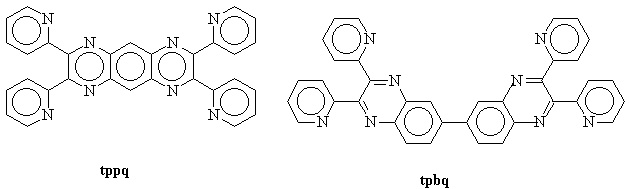
Global awareness has paved the way for various researches in environmental protection programs and one such area is the conversion of carbon dioxide into carbon-based products for the manufacture of fuels and chemicals. The ongoing search for energy efficient catalysts has been the core of this research in which inorganic complexes have played a major role. Rhenium monometallic complexes, among others, have shown unique activity towards CO2 reduction. Further development of multimetallic systems in their capability to store multiple equivalents of electrons is showing great promise in increasing the selectivity of the CO2 conversion processes toward highly reduced products. Recent work in our laboratory focuses on using rhenium(I) metal center in the development of another group of polymetallic catalysts for the electrochemical reduction of CO2. Polypyridyl bridging ligands, which are capable of attaching, one, two, three and four metal centers will be utilized to incorporate rhenium metal centers. In our study, tricarbonylchlororhenium(I) unit (Re(CO)3Cl) is incorporated in the ligands 2,3,7,8-tetra-2-pyridylpyrazino[2,3-g]quinoxaline (tppq) and 2,2’,3,3’-tetra-2-pyridyl-6,6’-biquinoxaline (tpbq). Progress concerning this synthetic design will allow us to extend known electrochemical and photochemical properties of monometallic rhenium(I) in multimetallic systems that may result to unique catalytic activity for CO2 reduction.
TS3 I4
BINDING OF HEAVY METAL IONS WITH ALBUMIN USING MICROCALORIMETRY
AND CIRCULAR DICHROISM
Avigail Caranto, Katherine Miranda, Rex Vergel, Jose Solis and James Villanueva
Institute of Chemistry, University of the Philippines, Diliman
Albumin is a ubiquitous protein known to transport vital molecules in living systems. The role of the protein in transition metal transport has been suggested and recent studies probed the Zn (II) and Cu (II) binding sites in albumin. This study investigates the effect of heavy metals such as zinc, copper and lead on the thermodynamic and binding constant data of albumin using microcalorimetry. Changes in secondary structure were also studied using circular dichroism as a probe.
Knowledge obtained from this study shall be of great value to the research on the regulation of heavy metals in the body by the proteins.
IP1
REDOX POLYMER FILM OF THE FORM, POLY-[Ru(bpy)2(PVP)Cl]: SYNTHESIS, CHARACTERIZATION AND BIOSENSING APPLICATION
Girlie Naomi N. Sison1,2, Jennifer V. Romero1, Janir T. Datukan2 and Gwen Penaflor1
1Institute of Chemistry, University of the Philippines, Diliman
2Natural Sciences Research Institute, University of the Philippines, Diliman
Biosensors known to date are found to improve the accuracy of tests done to quantify the presence of different biochemical species and to increase the rate of analysis of different samples. The effectivity of using metal complexes as redox mediators in these systems can lead to the design and development of analogous amperometric sensors, with applications other than determination of glucose levels. The redox polymer of the form, poly-[RuII(bpy)2(PVP)Cl]X where bpy = 2,2-bipyridine, PVP = poly-4-vinylpyridine and X = Cl or PF6 have been synthesized and characterized. The complex is prepared by covalently attaching a monomeric ruthenium complex to an organic polymer. The chloride salt of the polymer was converted to its PF6 salt to determine differences in polymerization properties. The redox polymer was characterized by electronic absorption and infrared spectroscopy, and cyclic voltammetry. Electrochemical studies have shown that this redox polymer when adsorbed onto a glassy carbon disk electrode is inherently robust and can be used repeatedly without alterations in its redox activity. Initial studies on its function as a redox mediator in a glucose sensor is also being investigated.
IP2
SYNTHESIS AND CHARACTERIZATION OF FREE STANDING SILICA AND ALUMINA MEMBRANES VIA THE SOL-GEL ROUTE
Emmanuel S. Ramos, Girlie Naomi N. Sison, Leonard P. dela Cruz, Emmanuel J. Hernandez, Arlene Aguilar, Leo Lee Bucsit, Marlon Conato, Jason dela Paz, Kosen Exconde, Winelma Garcia, Gail Manalo, Merlyn Monterozo and Jacqueline Siy
Institute of Chemistry, University of the Philippines, Diliman
Free standing SiO2 and Al2O3 membranes were synthesized using the sol-gel technique. Variation of silicon and aluminum source/precursor concentration, pH of solution (catalyst concentration), and DCCA (drying control chemical additive) concentration were investigated. The extent of cracking was monitored as a function of the different parameters. This paper also discusses the possible applications of the product ceramic membranes. Characterization techniques by gas permeation and gas adsorption analysis are also presented and correlated to the sol-gel conditions.
IP3
Chemical Vapor Deposition as a new method in the Synthesis of TiO2/Zeolite Photoassembly using Titanium Tetrakis Isopropoxide as Precursor Molecule
Ronald A. Malicdem1, Christian P. Canlas1, Mayrose R. Salvador1,
Leon M. Payawan Jr.1 and M. Cynthia Goh2
1Advanced Physical Chemistry Research Laboratory, Institute of Chemistry
University of the Philippines, Diliman
2Department of Chemistry, University of Toronto, Ontario, Canada
Chemical vapor deposition was employed as a new method in the synthesis of zeolite supported TiO2 photoassembly. Titanium tetrakis isopropoxide, a commercially available compound, which decomposes as: Ti(O-i-C3H7)4 ® TiO2 + 2H2O + 4C3H6 was utilized as precursor molecule. The compound was deposited at temperature ranging from 300oC – 400oC under a pressure of 400 - 450 mtorr. Deposition time was varied from 1 - 10 hours and calcination was done afterwards. Characterization through UV-Vis Spectroscopy, FTIR (diffuse reflectance mode) Spectroscopy, Atomic Absorption Spectroscopy, and Cyclic Voltammetry confirmed the presence of TiO2 localized inside the zeolite matrix.
IP4
STUDIES ON FTIR BEHAVIOR OF SOME METAL IONS COMPLEXED WITH N-HYDROXYETHYLETHYLENEDIAMINE ENCAPSULATED IN SILICON DIOXIDE
Emmanuel S. Ramos and Roland L. Barbosa
Natural Sciences Research Institute, University of the Philippines, Diliman
The synthesis and chemical reactivity of hybrid SiO2 powders containing the organic ligand N-hydroxyethylethylenediamine (HEED) have been explored.HEED was incorporated into the silica matrix by mixing with the starting solution of a sol-gel process. The porosity of the resulting products allows the interaction of HEED with metal ions. FTIR analysis showed changes in the spectra resulting from the binding of Zn2+, Cu2+ and Fe2+ with N and O sites of HEED. The intensity of the peak observed at 1600 cm-1 at different concentrations of the metal ions were investigated for pattern recognition. When successfully developed, this could be an alternative way of sensing metal species in aqueous medium and could shorten the analysis time of it.
IP5
Efficacy of Metal-Pyrazinamide Complexes Against Tuberculosis
Aaron Joseph L. Villaraza, Jose S. Solis Jr. and James A. Villanueva
Institute of Chemistry, University of the Philippines, Diliman
It has been reported that miners suffering from silicosis still contracted tuberculosis even with regular treatment with anti-TB drugs. The report suggests that there is a link between the presence of inhaled metals and the loss of drug effectiveness. One of the most common drugs for tuberculosis is pyrazinamide. The structure of pyrazinamide shows a great potential for chelation which might explain reduced efficacy among heavy metal exposed people infected with tuberculosis. This study probed the stability of copper and lead complexed with pyrazinamide. Characterization was done using fluorescence spectroscopy and spectrophotometry.
IP6
PHOTOSTABILITY AND ADSORPTION OF A SERIES OF RUTHENIUM(II) POLYPYRIDYL COMPLEXES IN A WIDE BAND GAP OXIDE SEMICONDUCTOR
Girlie Naomi N. Sison and Mishelle Hemandez
Institute of Chemistry University of the Philippines Diliman
Photosensitization of semiconductor particles is found to remarkably increase their catalytic activity towards several organic processes. Transition metal complexes, particularly ruthenium-based, have found application in this research area due to their unique photochemical and electrochemical properties. Studies to establish the photostability of these complexes under ultraviolet irradiation in the absence or in the presence of semiconductor particles, such as TiO2, are known. In our research, ruthenium(II) complexes, [Ru(bpy)2(BL)](PF6)2 and [Ru(o-phen)2(BL)](PF6)2 where BL = 2,3-bis(2-pyridyl)pyrazine (dpp), 2,3-bis(2-pyridyl)quinoxaline (dpq), and 2,3-bis(2-pyridyl)benzoquinoxaline (dpb) are investigated for this purpose. The photochemical and electrochemical properties of these complexes were studied using FT-IR spectroscopy, UV-Vis spectroscopy, fluorescence spectroscopy and cyclic voltammetry. Photostability was established by irradiating these ruthenium complexes in acetonitrile solutions for several hours at 254 nm. Spectral scans showed no evidence for sensitizer photodegradation. Radiation in the presence of TiO2 particles showed no significant change in the electronic absorption spectra. However, a decrease in the absorbance of the complexes in solution and distinct coloration of the semiconductor particles were observed; both of which are evidences for the efficient -adsorption of the sensitizer onto the TiO2 particle surface.