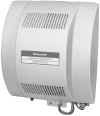
 The
most popular type of humidifiers are the Flow-through
type. Called "flow-through" because a portion
of the air from the supply side of the furnace is
detoured to force it across a wetted humidifier pad. The
humidified air is then routed back to the return side of
the furnace, blended with air from the cold air returns,
heated by the furnace and delivered to the conditioned
space.
The
most popular type of humidifiers are the Flow-through
type. Called "flow-through" because a portion
of the air from the supply side of the furnace is
detoured to force it across a wetted humidifier pad. The
humidified air is then routed back to the return side of
the furnace, blended with air from the cold air returns,
heated by the furnace and delivered to the conditioned
space.
The
most remarkable feature of all flow-through models is
the patented PerfectFloTM water
distribution tray. 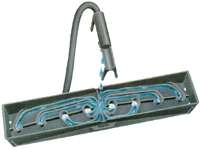 The
tray allows for speedy and complete humidifier pad water
saturation and efficient humidification.
The
tray allows for speedy and complete humidifier pad water
saturation and efficient humidification.
The
unique tray also ensures fast delivery of water to the
humidifier pad assuring that the pad is wet at the start
of the blower cycle and wets the entire humidifier pad
evenly providing optimal evaporation.
Pros:
Like bypass flow-through, powered flow-through are
hard-water tolerant and minimal maintenance - just
change the pad.
The fan
inside a powered unit blows heated supply-side air
across the humidifier pad so its water efficiency is
higher. Powered models can typically produce about one
gallon more humidity per day using the same size
humidifier pad as a bypass model.
The
additional electricity needed to run the fan is minimal
- about equal to a 25 watt light bulb - and could be
more than offset by the energy-savings possible with
lower thermostat setting when the air is kept at an
optimal humidity level.
In addition, powered flow-through humidifiers do not
require a bypass duct, so they can be installed in
tighter spaces. In fact, there is a specific market
niche for powered models - geographic areas like the
Southeast and Southwest where homes are built on slabs
and where HVAC systems are installed in closets, with
minimal room for the mechanicals.
Cons:
Because it includes a separate fan, a powered
flow-through humidifier costs more to purchase and
operate than an unpowered model.


![[Company Logo Image]](_borders/21st_Century_Heating__Cooling_Logo.jpg)