"A Day In The Life"
A Complete Beatles Biography

The year was 1964. The Beatles burst onto the American pop charts and ruled the airwaves. It seemed that these four youngsters from Liverpool, England had come out of nowhere. But behind them lay 8 years of hard work and frequent dissappointment and ahead of them lay the making of the most influential rock album of all time and many more events that would shock the world. There is no doubt about it that John Lennon, Paul McCartney, George Harrison, and Ringo Starr were the most influential and established recording artists ever. The forever changed the worlds of popular, rock, and classical music. I've writen this biography of them by compiling material from books, magazines, word of mouth, other Beatles pages, and my own thoughts and opinions on them. So here it is, the real insight on the greatest band of all-time...
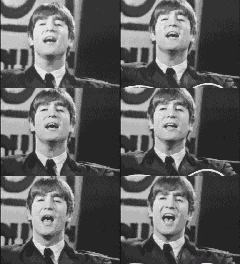
John Winston Lennon was born on October 9, 1940 to Alfred and Julia Lennon. His father was a sailor and who was often away from home. When he was very young his mother Julia decided to send him away to live with his Aunt Mimi. At school John was very outspoken and a troulbemaker.John first developed an interest in music at age 10 when his Uncle George bought him a harmonica. When the skiffle craze hit England in the early 1950s his Aunt Mimi bought him a guitar. He soon went on to form his first band "The Quarrymen".
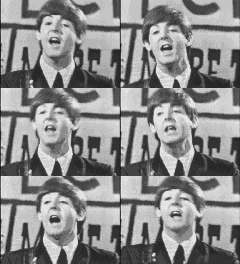
James Paul McCartney was born on June 18, 1942 to James and Mary McCartney. His father James was a cotton salesman who played in a jazz band in his spare time. His mother Mary was a housewife. Everyone called him Paul although his real first name was James. When he was just 13 his mother died of breast cancer. His father bought him a guitar to help him through the sorrow of his mother's death. Unlike John, Paul was reserved, eager to please and a good student.

George Harold Harrison was born on February 25, 1943 to Harold and Louise Harrison. His father drove the bus that George and his classmated rode to school on. His mother Louise was a housewife. To George's teachers he was a very quiet and laid back student who didn't care much about his school-work. George received his first guitar at age 13. Playing did not come as naturally to him as to his friend Paul McCartney but he was determined to become a lead guitar palyer.

Richard Starkey was born on July 7, 1940 to Richard and Elise Starkey. He hailed from a low-class Liverpool neighborhood called the Dingle. His parents divorced when he was 3 years old. He spent most of his childhood in and out of hospitals. During the time that he was sick he learned how to play the drums. When he finally became well again he began playing the Liverpool and Hamburg club scenes and got his stage name Ringo Starr.

The story of the Beatles begins in 1956 when John Lennon and his band "The Quarrymen" were playing at a chruch festival that Paul McCartney happened to be attending. A friend introduced Paul to John. John was impressed that Paul could tune a guitar. Paul was impressed that John had a band. And with that Paul became a member of "The Quarrymen". Soon after a young George Harrison also set out to join "The Quarrymen". He was only 14 however and John saw him as nothing more than a kid but soon he was accepted not only because of his skilled guitar playing but also because his mother could tolerate their noisy rehersals.

The group now consisted of John, Paul, George, and Stu Suttcliffe a friend of John's from art college. He couldn't play a note but was in anyway once he bought a bass guitar with the money he won at an art show. It was at this time that manager Alan Williams began booking groups to two clubs in Hamburg, Germany...the Indra and the Keiserkeller. When they tried out Williams said they could go if they found a drummer. One of the clubs they had been playing was the Jackeranda owned by Mrs. Best whose son was Pete Best who played drums. He was recuited and the group set off for Hamburg. With the new members came changes in the group's name first, Johnny and The Moondogs, then Long John and The Silver Beetles, and finally in 1960 The Beatles.

Hamburg, Germany was the Las Vegas of Europe. There was sex, drugs and alcohol everywhere. The trip hardened them. The group became tighter, and their repetiore expanded they were now professionals. During their time in Hamburg they played a back-breaking scheduele of up to 8 hours a night. Their trip was cut short however when the police found out that George was under-aged and he was deported. A year later in 1961 they returned to Hamburg they made their first record and then only as a back up group fopr their friend Tony Sheridan. The result was an awkward rock n' roll arrangement of "My Bonnie" intended only for German release. More importantly Stu Sutcliffe's dessicion to leave the group to stay in Germany to paint and to be with his German fiancce Astrid.

By the time they returned from Hamburg they were established local stars. When the Cavern Club began booking acts for their lunchtime entertainment the Beatles signed up. The Cavern was a dreary basement club in urban Liverpool. Sweat dripped from the walls shorting out their amps, and people sometimes threw things at them. In time however they were accepted, but playing the Cavern and other clubs had become routine and a dead end. A thrid trip to Hamburg only darkened the group's somber mood. The day before they arrived their friend Stu Sutcliffe died of a brain hemorage. Sad because of their friend's death and bored with playing the same clubs, they needed a miracle.

Help came in the form of Brian Epstein a wealthy upper-class Liverpool citizen. His family had alot of money and his father owned several record shops around the city. Brian went to see the Beatles after a customer requested a copy of "My Bonnie". He was immediatley struck by their beat on-stage and their charm off-stage and offered to mannage them. Brian used his connections to organize auditions for them at some of the major record companies in England. Their audition at Decca was a disaster and time after time they were turned down. So they set their sites on some of the smaller labels and organized an audition with producer George Martin at Parlophone records. Martin saw something in the Beatles that the other record companies didn't and knew they had potential. But their would be one more change before they began recording drummer Pete Best would be replaced by Ringo Starr and they truely became the fab four.

When the showed up for their first recording session the recorded and cut their first single "Love Me Do" which reached a respectable number 17 on the British charts. Martin was concious it was not the hit he was looking for. Then John brought in a song of his called "Please Please Me". Martin wanted to record a song written by a professional song writer called "How Do You Do It". The group resented and when they finished recording "Please Please Me" he presed the intercome button and said to them..."Boys, you've just made your first number one." and he was right. The day after it's release it topped the British pop charts. They then set to work makeing their first album "Please Please Me" which included such classics as "I Saw Her Standing There", "Ask Me Why", and "Twist And Shout". They finished the whole thing in less then 12 hours. The album also shot straight to number 1.

Their next two singles "From Me To You" and "She Loves You" also hit number 1. Despite their success however they continued to play the Caven, but their secret army of fans was growing. They soon had trouble leaving home. So they stopped playing the smaller clubs and soon went on to bigger venues. "Saturday Night At The Paladium" was Britain's most popular televison show and on the night the Beatles played over 15,000,000 viewers tuned in and got their first look at John, Paul, George and Ringo. Their next album "With The Beatles" was preceded with record breaking advance orders. It included such classics as "It Won't Be Long", "Don't Bother Me", and "All My Loving". People couldn't get enough of the Beatles. They had conquered England. America was next.

DJ's in America began playing imported copies of their latest single "I Wanna Hold Your Hand". When the Beatles landed at Kennedy airport in 1964
they were greeted by a mass crowd of fans. Before even setting foot on American soil the Beatles were the country's number one group. At their first American press conference they charmed the press with their charming persona an witty remarks. They then set off to meet the president and play their first American concert at Washington D.C. When the Beatles went on the "Ed Sullivan Show" millions of young Americans tuned in and caught their first glimpse of the group. They headed the largest monopoly of the American pop charts ever holding the top five singles postitions and also the number one and number two album positions. Beatles merchandice was everywhere and they were in constant demand.

When they retured to England in mid 1964 they set to work making their first full-length feature film "A Hard Day's Night". The movies featured John, Paul, George and Ringo being their happy-go-lucky selves, craking jokes and charming the press. Along with the movie the released the soundtrack album which included such classics as "A Hard Day's Night", "If I Fell", and "Can't Buy Me Love". They then set out on their first world tour playing cities across the globe and charming international fans. Ringo was sick and missed 3 quarters of the tour. Soon the Beatles were number one and in constant demand everywhere. The constant touring however was beginning to take it's toll on the group.

In late 1964 they released their fourth album "Beatles For Sale". The war-weary faces on the cover showed how "Beatlemania" was affecting the actual group. The album was mostly comprised of cover song but John and Paul still managed to crank out 6 new Lenn-McCartney originals which included such classics as "No Reply", "I'll Follow The Sun", and "Eight Days A Week". Most of the songs on the album sounded slightly depressed and made Brian Epstein and George Martin wonder how much longer the group could go on like this.

Jumping the gun somewhat Capitol records released the Beatles next single "Ticket To Ride" as being from their new movie "Eight Arms To Hold You". Before the movies release in early 1965 that title was changed to "Help!" The movie was in color and unlike "A Hard Day's Night" it featured the Beatles in fictional sitiuations that took them all over the world. Along with the movie a soundtrack album was also released. The "Help!" soundtrack included such classics as "Help!", "Ticket To Ride", and "Yesterday". The song "Yesterday" was a turning point in their career's. It began as a simple song of Paul's which he palnned to call "Scrambled Eggs". When Martin suggessted that srtings be added to the track it brought about the first departire from the sound they had created up until that point.

By Christmas of 1965 the major changes in the group's style had begun. Their individual writing styles beagn to emerge with John writing more introspective songs like "Nowhere Man", and "In My Life", Paul began experimenting with classical music and sounds, George introduced an exotic Indian instrument called a sitar and was developing as a songwriter, and Ringo was getting songwriting credit. They were moving into their "Peace and Love Phase". Their newest album "Rubber Soul" was writen entirely by themselves with out any covers. It included such classics as "Nowhere Man", "In My Life", and "If I Needed Someone". When Capitol totally re-arranged the album for American release the Beatles were furious and they took the picture of the so-called "Butcher Cover" which was immediatly pulled from the shelves and replaced with a more wholesome cover. The Beatles had gotten their first bad rep.

By 1966 "Beatlemania" had gone from epic proportions to out of control. Their tour of the far east caused riots in Japan when they played a rock concert at a sacred studim. More riots broke out in the Philippines when the group unintentionaly snubbed the first lady. The backlash spread to the U.S. when a reporter for a teen magazine missinterprated John's remarks about the decline of religion. They were receiving death threats and a sniper was caught at one of their concerts. The girls still screamed but the excitment was gone. Their concert at San Fransico's Candlestick Park on August 29, 1966 would be their last. It was the end of an era and the beginning of a new one.

With the release of they're psycadelic singles "Paperback Writer" and it's B-side "Rain" made people wonder where the Beatles were going. Their 1966 album, "Revolver" was a complete departure from the sound the Beatles had been known for. The overall mood of the album is much darker than the light-hearted spirits of "Rubber Soul". Two of the songs on the album "She Said She Said" and "Tomorrow Never Knows" were the results of John's recent expiriments with the wonder-drug LSD. They began to use more advanced studio techniques to get the sounds that they wanted. This album was a major achivement for them and would pave the way for the "Sgt. Pepper" album.

In Novemeber 1966 they returned to Abbey Road studios to record their follow-up album to "Revolver". They planned to do a theme album about their childhoods but when Capitol demanded a new single from them the first two songs recorded "Penny Lane" and "Strawberry Fields Forever" were hastily released and with for the first time ever a Beatles promotional film for each. Along with their changing sound they changed their images as well, leaving behind their mop-tops Paul and Ringo had grown long sideburns and moustaches, George had grown a full beard, and John had also grown a moustache and addopted a pair of small round granny-glasses which would become his trademark. The public thought that the idea of the Beatles having facial hair was a sign that the group was going crazy and about to break-up. The press had a field day when "Penny Lane" failed to make number 1 on the U.K. charts. Everyone was begining to wonder weather they were drying up....ha!

In 1967 they released "Sgt. Pepper's Lonley Heart's Club Band" the single most influential and talked about album in pop/rock/and classical history. Every song on the album had a story to tell and was a classic in it's own. Graphic design, style, additude, and the recording buissiness itself changed rapidly after "Sgt. Pepper". Other bands raced to make their own "Sgt. Pepper" style albums. Nothing that they could dish out remotley compared with the album. The four lads from Liverpool England were once again on top of the world and ahead of the game. The album was a work of art. The Beatles had reached the top they had finally made their masterpiece!

The Beatles had reached the top and there was no where to go but down, but the Beatles could not go down. It was an idea of Paul's to make the film "Magical Mystery Tour". The idea was to put together a group of their close friends and put them on a bus that would take them on trip across the Engish countryside and to film whatever happened. Nothing did. The critics hated it and for the first time people began to realize that the Beatles were truely human and capable of doing wrong. It was in late 1967 that George became immersed in the teaching of the Maharishi Mahesh Yogi. When the Beatles traveled with him to India he convinced them that they could find iner peace with him and truely find their purpose in life. Just when everything seemed to be going well for them their manager Brian Epstein was found dead in his appartment of a drug overdose. The man who had given them their start and who had faith in them when no one else did was gone.

When they returned to England in 1968 they laid out the plans for a new record label run by the Beatles themselves called "Apple Records". When Paul arrived at a party with a song he had written called "Hey Jude" they knew they had another hit on their hands. The single was their biggest selling ever and proved the value of "Apple". Their second trip to India with the Maharishi ended with a press conference announcing their break with the spiritual leader. While in India John and Paul had written a back-log of over 30 songs, George and Ringo were also busy composing. "The Beatles" a.k.a. "The White Album" was ready for release. The album showed that the Beatles were breaking apart. Their indiviual styles took over and they weren't terribly interested in what the others were writting anymore. The new presence in the studio of John's Japanese lover Yoko Ono was adding to the tension. Still the album went to numer 1 and stayed there for several weeks.

After the release of the "White Album" only one element of Brian Epstein's managment remained. A project that the Beatles feared would ruin them...appearing in as cartoons in a movie. The movie "Yellow Submarine" was losely based on a song from their 1966 album "Revolver". The Beatles themselves had little to do with making the movie besides the fact that their songs were in it but nevertheless, the movie was an instant success and made up for alot of heat the group had taken from their "Magical Mystery Tour" project.

They planned to call their next project "Get Back" in an attempt to get back to their rock n' roll roots and to include a documatary to show the public just how a Beatles ablum was made. What the movie did show was how the group was breaking apart. Paul began asserting himself more as the leader, John would go wandering off with Yoko, George would say he wouldn't be coming in the next day, and Ringo even quit the group for a week because he was fed up with Paul. The movie was released and called "Let It Be" but the album was put on hold because no one, not even George Martin wanted to sort through the miles and miles of tape.

In early 1969 it was clear "Apple" was going sour. Money was being spent and watsed everywhere. Paul wanted to bring in his new in-laws Lee and John Eastman to work out the financial problems, but the rest of the group voted against it and brought in the former manager of the "Rolling Stones" Alan Klien. Klien convinced the group that they had been totally mis-managed by Brian Epstein. His first plan of action was to hire famed American producer Phil Spector to sort through the "Let It Be" studio tapes and make an album. Fearing that the group would soon break up Paul called up George Martin and said it was time to make one last album as a sort of shot at redemption in order for everyone to make peace. "Abbey Road" was the Beatles most polished production to date and pretty much closed the door on the entire Beatles saga. John, George, and Ringo had all planned to quit the group only to be coaxed back by Paul. This time it was his turn, on April 4, 1970 with the release of his solo album "McCartney" the Beatles were officially no more. The 70s would go on without them, only to feel their influence. Fromthe moment that the Beatles broke up everyine wondered if there would ever be a reunion. Their hopes were shattered on December 4, 1980 when John Lennon was assasinated in front of his New York apartment. The man who had preached "All You Need Is Love" to the world had died by the gun.

A Beatles reunion did however finally take place in 1995 when ABC arried a the three-part "Beatle Anthology" as well as release three anthology albums with for the first time in 25 years two new Beatles recordings "Free As A Bird" and "Real Love". It proved once again that the Beatles would go down in history as the greatest band ever!
<-------Get Back
