|
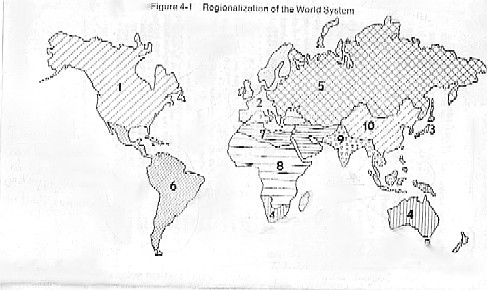
Regional Blocs, A World Without Nations?
10 SPHERES OF INFLUENCE -- NATIONAL REORGANIZATION
It is worth noting, the limits have shifted
according to the emerging spheres of influence since
1975. Also the blocs are to be merged with each other. Regionalism and Informal Multi-lateralism A workable system of international economic governance is not solely based on global arrangements. Many tasks can be carried out between neighbours. So far, only the European Union has created both a durable system of regional trade liberalization and a strong commitment to political co-operation, but others may well follow. Regional integration is currently receiving much attention elsewhere, especially in the Americas and South-east Asia, though it has made little progress in Africa and South Asia. Some issues are best dealt with regionally rather than globally (localized spillovers of pollution, for example). Regional economic groups can also contribute to burying historic enmities through developing closer economic and political linkages, realizing economies of scale, developing common infrastructure, and pioneering new methods for deepening integration in advance of progress at the global level. As noted, the concept of subsidiarity being vigorously debated in Europe provides a framework for allocating responsibilities between institutions of global, regional, national, and local governance in an efficient way. For regional institutions to form building blocks for global economic governance rather than exclusive 'blocs', they should also be open--both in offering membership on the same terms as existing members and in regard to market access. There is a fine line between the degree of exclusivity needed to create a regional identity and that which creates division. The European Union has many features of openness, especially now that it is being enlarged; but some other features, such as the Common Agricultural Policy, are protectionist and divert trade. The advocates of 'fortress' Europe are a minority, but they are not insignificant. Although regional arrangements can strengthen global economic governance, the wrong kind of regionalism can weaken it. Much governance can and does informally take place through groups of countries such as the G7, the OECD, or the Commonwealth. The G7 is a significant development and its role is discussed further later. The OECD has played a major role in developing principles to govern the behaviour of international investment, environmental management, and export credit. And it is now reaching out to a wider number of countries through enlargement and dialogue. Several functional, specialist institutions should also be mentioned, such as the International Telecommunications Union (ITU), the International Maritime Organisation, the Bank for International Settlements (BIS), and the Paris Club. ITU has responsibility--now shared with GATT--for creating a regime of global governance for the rapidly expanding, interconnected network of telecommunication, multimedia, and information technology systems. BIS provides the world's financial system with an underpinning of co-operative supervision. In these quiet, unspectacular ways, a system of global governance is being put in place, albeit on a piecemeal basis. Global governance is not, however, only a public sector activity. Multinational companies account for a substantial and growing slice of economic activity. Some centrally important industries--notably the complex of activities variously described as telecommunications, information, or multimedia; automobile production; banking and other financial services--are being developed largely through private companies that operate on a multinational basis. Their concerns are necessarily with the totality of their business operations rather than with any one country. We discuss later in this chapter the checks and balances that have to be established to ensure that business operates, at a global level, within a wider frame." More info coming soon. |