
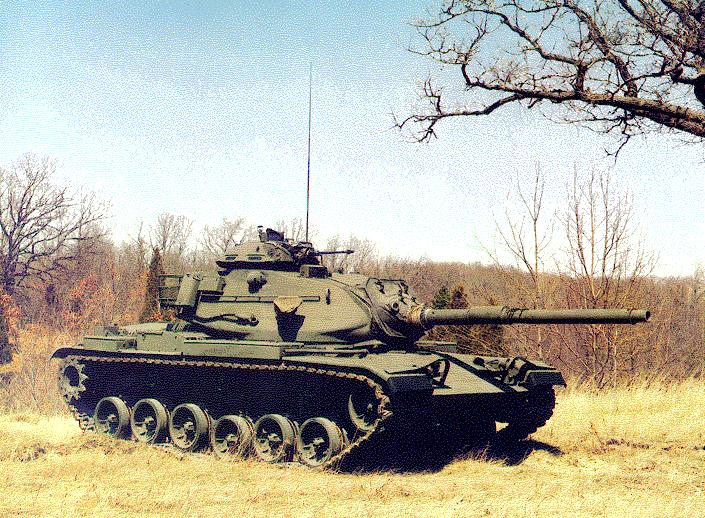
The M60 series tank succeeded the M47 and M48 Series. The improved design provided an increased operational range and mobility, requiried a minimum of refueling and servicing, and incorporated an improved main armament. A Continental V-12 750 hp. air cooled diesel engine powers the vehicle. Power is transmitted to a final drive through a cross drive transmission, which is a combined transmission, differential, steering, and braking unit. The hull of this vehicle is a one piece steel casting and is divided into two compartments, the crew in the front, and the engine at the rear.
The M60 Patton main battle tank is now primarily found in US Reserve and National Guard units, but served as the primary US main battle tank for two decades prior to the introduction of the M1. Developed from the M48 Patton series, the M60 was fitted with a 105mm main gun and manned by a four-man crew. Criticized for its high profile and limited cross-country mobility, this durable tank proved reliable and underwent many updates over its service life. Rarely has one vehicle type labored as the principle main battle tank for as long as the stalwart M60. The interior layout, based on the excellent designof the M26/46/47/M48, provided ample room for updates and improvements, extending the vehicle's service life for over four decades.
In the early 1950s, reports from British intelligence indicated the Soviets had developed a new heavily armored medium tank, the T-54. This new tank was armed with a 100mm gun, superior to the American M48 medium tank, which used an old 90mm main weapon developed in WWII. In response, the US developed a strategy to bring the M48 up a level to compete with the new Soviet tank -- the M60. Initially produced in 1960, over 15,000 M60s were built by Chrysler and first saw service in 1961. Production ended in 1983, but 5,400 older models were converted to the M60A3 variant ending in 1990. This tank saw action with the Israeli forces during the Yom Kippur War in both the Sinai and the Golan Heights.
Besides its main gun, the M60 series tanks are equipped with a 7.62mm M240 coaxial machine gun and 12.7mm M85 antiaircraft gun. Power is provided by a Continental AVDS-1790-2C 750 hp V-12 engine and an Allison CD-850-6/6A powershift crossdrive transmission. The first M-60s retained a turret similar to the M-48, but had a revised hull with better ballistic protection. The M60 tank hull was designed with a unique rounded boat shape, made from five cast pieces that combine to provide excellent ballistic protection for the four crew and equipment packed inside.
The army ordered the M60 into production in 1959 and the first M60s entered service with U.S. Army units during the fall of 1960. Most of the initial production vehicles were sent to Europe to offset the Russian T-54, then coming into widespread service with Warsaw pact armies.
Going into Desert Shield, the Marines' main battle tank was the M60A1, an improvement, several generations removed, of the M48 tank of the Korean and Vietnam wars. Retrofitted with applique armor, it is considered roughly equal to, if lesser-gunned than the best tank in the Iraqi inventory, the much-vaunted Soviet T-72. During Operation Desert Shield/Desert Storm the 1st Marine Expeditionary Force fielded 210 M60A1s to support the Saudi-Marine effort into Kuwait City.
Production of the M60A2 began in 1974. It featured a 152mm Shillelagh gun/missile system (with 13 missiles and 33 rounds). This new tank with a smaller turret was developed in the 1960s, but was not contracted until 1971, when the Army agreed to purchase 526 rebuilt vehicles with the new turret. This became the M-60A2 (the "A-deuce"). Armed with a revolutionary 152mm gun-launcher system, the A2 was also equipped with one of the first laser rangefinders ever fielded.
The gun-launcher could fire conventional ammunition with a fully combustible charge, or the Shillelagh laser guided missile. Shillelagh was designed to be the main armament for armored combat vehicles. The Shillelagh was a direct fire missile which was launched from a combination gun-launcher and was effective against tanks and fortifications. Its 152mm gun-launcher could fire either missiles or conventional ammunition. The missile was about 45 inches long, about six inches in diameter, weighed 60 pounds. This surface-to-surface missile system was designed to be carried on tanks and light armored assault vehicles. After being fired the missile could be guided to the target by a command system mounted on the launch vehicle. The gunner has direct command over guiding the missile to the target.
Specifications | |||||||||||||||||||||
| Weight | 60 tons | ||||||||||||||||||||
| Length | 32'4" | ||||||||||||||||||||
| Width | 13'6" | ||||||||||||||||||||
| Height | 12'6" | ||||||||||||||||||||
| Ground Clearance | 18in | ||||||||||||||||||||
| Track Width | 28in | ||||||||||||||||||||
| Forward speed | 30 mph | ||||||||||||||||||||
| Reverse speed | 10 mph | ||||||||||||||||||||
| Engine | 750 hp Continental AVDS-1790 V-12 diesel | ||||||||||||||||||||
| Vertical obstacle climb | 49 in | ||||||||||||||||||||
| Maximum width ditch | 108 in | ||||||||||||||||||||
| Fording Depth | 48 in | ||||||||||||||||||||
| Main Gun | 105mm/51cal M68 rifiled gun with 63 rounds | ||||||||||||||||||||
| Coaxial machinegun | M240 - 7.62mm with 5,950 rounds | ||||||||||||||||||||
| Commander's machinegun | M85 - .50 cal antiaircraft gun with 900 rounds | ||||||||||||||||||||
| Sensors and Fire Control | M21 solid state along ballistic computer, AN/VVG-2 ruby laser rangefinder usable by both commander and gunner, AN/vsg-2 Tank thermal Sights (TTS) withlaser rangerfinder and Mercury-Cadmium-Telluride (HgCdTe) IR detector for passive night and dust vision | ||||||||||||||||||||
| |||||||||||||||||||||
