
Pike County Federation of Sportsmen's Clubs
North American Porcupine
Erethizon dorsatum
The North American Porcupine (Erethizon dorsatum) is second only to the beaver as the largest rodent in North America. Known for their infamous quills, porcupines are quite gentle and will usually try to avoid contact with potential threats.
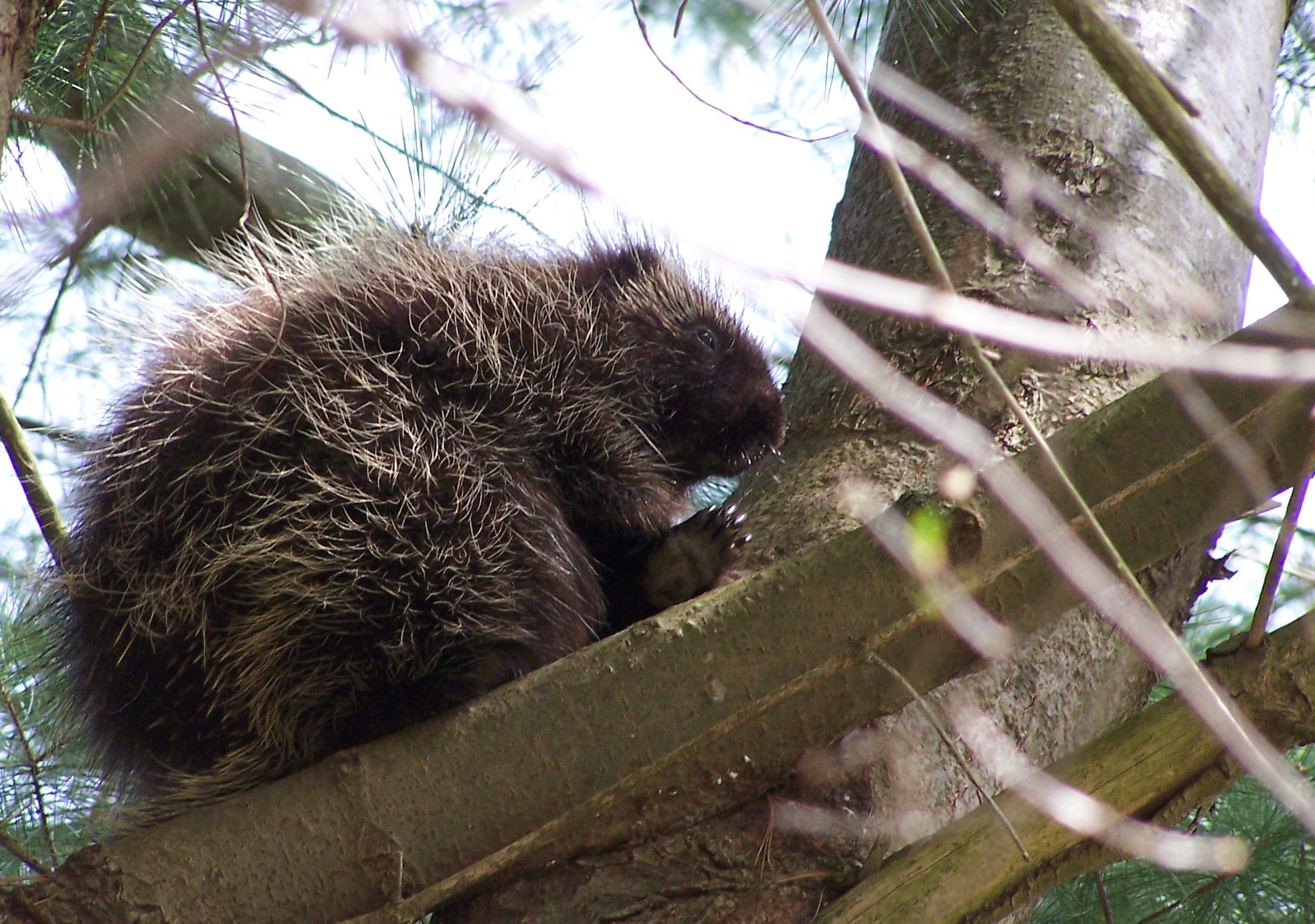
Although porcupines are dark brown to black in color, their quills make them appear somewhat grayish. The mature animal may be as long as 32 inches in length with an 8 inch tail. They are generally nocturnal but may occasionally be seen going about during the day. Usually though, daytime finds them resting in trees.
In the summer, porcupines eat buds located at the tips of tree branches. They are particularly destructive to apple trees often to the consternation of apple farmers. In the winter, porcupines eat pine needles and bark often damaging the trees. For that reason, many farmers and foresters look for ways to control porcupine numbers.
Porcupines have a love for salt. At various times of the year they may be found chewing on boards. Plywood which often has sodium added during the manufacturing process is especially vulnerable as are tool handles that may have been held by sweaty hands. Hunters often arrive at hunting camp only to find that porcupines have chewed into their cabin looking for cooking salt. The love of salt is often their downfall. Millions of porcupines are killed on highways each year while licking up road salt.
Because porcupine damage can cost land owner's millions of dollars each year, porcupine numbers must be controlled. Pennsylvania has been reintroduced the fisher (a large member of the weasel family) to various parts of the state in hopes of controlling their numbers.
Up to three inches long, the Porcupine's infamous quills are just modified hair. Hollow and barbed at the tip, they disconnect from the porcupine after being impaled in a predator. Contrary to popular belief, porcupines can not throw their quills. When threatened, the porcupine turns away from the predator. It covers its relatively unprotected head with its paws and slaps at the predator with its tail. Whether the predator gets the quills from the porcupine by a tail slap, or by attempting to bite or swat the porcupine's body, one thing is certain ...messing with a porcupine is a mistake, one that could cost the predator its life! While the quills do not kill the predator, animals with quills in their face are often left unable to eat resulting in death by starvation. Quills in other parts of the body may result in fatal infections.
Fishers are the one animal that regularly prey on porcupines. The fisher has learned to flip a porcupine over and to attack its unprotected underbelly. Being arboreal, the fisher need not wait for the porcupine to come down from its tree. The fisher can easily climb and pursue its meal above ground..
Porcupines mate in the fall and the young are born in the Spring. Usually single baby is born. Its quills are soft to avoid injuring its mother. Within hours, they will harden producing protection similar to that of an adult's, albeit on a smaller scale. The mother cares for its young and although it may begin eating solid food within two weeks, the mother will continue to nurse it for up to five months. The baby will leave its mother well before the next mating season.
Porcupines are quite clumsy. They like to eat buds found at the tips of tree branches. This combination results in many falls over the animal's lifetime. Examination of porcupine skeletons find that most animals have had several broken bones. Porcupines may also impale themselves with their own quills. Unless the quill punctures a vital organ, the porcupine will usually live. This is because their skin secretes a natural antibiotic which prevents infection as the quill works its way through the porcupine's body.
Pike County residents looking for porcupines could find one just about anywhere. They are somewhat common in the forest, but may occasionally be found in residential communities. Your odds of finding one will be increased if you seek out an area with fresh sign. Look for trees with a large area of bark freshly chewed away near its base. Scan the nearby tree tops and you may find one. Porcupines may also be found along roads at night in the Spring. Avoid major roads where it is not safe to stop. Keep your distance! Porcupine quills can be quite nasty and you will be very embarrassed if you have to go to the emergency room for removal.
