Jason's Punk History Page 1

 INTRODUCTION
Punk has often been called the "cutting edge" of modern rock & roll; it has clearly been
the most fully developed subculture of youth rebellion in America since the late 1970s.
Punk is really a state of mind, an attitude, a world-view. It is from the earlier sense of
the word "Punk" as "a young outlaw, a juvenile delinquent, a young hooligan or
troublemaker" that this term came to be applied to a musical genre, starting in New York
at the end of 1975 and spreading around the world since then. But the history of Punk
includes much more than music; there have also been punk art, punk film, punk video, punk
comics, punk athletics, punk fashion, punk politics, and even punk comedians.
Chapter 1: CBGB's: The Birth Place Of Punk Rock
New York City club/bar CBGB's is known to true punks as the birthplace of punk, and since 1973, when Hilly Kristal agreed to let Tom Verlaine and his band Televisio
CHAPTER 2: PUNK ROCK
Musically, Punk tends to be fast, loud, raw, and extremely energetic, simply structured,
at its best when performed live, and typically featuring bands with a singer, one or two
guitarists, a bassist, and a drummer. However, there are many variants on this description
and exceptions are not uncommon. Lyrics tend to be very important though they often cannot
be deciphered without a text. Places to perform are small clubs, rented halls, private
parties, and occasionally theaters; all-ages shows are common, featuring 3 to 6 bands for
$5 or so.
Punk rock is divided into several subgenres: HARDCORE, dominant through the 1980s,
American in origin, extremely fast and accompanied by slam-dancing, with lyrics often
shouted; CLASSICAL, more melodic and not quite as speedy, characteristic of the "first
wave" of the 1970s in the USA and England; OI!, British in origin but now widespread in
America, melodic and featuring choral chanting; THRASH/SPEEDCORE, with definite influences
from heavy metal and growling vocals; ART/INDUSTRIAL/NOISE, experimental and diverse; and
others. FUNNY PUNK, humorous or satirical bands such as The Dead Milkmen , was once common, but is now harder to
find.
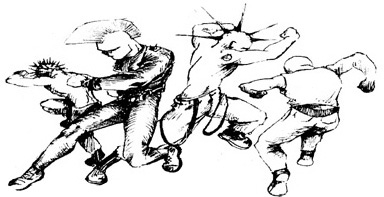
The "classic" punk dance is the POGO, characterized by jumping up and down to the beat,
but Hardcore brought SLAMMING, a much- misunderstood phenomenon — perhaps describable as a
mixture of football, circular folk dancing, Sufi whirling dervishes, drunken brawling,
spinning, amusement park bumper cars, and going over Niagara Falls in a barrel. It has
since been picked up by other musical genres. Diving head-first from the stage into the
mass of tightly-packed bodies, STAGE-DIVING, is usually part of it. Not for the faint of
heart, but tremendously exhilirating, the wildest, freest form of dancing in America. The
ignorant misuse it as an excuse to fight, but if anyone falls down, everyone around him
stops and helps him back up. Stage-diving is a true "leap of faith" and to be caught is to
know what community support is. You have to see it to believe it!
Punk is basically grass-roots minimalist and anti-elitist: "Anyone can play in a punk
band." Bands produce cassettes, records, and CDs, selling them by themselves locally or
through small independent record companies and distributors. Some go on to "major label"
companies (which most Punks consider "selling out" and no longer punk) but Punk is
generally set against the commercial music business and commercial radio with its
homogenized corporate bands, avoidance of controversy and social criticism, and
lowest-common-denominator values.
Punk already has a considerable history. It arose at New York City's small but legendary
club, CBGB's, at the end of 1975; spread to England and California in 1976, to Canada,
Australia, and other parts of America in 1977, and grew internationally in the 1980s until
it is now found all over Europe, South America, Japan, and many other countries. Many of
its values and features have diffused into other musical genres, from synthesizer
electro-pop to rap, and many bands with punk roots have attained worldwide fame.
CHAPTER 3: THE PUNK SUBCULTURE
Disdaining commercial media, American Punk has developed its own totally uncensored media
network, featuring university radio stations and many hundreds of non-commercial
publications, PUNKZINES. These range in circulation from a hundred to nearly 20,000 (with
a much higher readership due to pass-ons); most are locally oriented but some are national
or international. They rely on unpaid fans as staff. "Do it yourself!" is a punk slogan;
everyone with something to say is encouraged to express himself and put out music or a
zine, even if it is handwritten and photocopied. Zines tend to include cartoons, photos of
bands, drawings, collages, politics, articles critical of society, gossip and news as well
as music reviews, interviews, and "scene reports"; some are literary as well and many
carry poetry and editorials. A growing number of punk books have also been published. In
recent years, the punk presence has also been growing on the Internet.
Punk fashion, such as it is (and many Punks are anti-fashion) is characterized by the
color black, leather jackets, studs, chains, heavy work boots, and short or unusual (such
as mohawk, spiked, and skinhead) haircuts. Sometimes the hair is dyed unusual colors. Band
stickers and punk slogans distinguish punk leather jackets from those of other
subcultures. Appearances, however, are diverse, not uniform: clothes do not make a Punk.
As a subculture, Punk vibrates around a fascinating, creative, dynamic tension between the
values of community and of individualism. It is a society of non-conformists, encouraged
to "Think for yourself!" but support each other. It is a very colorful collection of
alienated youths (and some longer in a body) with often conflicting viewpoints, struggling
to strengthen their common bonds and preserve their differences at the same time. Punk is
relentlessly realistic, yet idealistic to the bone. It is a home for self-chosen misfits
and other social outcast(e)s which must constantly deal with the few who would abuse its
great freedom. The transmitters of Punk's ethos (its perspective, values, attitudes,
customs, traditions) must constantly struggle to educate the successive waves of
newcomers, many attracted by sensational accounts in the mass media, others crossovers
from heavy metal, to its own radically different values.
Whenever a new trend sweeps through the Punk scene, Punk's own rebel resistance to all
forms of homogenization immediately stimulates an opposition to the trend; thus diversity
is preserved. Some of the major currents in the subculture at this time are anarchist
politics, skateboarding, vegetarianism, alcohol, psychedelics, "straight edge" opposition
to the preceding two, squatting, animal rights, feminism, anti-rascism, and
internationalism.
CHAPTER 4: THE PUNK ETHOS
What is the Punk ethos? There is great variation, of course, and perhaps no single Punk
matches the pure archetype, but in general Punk seems to have these characteristics:
It is passionate, preferring to encounter hostility rather than complacent indifference;
working class in style and attitude if not in actual socio-economic background; defiant,
unconventional, bizarre, shocking; starkly realistic, anti- euphemism, anti-hypocrisy,
anti-bullshit, anti-escapist, happy to rub people's noses in realities they don't wish to
acknowledge; angry, aggressive, confrontational, tough, willing to fight — yet this stance
is derived from an underlying vulnerability, for the archetypal Punk is young, small,
poor, and powerless, and he knows it very well; sceptical, especially of authority,
romance, business, school, the mass media, promises, and the future; socially critical,
politically aware, pro-outlaw, anarchistic, anti-military; expressive of feelings which
polite society would censor out; anti-heroic, anti-"rock star" ("Every musician a fan and
every fan in a band!"); disdainful of respectability and careerism; night-oriented; with a
strong, ironic, satirical (often self-satirical), put-on-loving sense of humor, which is
its saving grace; stressing intelligent thinking and deriding stupidity; frankly sexual,
frequently obscene; apparently devoted to machismo, yet welcoming "tough" females as
equals (and female Punks are often as defiant of the males as of anyone else) and
welcoming bisexuals, gays, and sexual experimentation generally; hostile to established
religions but sometimes deeply spiritual; disorganized and spontaneous, but highly
energetic; above all, it is honest.
"Punks hang out wherever they're not thrown out!" We love to criticize each other, but
stick together in the face of common hostility from the rest of the world. Being Punk is
an adventure. Punks are outcastes by choice, by habit, or by necessity, being sick of the
real values of the social order. We are contemptuous of a majority which Punks criticize
as manipulated by the mass media, unthinking, unaware, sleepwalking through life,
conformist, fashion-controlled sheep who are being led to subtle economic slavery and
martial slaughter.
Punks may not be able to change the world, but we are dedicated to creating an island of
freedom, a community of dissent and experimentation, and we are determined not to go down
with our sinking civilization without a howl of protest and an angry fist shaking and
hurling curses at the inhuman gods above.
BACK NEXT
Email: jfowler@stwconn.com