Types of Roller Coasters
There are two main types of rollercoasters, defined by their building structure. While both are quite similar in many ways, the each have a unique sensation that is not found on the other.
Wooden coasters
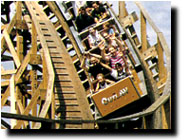
Wooden roller coasters tracks resemble train tracks. The are flat metal and are about 10 to 15 cm wide. The metal is bolted to the wooden structure of the coaster. As the tracks are similar to a train, so are the wheels. The inner part of the wheel has a wide lip which keeps the train on track. It also has another set of wheels placed underneath the track to keep the cars firmly planted.
Wooden coasters are braced by wooden supports, which support the entire structure. It is possible to create a wooden coaster which goes upside down, but this is very rare because of the inflexability of wood. Because of this, the motion of wooden roller coasters in mainly up and down.
Tubular steel coasters
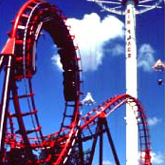
Tubular steel coasters were invented in the 1950's. Their tracks are made up of 2 long steel pipes, which are supported by a lightweight structure, also made out of tubes. The wheels used on these coasters are generally larger then the tubes and made out of synthetic materials such as nylon. Steel coasters a have 3 sets of wheels, one set on the track, one on the tudes, and one down the sides. Steel coasters are made in large curved pieces, which allows a much smoother ride and is able to move in all directions.
There are many variation to the steel design. The seating can be placed the traditional way, on top of the track or can be attatched by the top of the seats, and swing from a pivoted joint. These type of coasters are refered to as susupended coasters and add a side to side motion to the ride. Inverted coasters are much like suspended coasters but the seat do not swing back and forth.

Suspended coaster
|

