
Here's a potential routing for a freeway that would run from the Portland metro area, over the Cascades to eastern Oregon and finally south down to a junction with I-5 in California. I would designate it I-7 due to its location within the grid of interstates and the fact that the length of about 355 miles justifies a 1 or 2di. Most likely what will happen is this corridor will slowly get upgraded with more areas of passing lanes with the larger population centers getting limited access expressways, but not necessarily to interstate grade. Being that freeway and expressway are dirty words in environmentally conscious Oregon, most likely sections of roads that get upgraded will become parkways or greenways in order to cut costs and the amount of right of way necessary. While I think that would suffice, it is critical to not allow businesses to build right alongside the road or sprawl to congest the roadway.
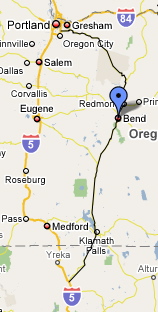
The freeway would begin along the proposed Sunrise Corridor that is currently in the works. Right now the only plan is to make it a freeway from I-205 to Rock Creek Junction, but it would be a good start for a freeway leading over the Cascades. At first the road would parallel OR 212, but would start to run along the same route/parallel the existing US 26 route. Sandy is planning on getting a bypass which would be a possible routing of this freeway.

The northern portion of this freeway would probably have to be on a new alignment separate from existing US 26, while once over the pass it would be easy to add another set of lanes side by side with the existing route. Having a true freeway or even expressway through a pass would be very expensive and probably the last thing upgraded. In the interim, I expect to see ODOT slowly put in more climbing lanes to allow faster moving traffic to pass freight trucks as well as RV's. This would pass through the Warm Springs Indian Reservation and I am unsure of how difficult it would be to expand a roadway on those grounds.
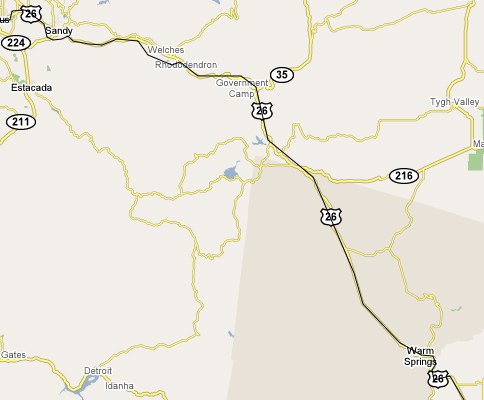
At this point the freeway would transition from the routing of US 26 to US 97 as it bears more south. This is stretch of road I expect to eventually see as an expressway/freeway due to the heavy volumes of local and tourist traffic. Redmond is in the process of having a re-routing of US 97 put in, but I think this bypass does not start and end before the sprawl of businesses that line the existing highway. There is talk of a Madras bypass, but I am not sure about the location of it in relation to the city and how limited access it will really be.

US 97 between Bend and Redmond is an expressway with a few roads that turn come off the main road, but does have a couple of exits and overpasses. This existing alignment could be upgraded to a freeway if these at grade intersections are removed and perhaps a frontage road is installed to handle them. Traffic along this route already travels at speeds well in excess of the speed limit of 55 mph, which leads to unsafe conditions when cars make entering the road come on from a standstill and a 90 degree turn. Before the Bend Parkway US 97 gets cluttered with lots of big box retailers and a shopping center. A refinement of this area to include extending the Parkway in such a manner to avoid any more stoplights and at grade intersections is in the works. Just south of the Bend Parkway, US 97 is an expressway with very few roads connecting to it. What's unique about this stretch of road is that there is a jersey barrier down the center until about the point where it becomes a 2 lane rural highway again. Again, a frontage road would solve access issues to a freeway here. In the near future, US 97 will probably become a four lane highway from Bend to Sunriver, and possibly go as far south as LaPine.
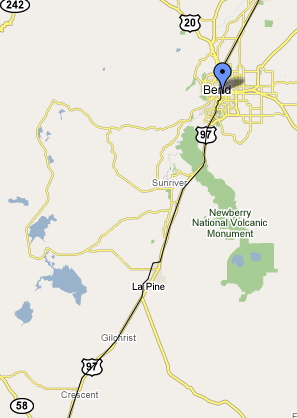
South of LaPine US 97 only passes through small mostly unincorporated communities. There are already lots of area where the road expands to four lanes to allow passing, but then shrinks back down to two. At this point there is less tourist traffic and more truck traffic. A freeway in this area would also benefit travelers going to Crater Lake without infringing upon the National Park grounds. US 97 hugs the banks of the Upper Klamath Lake, and this is an area where I can see a limited access highway either completely deviating from the current routing or else it would require significant blasting to and earth movement to provide the space for four lanes along the shores. Klamath Falls already has a bypass, but I believe it is only a super 2 highway. While this current bypass could be expanded, I would imagine a whole new highway alignment would be created to either the eastern or western side of the city.

The freeway would continue to travel along more or less the same path as US 97 as it enters California, and would intersect with I-5 after passing through Weed. Most likely it would only be a high speed directional interchange with southbound traffic having to exit this freeway and taking surface streets if they intend on going northbound on I-5.

I doubt a freeway like this will come about, and if it does it will not be for some time. The political will is just not there and many obstacles are in the way. The smaller communities may complain of the high speed traffic that routinely barrels through the main street of their towns, but they also don't want to be bypassed for fear of loss of business. I do feel that here is a need for a freeway more or less along this alignment and this US 26 to US 97 corridor is only going to get worse. As I wrote in each section, the the stretch from about south of Bend up to north of Redmond and even to Madras will become limited access in some manner to cope with the explosive population growth in the region.
Home

