Jack Lemmon
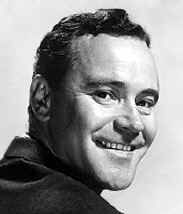
Born in 1925, the son of a Boston doughnut company executive, Jack Lemmon was educated at Phillips Andover Academy and taught himself to play piano as a teen. A budding thespian by the time he entered Harvard, he was elected president of the famed Hasty Pudding Club. After his college career was briefly interrupted by a stint in the Navy at the end of World War II, Lemmon graduated from Harvard and headed to New York to pursue acting. Supporting himself by playing piano in a bar and for silent movies, he soon began to land acting jobs in radio, theater, and TV. By the early '50s, Lemmon had appeared in hundreds of live TV roles, including in the dramatic series Kraft Television Theater and Robert Montgomery Presents, as well as co-starring with first wife, Cynthia Stone, in two short-lived sitcoms. After Lemmon landed a major role in the 1953 Broadway revival of Room Service, a talent scout for Columbia Pictures convinced the actor to try Hollywood instead. Defying Columbia chief Harry Cohn's demand that he change his last name lest the critics take advantage of it in negative reviews, Lemmon quickly made a positive impression in his first film, the Judy Holliday comic hit It Should Happen to You (1954). Essaying such roles as one of the suitors in the musical My Sister Eileen (1955) and a beatnik warlock in Bell, Book and Candle (1958), Lemmon became a reliably nimble comic presence at Columbia. A loan out to Warner Bros. for the smash Mister Roberts (1955), however, truly began to reveal his ability. Drawing on his Navy memories to play the wily Ensign Pulver, Lemmon held his own opposite heavyweights Henry Fonda and James Cagney and won a Best Supporting Actor Oscar for his fourth film. A free-agent star by the end of the 1950s, he began one of his two most auspicious creative collaborations when writer/director Billy Wilder tapped him to play one of the cross-dressing musicians in the gender-tweaking comic classic Some Like It Hot (1959). As enthusiastically female bull fiddler Daphne to Tony Curtis' preening Lothario sax player Josephine, Lemmon danced a sidesplitting tango with millionaire suitor Joe E. Brown and delivered a sublime speechless reaction to Brown's nonchalant acceptance of his manhood.

Jack with Walter Matthau and Sophia Loren in "Grumpier Old Men".
Fresh off a Best Actor nomination for Hot, he then gave an image-defining performance in Wilder's multiple-Oscar winner The Apartment (1960). As ambitious New York office drone C.C. Baxter, who climbs the corporate ladder by loaning his small one-bedroom to his philandering bosses, Lemmon was both the likeable cynic and beleaguered romantic, perfectly embodying Wilder's sardonic view of a venal world. Though he lost the Best Actor Oscar to Burt Lancaster, Lemmon's turn as the put-upon quotidian schnook pervaded the rest of his career. Determined to prove that he could play serious roles as well as comic, Lemmon campaigned to play Lee Remick's alcoholic husband in Blake Edwards' film adaptation of the teleplay Days of Wine and Roses (1962). Revealing the darker side of middle-class desperation, Lemmon earned still more critical kudos and another Oscar nomination. Despite this triumph, he returned to comedy, re-teaming with Wilder and The Apartment co-star Shirley MacLaine in Irma la Douce (1963). Though the love story between a Parisian prostitute and a cop-turned-lover in disguise was a lesser effort, Irma la Douce became a major hit for the trio. Continuing to display his skill at offsetting his characters' unseemly behavior with his innate, ordinary-guy affability, Lemmon's mid-'60s comic roles included a lascivious landlord in Under the Yum Yum Tree (1963) and a homicidal husband in How to Murder Your Wife (1965). Lemmon began his second legendary creative partnership when Wilder cast Walter Matthau opposite him in The Fortune Cookie (1966), a razor sharp comedy featuring Lemmon as a not-so-injured cameraman and Matthau as a slimy lawyer. The duo's popularity was cemented when they re-teamed for the hit film version of Neil Simon's The Odd Couple (1968). Despite his genuine pathos as suicidal, anal-retentive divorcé Felix Unger, Lemmon still managed to evoke great hilarity with Felix's (improvised) moose call technique for clearing his sinuses, becoming a superbly neurotic foil to Matthau's very casual Oscar Madison. Matthau subsequently starred in Kotch (1971), Lemmon's sole directorial effort, and Lemmon appeared in scion Charles Matthau's The Grass Harp (1995). Lemmon and Matthau also fittingly co-starred in Wilder's final film, Buddy Buddy (1981). After starring as a beset tourist in The Out-of-Towners (1970) and as an uptight millionaire bewitched by Italy in Wilder's underrated Avanti! (1972), Lemmon took minimal salary in order to play a disillusioned middle-aged businessman in the drama Save the Tiger (1973). Though the film did little business, Lemmon finally won the Best Actor Oscar that had eluded him for over a decade and moved easily between comedy and drama from then on. As in The Odd Couple, he marshaled both humor and gloom for his portrayal of an unemployed, despondent gray flannel suit executive in Neil Simon's The Prisoner of Second Avenue (1972).

Jack with Tony Curtis and Marilyn Monroe in "Some Like It Hot".
His reunion with Wilder and Matthau for another screen version of the fast-talking newspaperman comedy The Front Page (1974), however, was strictly for laughs. Working less frequently in films in the mid-'70s (but still making the de rigeur disaster flick with Airport '77 [1977]), Lemmon managed to retain his status as one of the best actors in the business with his passionate turn as a conscience-stricken nuclear power plant executive in the prescient drama The China Syndrome (1979). Along with the Best Actor prize at the Cannes Film Festival, Lemmon also earned an Oscar nomination for Syndrome. He received another Oscar nod when he reprised his 1978 Tony-nominated performance as a dying press agent in the film version of Tribute (1980). Despite his status as one of the Hollywood greats, Lemmon continued to push himself as an actor throughout the 1980s and 1990s. As an anguished father who seeks the truth about his son's disappearance in Constantin Costa-Gavras' politically charged drama Missing (1982), he revealed another facet of middle-class disenchantment and repeated his Cannes win and Oscar nomination diptych. In 1986, Lemmon returned to Broadway in the challenging role of wretched patriarch James Tyrone in Eugene O'Neill's Long Day's Journey Into Night. Though critics began voicing their doubts after such films as Dad (1989), Lemmon offset his affection for sentiment in the early '90s with vivid performances as a slightly seedy character in JFK (1991), a fading, high-strung real estate agent in David Mamet's harsh Glengarry Glen Ross (1992), and a truant father in Robert Altman's Short Cuts (1993).
Still going strong several years after winning the American Film Institute's life achievement award in 1988, Lemmon proved that older actors could still draw crowds when he co-starred with Matthau as warring neighbors in the hit comedy Grumpy Old Men (1993) and the imaginatively titled sequel Grumpier Old Men (1995). The two concluded their decades-long, perennially appealing odd couple act with Out to Sea (1997) and The Odd Couple II (1998). Along with gathering such lifetime laurels as the Kennedy Center Honors and the Screen Actors' Guild trophy, Lemmon also continued to win nominations and awards for his work in such TV dramas as the 1997 version of 12 Angry Men (inspiring Golden Globe rival Ving Rhames to famously surrender his prize to Lemmon) and Inherit the Wind (1999). Though he provided narration for Robert Redford's golf fable The Legend of Bagger Vance (2000), Lemmon's Emmy-worthy turn as a serenely wise dying professor in Tuesdays With Morrie proved to be his final major role and an appropriate end to his stellar career. One year after longtime friend Matthau passed away in July 2000, Lemmon succumbed to cancer on June 27, 2001. He was survived by his second wife, Felicia Farr (whom he married in 1962), and his two children.
Biography courtesy: Moviefone.

Jack with Judy Holliday in "It Should Happen To You".
Crystal's Favorite Jack Lemmon Films:
Some Like It Hot (1959) - Jerry
The Odd Couple (1968) - Felix Ungar
Grumpy Old Men (1993) - John Gustafson
Short Cuts (1993) - Paul Finnigan
Grumpier Old Men (1995) - John Gustafson
Hamlet (1996) - Marcellus
12 Angry Men (1997) - Juror #8

Click on Jack to go back.

