Harry Belafonte

Born in Harlem to Jamaican immigrants, Harry Belafonte escaped his poverty-stricken environs by studying and performing with the Actors Studio, the drama workshop at the New School for Social Research and the American Negro Theater. After enjoying a measure of success as a stage actor/cabaret singer, Belafonte made his film debut in Bright Road (1953). In this and his subsequent film Carmen Jones (1954), his co-star was the dazzlingly beautiful Dorothy Dandridge. In 1954, Belafonte won a Tony Award for his work in the Broadway revue John Murray Anderson's Almanac. Two years later, he spearheaded the Calypso music craze with his RCA single "Jamaica Farewell"; the following year, he made the phrase "Day-O!" a household word with "The Banana Boat Song." Using his star clout, Belafonte was able to realize several controversial film projects that might otherwise been denied a man of color in the late 1950s. In 1957's Island in the Sun, Belafonte's character entertains notions of an affair with white Joan Fontaine (thereby incurring the wrath of bigots everywhere).
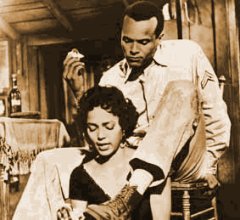
Harry with Dorothy Dandridge in "Carmen Jones".
In 1959's Odds Against Tomorrow, he played a bank robber, uncomfortably teamed with a racist partner. And in The World, The Flesh and The Devil, also made in 1959, he portrayed one of the last three survivors of a world-wide nuclear disaster. Following his SRO Carnegie Hall show in 1959, Belafonte won an Emmy for his 1960 TV special, Tonight With Harry Belafonte. Dissatisfied with his film work, he made fewer and fewer movie appearances with each passing decade. By 1971, he would act before the cameras only in the company of such close friends as Sidney Poitier, who directed Belafonte in Buck and the Preacher (1972) and Uptown Saturday Night (1974). In 1984, Belafonte produced and scored the musical film Beat Street, and in 1985 he was awarded an Emmy for initiating the all-star We Are the World video. After a typically long absence from the screen, Belafonte returned in the 1996 reverse-racism drama White Man's Burden. That year, Belafonte also received good reviews for his performance in Robert Altman's Kansas City. By this point, however, it was clear that movies were way down on his priority list, as demonstrated by the dozens of awards and honors bestowed upon him by various social-service and political organizations. Harry Belafonte is the father of actress/singer Shari Belafonte-Harper.
Biography Courtesy: New York Times.

Harry with Sidney Poitier and Charlton Heston.

Click on Harry to go back.

