Gary Cooper

Gary Cooper was born Frank James Cooper on May 7, 1901 in Helena, Montana. In 1906, when Gary was 5, his dad bought the Seven-Bar-Nine, a 600-acre ranch that had originally been a land grant to the builders of the railroad through that part of Montana. In 1910, Gary's mother who had been ill was advised to take a long sea voyage by her doctor. She went to England and stayed there until the United States entered World War I. Gary and his older brother Arthur stayed with their mother and went to Dunstable school in England for seven years. Too young to go to war, Gary spent the war years working on his father's ranch. After high school Cooper attendednHelena Montana and Iowa College, Grinnell, Iowa. His first stage experience was during high school and college. Afterwards, he worked as an extra for one year before getting a part in a two reeler by Hans Tissler. Eileen Sedgwick was his first leading lady. He then appeared in Winning of Barbara Worth, The (1926) for United Artists before moving to Paramount. While there he appeared in a small part in the osacar winning Wings (1927), It (1927), and other films.

Gary with Jean Arthur in "Mr. Deeds Goes to Town".
Coopers own mark as a top-billed star of Paramount's program Westerns, including 1927's Arizona Bound, Nevada and The Last Outlaw. He was paired with Colleen Moore in Lilac Time and Nancy Carroll in Shopworn Angel two successful 1929 dramas set during World War 1. Talkies found Cooper refining his naturally taciturn Western character; in The Virginian (1929), he rarely spoke unless he had something to say, including the famous line, "When you call me that, smile" delivered to swearing badman Walter Huston. In 1930 he starred in The Texan and A Man From Wyoming before being teamed with exotic Marlene Dietrich in Morocco a scorching desert romance that found him in Legionnaire's garb, and led him away from Westerns. Although Cooper frequently essayed roles that called for him to be shy or reticent, his offscreen conduct vitiated that image; his affairs with Bow, Lupe Velez, and others were both numerous and well known. Cooper played a hard-boiled gunman in City Streets (1931), a gangster story written by Dashiell Hammett; his performance suggests that he'd have been right at home playing one of Hammett's pulp-fiction detectives. I Take This Woman, His Women (both 1931), The Devil and the Deep and A Farewell to Arms (both 1932), the lastnamed a Hemingway adaptation costarring Helen Hayes) refined and reinforced his new image as a romantic leading man. And, while ostensibly miscast as an artist in Ben Hecht's spicy adaptation of Noël Coward's witty Design for Living (1933), Coop acquit ted himself admirably. It's unfortunate that he didn't choose to appear in more comedies, because he certainly had the knack. He continued to top-line some of Paramount's most successful films of the 1930s, including The Lives of a Bengal Lancer (1935), Desire and The General Died at Dawn (both 1936), before going to Columbia to star as small-town sage Longfellow Deeds in Mr. Deeds Goes to Town (1936), one of Frank Capra's best populist comedies and one of Cooper's signature roles. Mr. Deeds Goes To Town earned him his first academy award nomination.

Gary with Ingrid Bergman.
Back at Paramount he played a romanticized Wild Bill Hickok in Cecil B. DeMille's The Plainsman (1936) and starred in Souls at Sea (1937) before tackling (most improbably) the title character in The Adventures of Marco Polo (1938), continuing a working relationship with producer Sam Goldwyn begun with The Wedding Night (1935). He lapsed back into "shucks, ma'am" mode for Goldwyn's formula comedy The Cowboy and the Lady pleasantly paired with Merle Oberon. It fared better than Bluebeard's Eighth Wife (1938), a rare misfire for Lubitsch (working from a Billy Wilder-Charles Brackett script, no less). Beau Geste (1939) saw him back in form; although hardly the type to play an aristocratic young Englishman who joins the Foreign Legion to save his family from disgrace, Cooper cut a dashing figure in the distinctive Legionnaire uniform, and the surefire remake of the 1926 film was a solid hit. Two more Goldwyn-produced efforts, The Real Glory (1939) and The Westerner (1940, in which he matched wits with Walter Brennan's Judge Roy Bean), preceded Cooper's return to DeMille for Northwest Mounted Police (1940), a robust if somewhat silly Technicolor actioner. Cooper's next four films set a highwater mark in screen acting-and sheer starpower-seldom (if ever) equaled since. He played an idealistic hobo turned media hero in Frank Capra's bittersweet Meet John Doe (1941), then portrayed real-life pacifist-turned-WW1 hero Alvin York in Sergeant York later that year, winning the Best Actor Oscar for his performance. Ball of Fire (also 1941, a Goldwyn picture directed by Howard Hawks) showed he hadn't forgotten how to play comedy; as one of the prissy pro fessors who enlists wisecracking burlesque dancer Barbara Stanwyck to help them with a slang encyclopedia, Cooper showed himself to be a terrific straight man. And The Pride of the Yankees (1942, also for Goldwyn), featured him as baseball great Lou Gehrig (then recently deceased) in a touching, warm biopic that yielded another Oscar nomination.

Gary with Shirley Temple.
He earned another Oscar nod for his hardbitten performance in For Whom the Bell Tolls (1943), based on the novel by his friend Ernest Hemingway, but his next few vehicles, while certainly pleasant, suggested that he might be marking time: The Story of Dr. Wassell, Casanova Brown (both 1944), the former directed by Cecil B. DeMille), Along Came Jones (1945, which he also produced), Saratoga Trunk (1945), Cloak and Dagger (1946), Unconquered (1947), and Good Sam (1948). Cooper was riveting as the iconoclastic architect in The Fountainhead (1949), an ambitious but middling Ayn Rand adaptation. More routine films followed-Task Force (1949), Bright Leaf, Dallas (both 1950), and You're in the Navy Now (1951) among them-before an aging, weary looking Cooper assumed what may be his greatest role, that of the embattled marshal abandoned by the townspeople he spent years protecting, in High Noon (1952), a "traditional" Western, earned him another Academy Award. The Court-Martial of Billy Mitchell (1955), Friendly Persuasion (1956), Love in the Afternoon (1957), paired romantically with Audrey Hepburn and directed by Billy Wilder), Man of the West (1958), and The Hanging Tree (1959) were some of Coopers's last films. The Naked Edge (1961), a routine thriller shot in England, showed a worn out Cooper and because of how illness was his last film. In April 1961 he won a special, career-achievement Academy Award, which was accepted by his friend James Stewart. A month later he died on May 31, 1961 of lung cancer in Los Angeles, California.
Biography Courtesy: Classic Movie Stars.
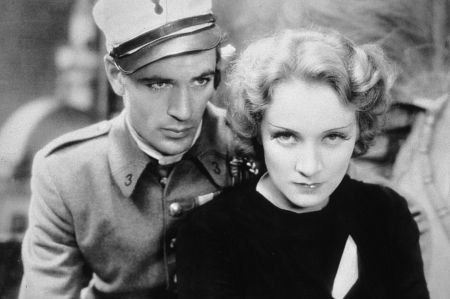
Gary with Marlene Dietrich in "Morocco".
Crystal's Favorite Gary Cooper Films:
High Noon (1952) - Will Kane
Mr. Deeds Goes to Town (1936) - Longfellow Deeds

Click on Gary to go back.

