Burgess Meredith
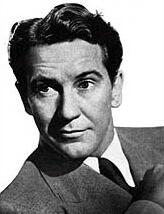
A former child soprano, Burgess Meredith became a leading figure in American theater of the 1930s. He made his film debut reprising his stage triumph in "Winterset" (1936), in a role written for him by Maxwell Anderson. Versatile and highly accomplished, compact in size and with a boyish yet eccentric quality, Meredith had a prolific but uneven screen career, partly because producers were often unsure of how to best utilize his talents. He nonetheless gave an outstanding performance as George in "Of Mice and Men" (1939) and brought a sweet quality to his romantic scenes with Ginger Rogers in "Tom, Dick and Harry" (1941). In the unjustly overlooked "Street of Chance" (1942), Meredith offered a strong turn as an amnesiac trying to reconstruct his past. He also shone as WWII correspondent Ernie Pyle in "The Story of G.I. Joe" (1945, although Robert Mitchum nearly stole the film) and as a psychiatrist treating a former prisoner of war in the disturbing British-made noir "Mine Own Executioner" (1947). Meredith also produced, wrote and co-starred with his third wife Paulette Goddard in Jean Renoir's uneven but fascinating "Diary of a Chambermaid" (1946).
Because of his widely publicized liberal views, Meredith found himself blacklisted in Hollywood for much of the 1950s. He returned to the Broadway stage acting in such seminal productions as "The Fourposter" (1952) and "The Teahouse of the August Moon" (1955) as the Okinawan interpreter Sakini. The actor donned 'yellowface' again for his return to features, portraying a Japanese supplier of goods to American soldiers in "Joe Butterfly" (1957). After scoring a stage triumph with "A Thurber Carnival" (1961), Meredith made "Advise and Consent" (1962), the first of six features with director Otto Preminger.

Burgess with Ginger Rogers and Phil Silvers in "Tom, Dick and Harry".
Perhaps ironically, the actor played an informer who names Henry Fonda's Secretary of State designee as a member of the Communist Party. Other work for Preminger included playing a priest in the overblown "The Cardinal" (1963) and a judge in "Hurry Sundown" (1967). Meredith earned back to back Oscar nominations in the mid-70s for his work as a former vaudeville star reduced to eking a living as a salesman in "The Day of the Locust" (1975) and as Sylvester Stallone's crusty trainer in "Rocky" (1976), a role he reprised in three of its four sequels. He remained active in small roles into the 90s, most notably as Jack Lemmon's randy father in "Grumpier Old Men" (1993) and its superior sequel "Grumpier Old Men" (1995). TV buffs treasure his bookworm in the memorably ironic "Time Enough to Last" episode of "The Twilight Zone" from the early 60s. Baby boomers also fondly recall the actor as the monocled villain The Penguin in the campy 60s version of "Batman". Meredith's distinctive, sing-song rasp was also enlisted for countless commercial voice-overs and documentary narrations. Among his other more notable small screen roles was his Emmy-winning portrayal of attorney Joseph Welch in the above average biopic of Joseph McCarthy, "Tail Gunner Joe" (NBC, 1977). In 1994, he published his autobiography, "So Far, So Good". Meredith died in his Malibu home at the age of 88 on September 9, 1997.
Biography Courtesy: Hollywood.com.
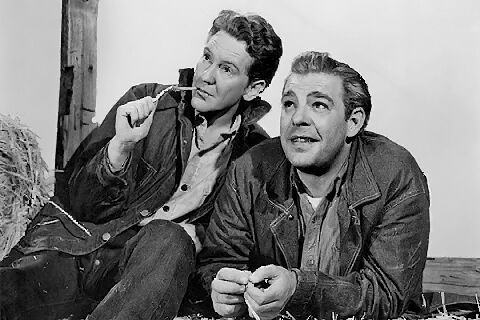
Burgess with Lon Chaney Jr. in "Of Mice and Men".
Crystal's Favorite Burgess Meredith Films:
Of Mice and Men (1939) - George
Rocky (1976) - Mickey Goldmill
Grumpy Old Men (1993) - Grandpa Gustafson
Grumpier Old Men (1995) - Grandpa Gustafson

Click on Burgess to go back.

