
Vidding Computers
This page discusses the hardware requirements for vidding. It deals strictly with PC's and it tries to find the most economical solution. I believe you can always spend more money, but most of what a good vidder wants to accomplish can be done for less.
There are three components that I will deal with in this section: The Processor (CPU), the Hard Disk, and the Video Card. Whatever else you have on your system (modems, network cards, CD-ROMs, dvd, etc) is immaterial; this is all you really need.
The Processor 
I'm told that the next release of Adobe Premiere will recommend a 300 MHz Pentium II processor, but good vidding can be done on a system with much less than that. Today, you can buy a Cyrix 200 MMX CPU and mother board for about $150 (if you don't have a local distributor I can recommend one - try Advanced Computers and Technology). I think this is a good system, it is what I use and it has served me well. Always buy as much RAM as you can afford but no less than 32mb. All this has to do with how fast the movie is created. The faster the motherboard, the more the RAM, the faster things happen.
The Hard Disk 
Conventional wisdom says that to do true vidding you have to have a SCSI disk. SCSI disks are fast, and they avoid a problem called "thermal recalibration." Essentially, with non-SCSI disks, as the drive heats up it expands (such is the property of metal) and the driver periodically takes a moment to take this expansion into account. [I should note at this point that the guy at Promise told me drives haven't had this problem for 2 years, but I'm skeptical, I think I've seen it] On the other hand SCSI drives are extremely expensive. A 4 GB SCSI drive can cost between $350-$650, whereas a 4GB EIDE costs about $220. You could double your storage space and get an 8 GB EIDE drive for $320, still less than a 4 GB SCSI.
In the vidding game, more is more. Vidding takes a lot of disk space, the more you have the better. An average three minute vid on my system takes about 3GB, but the stats say that even better quality can be had at about 1GB per 30 seconds (using a different capture card than I have). Suffice it to say to for my tightly held dollar, I want to go EIDE.
But, you may ask, "are IDE drives fast enough and what about thermal recalibration?" My experience is that the new Ultra DMA drives with a 6mb/s constant rate and 33mb/s burst speed is more than fast enough for my needs. Occasionally I do see evidence of thermal recalibration in the form of a dropped frame. This happens when I capture a scene that's 30 seconds or longer. But think about it. The average song line is somewhere between 4 and 8 seconds. Generally speaking, my clips are rarely longer than 20 seconds. When I have captured for longer than 30 seconds I have rarely dropped more than 1 frame (a lot of it seems to have to do with the quality of the source video, noisy videos tend to drop more frames), most of the time its unnoticeable, and, through the magic of digital video, I can always capture parts of same scene and splice them seamlessly together in the editing process.
The Video Card 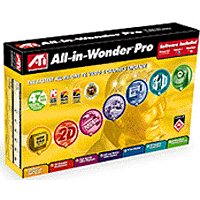
The video card decision is a little tougher. I have an ATI Expert @ Play card that works wonderfully. The key to video cards is to make sure they support video overlay so that you can see your work on your screen. I'm still doing research on this. Any advice would be appreciated.


|
|

