Lesson 15: Half-Diminished 7th Chord Forms
In a major key, the half-diminished chords
are most commonly used as the viių chord.
In a minor key it's the iių chord. The interval construction is 1 - m3 - D5 -
m7.
Another name for this chord is minor
7b5. Remember this because both names are
used equally as often.
The term half-diminished refers to the fact
that the chord contains a diminished triad
but the 7th interval is not diminished.
Therefore the entire chord is thought of as
only half diminished.
In a full-diminished
chord the triad is diminished as is the 7th
interval.
Below are 3 common forms that should
provide you with a good
foundation in half-diminished 7th chords.
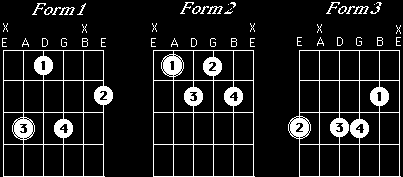
The roots of the chords have been circled.
Roots are the notes for which the chords
have been named.
For example, to play a Gm7b5 chord,
make sure that the circled note of the form
is on the note G on the fretboard.
X's indicate strings should
not be played. The numbers in
the black dots indicate which finger to use.
Exercise #1:
Play chord form #1.
Make sure that your left hand thumb is near the center of the curve in the neck so that your fingers can come straight at the fretboard.
Play each note of the chord one at a time to make sure that each note sounds clear.
Once this is done, slide the entire chord up the fretboard one half-step.
Again, play each note of the chord one at a time to make sure that each note sounds clear.
Then move up one more fret and play the chord. Keep doing this until you run out of fretboard.
Now, move back down the fretboard by half-steps.
Repeat the above steps using form #2 and then again using form #3.
Exercise #2:
Play through all three forms for each chord in the order listed after the chord name.
Play:
Cm7b5 forms: 1 --> 2 --> 3
Fm7b5 forms: 3 --> 1 --> 2
Bbm7b5 forms: 2 --> 3 --> 1
Ebm7b5 forms: 1 --> 2 --> 3
Abm7b5 forms: 3 --> 1 --> 2
Dbm7b5 forms: 1 --> 2 --> 3
Gbm7b5 forms: 3 --> 1 --> 2
Bm7b5 forms: 2 --> 3 --> 1
Em7b5 forms: 3 --> 1 --> 2
Am7b5 forms: 2 --> 3 --> 1
Dm7b5 forms: 1 --> 2 --> 3
Gm7b5 forms: 3 --> 1 --> 2
Exercise #3:
Play the following m7b5 chords.
Make sure to play the chord form number
specified in parenthesis. After playing
through this exercise you should begin to
see a pattern.
Cm7b5 (form 3) --> Fm7b5 (form 2) -->
Bbm7b5 (form 3) --> Ebm7b5 (form 2) -->
Abm7b5 (form 3) --> Db7m7b5 (form 2) -->
Gbm7b5 (form 3) --> Bm7b5 (form 2) -->
E7m7b5 (form 2) --> Am7b5 (form 3) -->
Dm7b5 (form 2) --> Gm7b5 (form 3).
Exercise #4:
Play the following m7b5 chords.
Again, you should begin to see a pattern.
Cm7b5 (form 3) --> Fm7b5 (form 1) -->
Bbm7b5 (form 3) --> Ebm7b5 (form 1) -->
Abm7b5 (form 3) --> Dbm7b5 (form 1) -->
Gbm7b5 (form 3) --> Bm7b5 (form 3) -->
Em7b5 (form 1) --> Am7b5 (form 3) -->
Dm7b5 (form 1) --> Gm7b5 (form 3).
Exercise #5:
Now that you have the chords under your
fingers it's time to do a little brain work.
Go through each of these chords and identify
each note - whether it is the Tonic, the
Third, the Fifth or the Seventh.
Final Note: The chord forms you have just
been working on sometimes provide too
many notes. For example, if you are working
with a keyboard player and you are both
playing big full chords, things might start to
sound a little muddy. Sometimes it is better
to play only two or three notes of the chord.
This can help clean up the sound. You can use
any combination of notes of
the 3 forms.
Please email me at TVieira@ix.netcom.com if
you have any questions regarding this lesson.
Back to Online Lessons
This site created and
maintained by
Unicorn Productions

