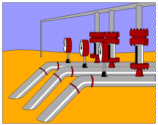
LINE BREAKING
INTRODUCTION

Line breaking is an important process that is needed to clean, repair,
and properly maintain the pipes and lines at your facility. Designing
and implementing a Line Breaking Policy is essential to ensure health
and safety, and reduce the potential hazards. This course will train all
participants in line breaking policy, use of a line breaking permit, and
the proper procedures to follow before, during, and after line breaking
or equipment opening.

LINE BREAKING POLICY

Starting with the definition of line breaking, the participants will
then learn about the potential hazards involved such as dangerous gases,
hot dusts, toxic atmosphere, steam, temperature, flammable or combustible
liquids, and corrosives. It is essential that all workers, including
contract employees, are familiar with your line breaking policy in order
to avoid confusion, accidents, damage, and injury.

LINE BREAKING PERMITS

As part of your line breaking policy, a line breaking permit must be used
to ensure overall safety. In addition, this permit will only allow
trained and authorized personnel to open a line, and only for a specified
job and period of time.

The line breaking permit will act as a safety checklist that must be
completed in writing, signed off, and strictly adhered to. The
information contained within the permit will be discussed with the group
in detail, and will include such information as potential chemical
hazards, personal protective equipment, required safety equipment,
lockout/tagout procedures, emergency response information, and double
checks with sign-off signatures.

PREVENTION OF CHEMICAL HAZARDS
Before any equipment opening can occur, a worker must have proper
training and knowledge of the chemicals that are used at your facility.
This section covers how to gather the appropriate information with the
use of Material Safety Data Sheets, and how to use the information
correctly as it pertains to the work. There is an emphasis on using
the proper solvents and solutions as prescribed by the company as using
the wrong mixtures can be hazardous, and even lethal.

PERSONAL PROTECTIVE EQUIPMENT

This section covers the various types of personal protective equipment
that may be needed when line breaking. Such equipment may include safety
shoes, safety goggles, face masks, rubber or neoprene gloves, split palm
or leather gloves, aprons, acid suits, respirators, and self contained
breathing apparatus. Additional potential hazards such as asbestos
wrapping and lead coating are also identified.

SAFETY EQUIPMENT AND PROCEDURES

Before the start of any line breaking procedure, there will be a need to
clear the area, post warning signs and permits, ensure for proper
flushing and drainage, place barricades, and warn all personnel within
the area.

All workers must be trained in the company's emergency evacuation
procedure and emergency response plan. The use of proper safety equipment
such as scaffolds, ladders, air quality monitors, alarms, fall protection
equipment, fire extinguishing devices, neutralizing agents, and air
moving equipment are covered throughout this segment of the course.

LOCKOUT/TAGOUT

Knowledge of the appropriate lockout/tagout procedures is vital when it
comes to line breaking. Following the permit carefully, and warning all
personnel of which machines will be deactivated will prevent potential
accidents from occurring.

An important part of this procedure also includes careful
de-pressurization and draining of the lines, equalizing pressure,
washing and purging, blinding, blanking, and removing pipes. These
topics, as well as knowledge of supports, pumps, baffles and floats
are also discussed. At this point, each step must be double checked
and signed off by a qualified person.

LINE OPENING PROCEDURES

This section covers the inspection and replacement of bolts, with an
emphasis on theproper technique for maintaining integrity at the joint,
and containment of hazardous residue. Next, we move on to the procedure
for the actual line break, including bonding the pipe to funnels and
containers, clearing blockages, controlling spills and flow, and applying
pressurized agents safely.

CLOSING THE LINE

Upon completion of the work, the lines must be re-connected. The
participants are trained on the proper procedure for joining the lines,
removing supports and grounds, notification of a qualified person of
work completion, receiving authorization to remove the lockout/tagout,
and restarting the equipment.

CHECKING THE WORK

To close out the procedure, the group is instructed on how to check the
lines for leaks, remove the barricades and other safety equipment,
record the time and date of completion, removal of PPE, and proper
cleansing agents to be used. In addition, we stress the importance of
completing the permit in full, including signing and dating the form,
and filing the permit in the appropriate location.
RETURN TO SAFETY 1ST - MAIN PAGE"
Safety 1st
P.O. Box 21044
84 Lynden Rd.
Brantford, Ontario N3R 7W9
Phone: (519) 758-0900
Toll Free: 1-877-251-1172
Fax: (519) 758-0900
website: www.thinksafety1st.com