
Prior Knowledge:
*If a heat source is at the bottom of an oven, how does the air at the top of the oven get warm? For example, how does the cake on the top rack bake? (convection)
*Why does a room become warm when the furnace is turned on? (the furnace circulates heat through the gases in the air)
*Why is it always windy at the beach?
Definition of Convection:
The transfer of thermal heat energy matter by means of up-and-down movements called convection currents. Convection is the flow of liquids and gases based on differences in density caused by differences in temperature. As a liquid or gas is heated its molecules move faster and farther apart causing the heated substance to be less dense than the surrounding liquid or gas. The less-dense liquid or gas will rise, carrying the heat with it. It is in this matter that warm air near the surface of the Earth is heated by the earth. The cooler air above will sink toward the surface because it has a greater density. As the warm air rises and cool air sinks, convection currents are formed. These currents greatly contribute to the Earth's weather patterns.
Activity:
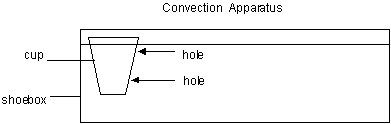
Materials: clear plastic shoe box or similar sized container; Styrofoam cup; food coloring; ice water; very hot water (hotter the better); clothes pin.
1. Fill shoe box almost to top with hot water
2. Attach cup to inside of box with clothespin
3. Fill cup with ice water
4. Add food coloring to ice water in cup
5. Poke holes in cup as shown
6. Observe and draw results
7. Empty containers and fill shoe box with ice water
8. Fill new cup with hot water
9. Poke holes as in step 5
10. Observe and draw results
*Cold water should flow out of the bottom hole of the cup and sink and run along bottom in first example
*Hot water should flow out of the top hole in the second example and flow toward and along the surface.

