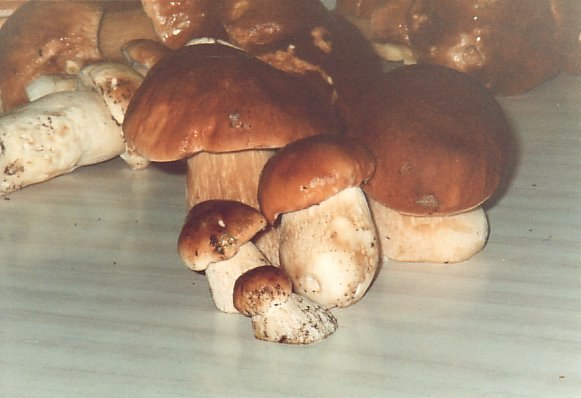
Published in 'The Age' newspaper, 'Escape' travel supplement on 29th October 2000. Our preparations for the ‘hunt’ were shrouded in secrecy. During the preceding weeks, regular reconnaissance missions into the forest were carried out. Cheers went up all around the kitchen table as the little weather-map of France appeared on the television screen. It showed grey clouds hovering over our part of the country, just west of Lyons. Rain and warmth were what was needed, so as to encourage forth from the soil the treasure which lay below. Our forays into the forest, walking stick in hand and casually carrying a few 20 litre buckets, were almost comical. When conditions were deemed ideal, we would set off from the farm as if casually taking a stroll. Walking along the road, we would listen for cars, and if none were approaching we would quickly dash in amongst the trees. Once you are a few feet inside the forest you cannot be seen. With our khaki jackets and brown beanies we blended in with the pine trees. And you certainly do not want to be seen in a prime area, carrying the tools of the trade for all to see. That would give the game away and encourage the curious to return for a closer look. Once in the forest we could relax. Out come the plastic bags and our vital tool, the Opinel knife, was unsheathed. Orders were shouted for all to hear. We arranged ourselves into formation and followed an invisible grid beneath the trees. No ground could be left un-scanned, no log or leaf unturned. For underneath could be growing the greatest treasure of the forest - the mushroom, (or to be more precise Bolet, a.k.a. Cepe.) I had easily become addicted to the glorious stewed mushrooms cooked by my mother in law. No mere sautéed mushrooms were these. Their woody, earthy taste is unlike other mushrooms. The fleshy Bolets are rich enough to eat alone, or else they are cooked with onions and cream, and maybe a dash of garlic and a sprinkle of parsley. They represent a meal in their own right accompanied by a fresh, crusty baguette. Add to the pot a handful of Chanterelles or for a real treat a few slices of a Morel and you have a meal that will cause a Frenchman to swoon. But before you can eat you must first find. During the preceding months I had heard talk of 'the mushroom gathering'. For a strongly religious area, and judging by the reverence with which these matters were discussed, I could have easily believed that we were about to partake in some ancient ritual. Towards the end of summer I was taken on many a walk through the forests. My brother in law would point out the areas of abundance. In one area alone they collected 50 kilos the year before. Further down the hill you may find a ‘choux fleur’, a strange coral-shaped fungus that grows at the base of trees and is named after the cauliflower. In the grassy fields beyond the main hill you will find the Morel, almost as highly regarded as the truffle. As August came to an end and September was just the end of the week, the tools of the mushroom trade were brought out of storage. It soon dawned on me that we were not out to collect just a few mushies for dinner. There were seven 20 litre buckets, a collection of knives, plastic bags, walking sticks, picnic baskets - and the tractor. The tractor was necessary for carrying the hoard (and us) back home. They didn’t expect me to be able to carry a 20 kilo bucket of mushrooms from the forest back to the farm. Especially as we did not know how far from the farm our foraging would take us, or how long we would be away. To be seen wandering along the side of the road with a huge bucket-full of valuable mushrooms was akin to telling the whole village that the mushrooms were finally out, and where to find them. Pure madness. Stealth is a valuable attribute in mushroom hunting. Bolet are easy to find, like anything I guess, if you know what you are looking for. To find a brown capped mushroom growing close to the ground in a dark forest requires some skill, not least of which is to have the night vision abilities of a cat. For the first few days I returned to the farm with only a few Bolet, hanging my head in shame for bringing back a bucket that wasn’t full. This must have been a common experience for beginners. No one gave me a hard time, and I went out day after day until I slowly learned to spot a Bolet a mile away. After a week or so I could find them before they had even broken the earth. I began to know where they grew, and was able to bypass less likely habitats. The true sign that I had made it as a mushroom gatherer extraordinaire was when I found a multitude of Bolet in an area previously bypassed by the others. It was an open, grassy rise not too far from the road. Not a typical habitat, but nestled in the long grass were Bolet of fine proportions and quality. My find was talked about for weeks after the event, somewhat like when my dad tells me about the 18 kilo tuna he caught that time at Merimbula....... So how do you spot a Bolet? They are not like the common field mushrooms that we buy in the supermarkets, or that we find growing on the front lawn after a lot of rain. Bolet are a creamy white colour, except for the cap, which ranges in colour from light to dark brown. If you are lucky you may also find the highly prized ‘Tete de Negre’, or Negro’s Head, where the cap is almost black. The stem is fat and fleshy and it can often be wider than the cap itself. They are very robust and they also have a high water content. You can squeeze them and they will drip like a dish sponge. In size, they can be as small as my thumb or as large as a dinner plate. The size of the Bolet determines what it will be used for - a delicate entree, stewed with meat or pureed for soup. Once the Bolet begin to age they spread outwards, and the underside of the cap becomes greenish yellow in colour. I had great fun kicking these large ones around like a football until I was told that we also gathered these. It is amazing what is actually brought back in the buckets. Unless it has decomposed or is growing fur, it can still be whittled down to something edible. When a Bolet is spotted you have to carefully brush aside the surrounding soil and foliage. They are gently rocked until they come out of the ground. The end of the stalk, the root, is cut off and returned back to the soil. Another favoured method is to loosen the mushroom whilst still in the soil and slice off the stem, thus leaving the root in the ground. This is done in the hope that a new mushroom will sprout in the same place next year. Apparently this theory is not entirely accurate but every such activity has to have it’s superstitions. The stem has to be checked for worms. Not garden worms but tiny little mushroom worms that leave tell-tale holes and tunnels all through the stem. If your Bolet has worms you need to whittle away at it to the level where the worms have stopped. Buckets are often full of stunted Bolet, and the shavings that are left behind are carefully buried. It would not do to let our rival hunters find evidence that there are Bolet in the area. If the pickings are rich we would normally spend the entire day in the forest. Lunch is brought with us and we usually just plop down in the forest and eat where we stop. Even if we do not set out on an official gathering expedition, invariably someone comes back from their evening stroll with pockets full of mushrooms. Or someone leaves a little earlier than usual to bring in the cows for the night. The extra time is spent taking the long way to the cows, roaming the hills searching for mushrooms. A plastic bag is a permanent tenant of any farmer’s jacket pocket. You just do not know what you will find out there, growing by the side of the road or just off the track in amongst the trees. As laborious as it sounds, the gathering is the easy part. Once it is too dark to see the mushrooms (they have not yet taken to torchlight expeditions) we return to the farm to weigh and begin cleaning. The group stands around in the kitchen for a few minutes, gloating at the contents of their buckets, comparing and boasting about the wonderful treasures that lay inside. The Bolet are sorted according to size and quality. The really impressive ones will be taken to local restaurants the next day and sold. Cleaning is a delicate process. Kitchen paper is used to gently wipe the surface of the mushroom. You have to be careful not to break off the cap. If the cap is broken off, the Bolet is then only good for slicing and cooking. Usually the old Bolet are sliced up and cooked. They are cooked for about 20 minutes, just long enough to bring out all the excess water. They are then bagged and frozen. Some of the less desirable Bolet are given to relatives and the smaller ones are frozen whole. The Bolet for the restaurants are taken down first thing the next morning. The longer they sit in the fridge, the more they suffer from dehydration. Because we earn money based on weight, it is in our interests to send them off first thing when they are at their heaviest. The price at the beginning of the season is good, about 50 francs a kilo. As more people catch onto the idea of selling to local restaurants the price will halve. The best part of selling mushrooms is that I get to poke around in the kitchens of some great French country restaurants. After a few weeks we give up selling, as the price becomes so low it is not worth the effort of driving down to the restaurants. Our mushroom money is saved, and one day we will buy something useful with it. I suggested that we get an old Landrover so we can drive to and from the forest without fear of falling off the back of the tractor. Nothing has changed however. The tractor still slips and slides along the wet tracks into the forest and the purse still sits in the kitchen table drawer, waiting for the day when the tractor finally dies and we can go out and buy a Landrover.  Melanie Dooley 1999-2001. Reproduction in any form is prohibited without the permission of the owner. Melanie Dooley 1999-2001. Reproduction in any form is prohibited without the permission of the owner.
|