Site hosted by Angelfire.com: Build your free website today!

Saints John`s Institution History

the beginnings

Great things generally have small beginnings. It is the general rule and fits most human enterprises. Such is the story in a nutshell of the large buildings that now grace a dugout corner of Bukit Nanas, which form the St.John’s of 1987.

The establishment of St.John’s Institution was the answer of the Brothers to the often-repeated requests of His Lordship, the Bishop of Malacca Bishop Fee and the Education Authorities, both of who were convinced of the urgent need of another First Class Grant-in-Aid-School in Kuala Lumpur.

The demand for English education increased with growth of the Federal Capital and in 1903 leave was asked by the Bishop of Malacca to open a school in Kuala Lumpur. Unfortunately the Bishop was called to his reward just when a commencement was being made. A beginning was made however,

in spite of obstacles which at first appeared insurmountable. Temporary buildings were put up through the efforts of Father Renard, who might deservedly be called the Father of St.John’s Institution. It was mainly through his extensions that St.John’s Institution could commence on the 18th of January 1904.

The School was given the name of St.John’s Institution, as the Parish Church, was the Church of St.John the Evangelist.

On the 15th January 1904, three Brothers; Brother Julian Francis (Director) came from Hong Kong; Brother Andrew Corsini from Mandalay (Burma), and Brother Cyril Alexander from Penang. There were three young lay masters too, all of whom came from St.Xavier's Penang, sent by Brother James, Director, who also came for the occasion and continued for many years to inspect the school and guide its destiny. The three teachers were Mr. W. M. Kruseman, Mr.Guido von Arnstet and Bernard Anslem.

The official Blessing and Opening ceremony of the school was held on the evening of the 17th of January 1904. The Rev. Father Vigol blessed the building and Mr. R. J. Wilkinsons, Director of Education officially declared the School open.

January 18th 1904 was a great day for St.John's … the first school-day of the Institution. Forty boys were on the Roll. Within six months the number of boys had risen to very nearly one hundred.

The building in which the school started was a wooden structure of two storeys with brick pillars. It was about 80 feet long and 20 feet wide, with a veranda on the north side and with two staircases in the veranda and two more in the interior. The building was originally intended to be a tenement house, and was divided into two parts by a brick wall. For the year 1904 it proved adequate for five classes and for the quarters of the Brothers and of the lay masters.

The only change that took place in the staff in 1904 was the arrival of Brothers James Gilbert who was sent from Singapore to take the place of Brother Julian Francis as Director.

As early as 1905 the 80 x 20 foot building proved inadequate, and Father Renard came to the rescue by lending, first the house of the Chinese Catechist (the Chinese Church in Brickfields had been opened for service on the 18th December, 1904), which was capable of holding one class, then later he lent for the use of the school an attap shed lying along the hedge near the place now occu-pied by the Telecoms.

The feeling of 1906 was that, as the school was rapidly increasing in numbers the need for an ade-quate building became more and more imperative. Plans were prepared in Penang, and then the question of the best available site arose. Brother James in-tended at first to purchase the property of a Mr. Joachim .. absentee landlord ... but Mr. Lee Kong Lam told Brother James that he wanted that parti-cular site and that he would certainly outbid him. So Mr. Lee Kong Lam built his mansion (which became Loke Hall ... now A. I. A. ) in front of the school meanwhile lending his kitchen and a two-storeyed kiosk, for the use of the school, pending the completion of his own building. This gave room for three more classrooms. An attap shed was erected to replace the one lent by Father Renard. It remained for many years before it was replaced by the present hall.


The Main Block

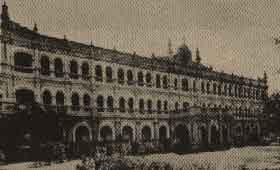
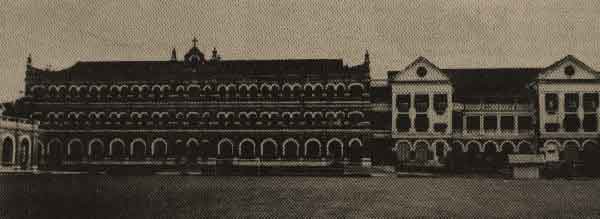
On the 3rd November, 1906, the foundation stone of the new building was laid (The main block with its romanesque style architecture).
The Foundation Stone laying ceremony was per-formed by Sir Conway Belfield , than Resident Councilor for Selangor. Several causes delayed the work, not the least of which was the difficulty of obtaining timber from the forest, owing to the attacks made on the oxen drawing the carts by tigers.
The building was advanced enough by the end of 1907 to be used for the Cambridge Examination. All the candidates of Kuala Lumpur both juniors and seniors found ample room in the hall of the top floor. Many of the classrooms were in use from the beginning of 1908 but the inauguration took place only on the 10th August.

This was precided over by His Excellency the High Commissioner and governor, Sir John Anderson. St. John's was now on a firm footing and could look forward with confidence to a bright future. In due course still further improvements were added.
The main block was built in less than two years a remarkable feat taking into consideration the type of building technology available. After comp-leting the building of this magnificent edifice, Brother Gilbert was given a short and well deserved leave in Ceylon.

He held office until 1916 during which time he had cherished a scheme for the building of a swim-ming pool in the valley south of the school (Since filled and became the field). He also started a fund for the building of a school hail, but World War I checked his efforts and those too, of his immediate successors.

In 1914, Brother Marcian had been appointed Director of the newly formed Juniourate. The Bro-thers' building was enlarged by the erection of two wings. One was destined for the boarding department, the other for offices and a chapel. The Boarding Department, however, had to make room for the Juniourate and later for the Novitiate.
Bro. Claude Marie replaced Brother James Gilbert as Director and remained in office till 1921. Not very much is recorded of him probably due to the economic disruptions during World War 1 which affected the school. Bro. Claude Marie served the institution for five years before being transferred to Malacca in 1921.


The School on 1904


Bro. Stephen Edward replaced him. Bro. Stephen added a new facade to St. John's. Under his direction the Brothers' building was completely -demolished and replaced by the present one, to which additions were made later.
Bro. Louis initiated the plan of enlarging the playground by filling the valley, but the success of this enterprise was reserved for his successor, Brother Cornelius, who took charge in 1930. Anyone who would know how far the valley extended has only to observe the series of manholes of the sanitary installation which runs across the play-ground. They were built on the brink of the valley.
Bro. Louis who was appointed Sub-Director in December 1924 took Brother Stephen's place in
1925 and remained until his transfer to Malacca in 1930.


St.John Baptist De La Salle


School Hall built in 1936

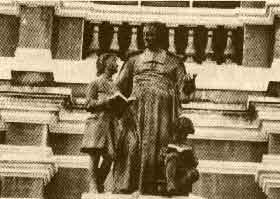
In 1925 the Statue of St. John Baptist De La Salle was installed in the balcony above the portico.
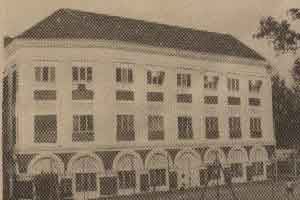
Brother Cornelius had the longest uninterrupted tenure as Director. 15 years in all. He took charge in 1930, and under him the Hall that had been on the agenda of Brother Gilbert and Brother Claude finally came into existence. Provisions were made when it was built, for the erection of two more storeys above it and how wise a measure it was. Mr. B.L. Nathan was the architect of Brother Stephen and Brother Cornelius..


Brother Cornelius's activity would not be stopped. He next built a wing on the East Side of Brother Stephen's building. The latter was reserved for the Brothers and the new wing became the boarding department.
Japanese classes were opened; the Japanese language was studied with apparently great zeal and Brother Cornelius himself particularly enthusiastic in this line. But these activities were only a handful of dust cast in the eyes of the invaders. More meritorious work was in store, when crowds of refugees flocked to him for help. Every corner available was turned to account and the floors and walls of the school still show the marks of the partition put up to accommodate the families of refugees. It is pleasant to record how grateful these refugees showed themselves, when peace had returned, by establishing a scholarship to perpetrate the memory of their gratitude. In September 1946 Brother Cornelius was given a welt deserved year of rest.


East Wing in 1986

Brother Amor Mathias took over the mantle from Brother Cornelius. During the Japanese Occupation our school had been completely disorganized. The dial of education had been put five years back. There was no question of extension but only the difficult problems of reorganization, materially and intellectually and Brother Matthias confined his attention to them.

In May 1948 Brother Dositheus Joseph Brophy began his term of office during which he established the feeder schools of Sentul and Brickfields, completed the plans for La Salle Peel Road and saw the beginnings of La Salle Klang. In St. John's itself he renovated the school hall and built a new up-to-date cafeteria (which today in 1987 is the Art Room on one side of the walled partition and the Staff Room on the other side).. A large staff-room and new office appeared (which today 1987 is occupied by Forms
3A, 3B & 3G.)
A spacious library was furnished and equipped and an extensive Public Address system was installed, which included a speaker in every classroom, with the control panel installed in the room adjacent to the Brother Director's Office.
In 1954 - the Golden Jubilee year, Brother D. Joseph Brophy despite almost insurmountable obstacles, achieved his final objective - the completion of the field extension.Though the first to extend the field slightly was Brother Louis in the late 1920's it was Brother D Joseph who completely filled the valley by cutting down the adjacent hill to form the present field with a 400 meter track with six lanes.
Bro. Lawrence Spitzig's appointment as Director in 1955 saw the continuation of the expansion of St. John's physically, culturally and academically.

In 1956 Bro. Lawrence carried out the extension of the 14 classrooms at the cost of $90,000. He converted the wooden flooring of the first and second floors into concrete flooring; got rid of the north veranda to enlarge the breadth of the classrooms and he built the two staircase blocks getting rid of the old wooden staircase situated at the east end of the Main Block.

In 1957 the Industrial Arts Block at the foot of St. John's primary was built. (Vocational Work-rooms).

In 1959 a new branch school La Salle Petaling Jaya was started.

On the 16th of September 1960 St. John's Primary was officially opened by Bro. Fintan, Visitor.

The new chapel on the middle floor was officially opened and used on the 19th October.

In 1961 Renovations to the Brothers' quarters on the 2nd Floor were completed. The Audio Visual Aid Room was further improved and the Library reorganized and moved to the second floor. A new Biology laboratory was added to the Science Depart-men t.

At the end of 1961 Bro. Lawrence was transferred to Penang to take over St. Xavier's Institution. He had been in St. John's since 1936 as a young Brother.

In 1962 Bro. lgnatius who replaced Bro. Lawrence gave all his attention to the raising of academic standards in the school. In September, due to failing health, Bro, lgnatius was forced to return to Ireland, and his place was taken by Brother. Joesph McNally (The Artist)

He gave the school a new look. He repainted the school white and made numerous artistic changes, including the placement of sculptures, the Japanese Garden and beautiful paintings in all the classrooms, bringing beauty and serenity to the atmosphere of the school.

He carried out numerous major projects. His first major project was the draining and enlarging of the school field, made possible by the generous donation of $20,000 from Mr. Lim Foo Yong, in 1963.

In January 1964 the school embarked on its programme of expansion and development by the formation of a Development Committe headed by the then Minister of Home Affairs, Tun Dr. Ismail bin Dato Abdul Rahman, who eventually became the Deputy Prime Minister of Malaysia.
In the next three years the following projects were completed:
1) The Old Johannians' Building replacing the one taken over for the construction of the New Primary School was built at the end of the school field overlooking Jalan Raja Chulan.
2) The Arts Block now housing the Form 5 Classes which was originally intended to be a Sixth Form Block.
3) The improvement of library facilities with the addition of an air-conditioned reference library for Form Six and two reading rooms above the library. Mr. Ng Eng Hiam who had generously donated $30,000 to the project officially opened the library.
4) A handsome portico leading through a marble-floored colonnade to the main staircase of the school.
5) The construction of a block consisting of two lecture theatres, each capable of holding 300 pupils, and a modern gymnasium..
6) The old tennis court in front of the school was moved to the side of the east wing, to provide a much-needed car park for the teachers.
In the Primary School a new spacious and impressive hail, named Dewan Tun Dr. Ismaii, was built to cater for the needs of both the Secondary and Primary Schools.
In mid-1967 Brother Joseph McNally's term of office came to an end and Bro. Basilian Wong became the Director. In, the two years that Bro. Basilian was Director, his main task was to clear the immense debt incurred in the expansion and improvement carried out during the previous years - a task which he. Courageously and successfully accomplished eventually with his shrewd business acumen.
In January 1969, St. John's came under the Directorship of one of its own sons, Bro. Joseph Yeoh. He was the son of Mr. Yeoh Teck Soo who had been a teacher at St. John's for 40 years. Bro. Joseph was so immensely in love with the school that he wanted to see it succeed in all fields, academic and extra-mural.

He put his shoulder to the task and with an untiring diligence and an indomitable spirit he lifted the school to such heights that St. John's became the envy of all and became the one that everyone would love to defeat. As a result of his dynamism during his 10 year tenure, St. John's scored successes in everything worth winning, be it games, musicals, uniformed units, cultural or academic.

He had many firsts too:
1) The first to organize a walkathon which brought in $43,000 - 1972.
2) The one and only to organize a Fishathon' which brought in $9,000 - 1972.
3) The first time the student body cast their votes for the election of a school captain 1972.
4) The Student Welfare Board was formed.... 1972.
5) The Parent Teacher Association was formed
1973
6) Awards Day was first introduced to show appreciation to those who had excelled in games and school activities and those who had given valuable services to the school ... 1976.
7) The former Minister of Public Enterprise Dato Hj Mohamad Yaakob officially opened the Scout's Den on November 5th 1977. The Scout's Den is situated across the road behind Cardign House just below the Telecoms pylon.

His loyal and dedicated service to the education of the young did not go unnoticed. His Majesty the Yang Di Pertuan Agung decorated him with the A.M.N. in 1978. At the end of that same year, he left St. John's to serve in his new capacity as Auxiliary Visitor of West Malaysia.

He had the second longest run 10 years as director of St. John's.
In 1979, St. John's was blessed to have Bro. Lawrence as Director again, thereby being the only one to have the distinction of serving twice in the same school. His zest for life was clearly evident when he began shipshaping the school with various pet projects like the 'Cleanliness Campaign - 1980' and 'Furniture Year - 1981'. His sincerety poured out from the bottom of his heart, placing great emphasis on moral and civic values, constantly reminding the students to show respect where it was due, especially toward the elderly and handicapped.

He was steadfast on religious values always reminding the boys to be faithful to their respective religious obligations. He also revived public speaking and began awarding 100% attendance certificates, the latter aimed at improving overall attendance.

Every year he had a certain cause or project emphasized upon. 1981 was the Year of the Handicapped, whereas 1982 was the Year of the Aged. 1982 was also the Library Year, when he tried to inculcate the reading habit, thus with the students compiling book records and adding to their tally of hours in the library.

In 1980 Bro. Lawrence launched a massive 'JobA-Long' Fund raising project. Within 21/2 months, it brought to our coffers an astronomical $97,000!-This was used to bring many improvements to our school, among them the purchase of a new school bus to replace the old one.
On the 5th of February 1983, once again St. John's bade a tearful farewell to Bro. Lawerence in a grand and extravagant ceremony.
Brother Cassian Pappu took over the reigns from Brother Lawrence in February 1983. After settling in, the instinct to build surfaced again.

With St. John's already bursting at it seams with 2500 pupils craving for quality education and with such tremendous demands made on the existing facilities, ideas were already formulating and Brother Cassian decided to extend the school facilities.

To raise money two major projects were carried out. The first was in 1984 when a food and fun fair was held. The second was a Walkathon in 1986, which was a resounding success. In just two months the students raised $120,000.In 1986 Brother Cassian began the construction of a new win for the school. He first obtained permission from the Archbishop of Kuala Lumpur Mgr. Dominic Vendargon and then Mgr. Soter Fernandez for the use of Church land behind the St. John's Cathedral. Once approval was obtained he immediately began construction of the view extension which occupies one basketball court and extends into the church land.

The End