Every so often I have used the ezine to highlight the work of one particular person, if you go back through the archives you will discover an issue given over to a study of the work of Ralph Alfonso, the creator of the zine Ralph and the man who brought back the Beat sensibilities. This issue continues the tradition with an examination of the work of Jeff Crouch. If you've been reading the ezine over the past number of months you've seen his work featured either within the ezine or on the front cover. Indeed there has been more work that could have been showcased but at the time I was running out of free space on the angelfire.com account. Since then I've moved to 1&1 and they feature a great deal more space, which ensures the continuation of the ezine for many more issues to come.
If you want to know more about Jeff, you could google his name, and when you do you will discover page after page featuring both his poetry and his artistic work. To give a quick introduction, a number of sites will feature the following as his biography:
Jeff Crouch is an amateur artist in Grand Prairie, Texas. He plays at art as though it were a game of hide and go seek. His graphic work has appeared in The Blue Smoke Band, ardent, moria, eratio postmodern poetry, Speculative Fiction Centre, JMWW, Quill and Ink, Stirring: A Literary Collection, Spoiled Ink, Lunatic Chameleon, Triplopia, Events Quarterly, Skive Magazine, Subtle Tea, Literary Vision Magazine (LitVision), Prose Toad, Lily, Ink Pot, Generator Press, Monkey Kettle, BluePrintReview, DogEar, Expose’d, Misanthropists Anonymous (with Molly Crouch), Above Ground Testing (with Molly Crouch), Dicey Brown, Unpleasant Event Schedule, The Dreaming Pool, Underground Window, and zafusy with more forthcoming in Ancient Heart Magazine, Neon Highway, Unlikely Stories, Bending Spoons, 63 Channels, Internet Fiction, The Aurora Review, Acton, Poems Niederngasse, Mad Hatter;s Review, Forklift Ohio, DISPATCH Literary Review, and edifice WRECKED.
But more then the graphic artist, he shares a poetic soul and even combines the two for works of poetry art, which are featured here for you to study and enjoy.
Interview
1)
First of all, tell me who is Jeff Crouch?
Jeff
Crouch is a Hegelian experiment, a roadblock to heaven and
a bounce back on the highway to hell. A three thousand pound
puppet on a bungi cord dangling over a frozen water fall while
shielding his eyes from the sun.
2)
Your biography refers to you as a writer and an amateur artist.
Tell
me about your artisitic work.
I
am not a traveling
circus. I have, however, written professionally. Yes, tech manuals.
Not technical drawings. Me likes to take things apart, re-assemble
them with string, and dangle the newfangled contraption as art.
Digital makes destruction easy because virtual. Rye tin two. Until
that day I sat on my scanner.
The
graphic artist: I have always like art, and I always wanted to be a
photographer, but not a photo-journalist so much as an experimenter.
I think my family got a few of the Time-Life books on
Photography when I was in my teens. What I liked was the freaky
stuff: slow-motion milk drops, bullets in clay, color bleeds, works
at the edge of realism and the pure abstract. ... . Distortion,
contortion, enhancement. Later, the surrealist experiments in
photography were what appealed to me, Man Ray especially. I always
wanted a dark room, but I realized I would not be able to afford it.
I had to wait until photography got cheap to pursue my experiments.
So, digital became the route for me. Why? It's cheap. And outside
cheap--probably because so much photography is simply blurry, lacking
a subject, and ugly that I figured I should have fun with it. I
decided art should be about dealing with the mundane rather than
simply trying to escape the banal through the beautiful or hyper
intense.Not that art should not seek out the beautiful and hyper
intense, but that it should also come to terms with the drive to
work, the dirty windshield, bad lighting, lack of focus, ... in a
word, the un-consum-able. Yes, then there's art that forces the issue
of transformation, i.e., what is being--this or that? (Illustrating
Ovid or Kafka?) As for tools, essentially, I'm using the digital
tools that came with my printers. High-end techniques that the more
expensive digital tools allow are great, but so what? What can a
magic marker drawing combined with a digital photo give me? What can
a picture I draw and run through a scanner get me? Think cheap. Think
cheap tricks. (Before graphic files became a means of internet
attack, one interesting trick was to convert a JPEG to a Bitmap, open
the Bitmap as text, run substitutions .. on the text, and then
view the file ... (always was harder to do with a JPEG). Was
the giraffe more interesting than the bush behind it? And what makes
something interesting? I haven't made it to digital videography, nor
to computer-generated or enhanced sound, not yet (a few experiments,
but not enough yet), but these areas are open for exploration.
3)
I've noticed a great deal of your work on the internet, can you give
me some information about what medium do you use.
The
common element in my approach to digital art and to digital
literature is crossbreeding, mixing hypertext with poetry,
mixing poetry with visual art, ... . Though its scope is
traditionally more limited than the scope I have opened up, in
literature, this mixing of modes, styles, genres, is called Mennipean
satire (http://en.wikipedia.org/wiki/Menippean_satire).
Use the definition of Mennipean satire as an analogy to describe what
I'm doing across genres--philosophy and pop with country, rap, and
rock. Portmanteau is also a useful term in that it refers to blending
(http://en.wikipedia.org/wiki/Portmanteau). Who
chewed the chocolate in my coffee? My approach is not opera, but it's
sometimes operatic in scope. What might be said of multimedia in line
with interdisciplinary studies--what is it? That's the question in
the re-making/mixing of one thing with another. The purport--to
crelate meanspective. Bouncy bounce.
4)
What is your favourite means of expression
My
children. They're not me, but they like to draw.
Jeff also gave an explanation of his work
with the scanner:
I use the scanner to digitalize non-digital art.
I
use the scanner to take pictures. One issue here is the edge
the scanner produces on an image--whether to use it or trim it.
Also, scanner noise and
how to deal with it are other concerns. The scanner is quite good at
producing "floats"--objects that float on top of other
objects. The effect is that of looking up from under a glass floor.
I use the scanner to produce styles. The description on the _Poems
Niederngasse_ site explains one way to produce style:
These
images are the result of a double process: the first part of the
work required sketching with magic marker--in a
wide-open cartoon style--a set of images on paper, the
intermediate part of the work required scanning the images
to digital files, and the second part of the process
required enhancing the scanned images with digital tools.
The goal of the second process was to create a "digital
spray paint" effect and thereby give the images an
energy different from the energy of their cartoon
style.
The Works of Jeff Crouch


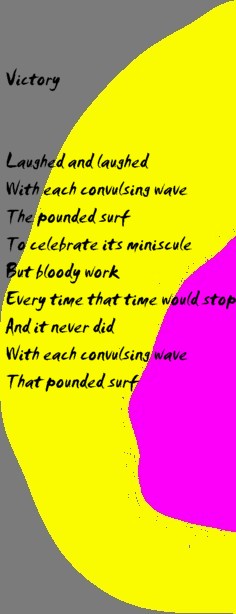
More Works of Jeff

Cezanne's Carrot

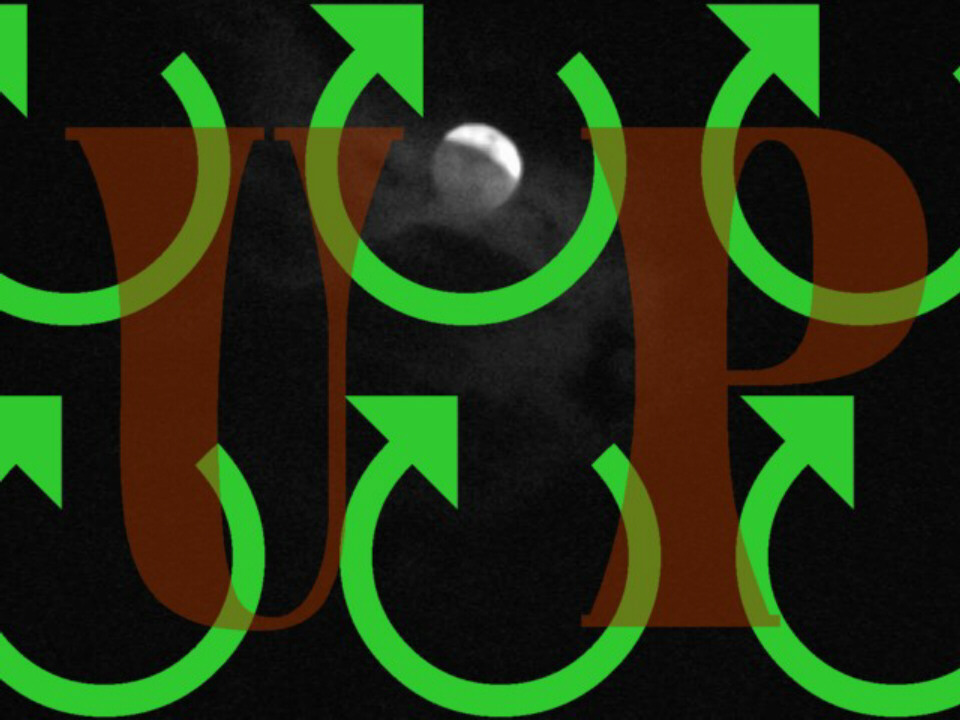
Moon Up
Pilot Magazine is receiving submissions for its upcoming literary journal Pilot Pocket Book 2. The editors are looking for any and all literary work such as poems, prose, short stories, essays or excerpts from longer works. If interested, you may submit your work as an email attachment to pilotbyow@hotmail.com. For more information go to www.thepilotproject.ca.
Closing Words