I keep hoping Spring will
come, this seems to be the winter of our discontent, to quote William
Shakespeare and John Steinbeck, of course. A winter that seems to
be hanging on like a bad head cold that will not be shaken loose from
its hiding place. I am getting ready, and itching to get to the
garden and turn the soil to plant the seeds. Perhaps I'll see
some more sunflowers from the one plant that produced seeds last year.
Well, enough of me, continue to read the poems
provided, and I'll talk more at the end of this issue.
Poetry
A series of poems based upon the theme of
Marianne's Tango start this month poetry collection, by Duane Locke.
You can read his biography at the end of this collection.
MARIANNE’S TANGO 36
Marianne and I departed in Livorno
By an inlet of coastal rocks,
The water was covered with sea lettuce.
We stood by a sea wall when she slipped,
Slid down red soil to redden her dark blue slacks.
As she slid, as her slack redden,
She disappeared. When she was
Supposed to have reached
The water, I never heard a splash.
I never saw one drop of water rise
Up through the still surface of the sea lettuce.
I can still see he sea lettuce, Stranger,
But Marianne disappeared before
Splashing into the coastal
Sea-lettuce covered waters.
I remember that before the fall we stood
By this old, insubstantial sea wall,
We had drunk many glasses of Chianti.
Stranger, now as I review my past,
I cannot ascertain where Marianne
Was there or not. It seemed her presence
Was a vision stimulated by the Chianti,
But yet I remember her disobedient remarks,
I am certain the sea lettuce was there,
But I am not certain that Marianne was there.
Stranger, I am not even certain
I was there. I checked my travel notes,
I checked the tickets I had bought.
There is no record I was ever in Livorno,
Yet when I recall being in Livorno,
Drinking Chianti with Marianne,
Running my hand down the side of her arm,
Down the side of her blue-slacked clothed leg.
Stranger, this was one
Of the most happy moments in my life.
MARIANNE’S TANGO 37
By the ocean with its shore of coral
rocks
And its madrigal music, morose and stoic,
Of its morning waves, I saw a white curtain
Of fog making the curve in the distance
Uniform and Platonic, an Idea without a particular,
But breaking through this idea was Marianne,
She ran past a fallen Australian pine,
Whose roots were caked with shells.
She brought with her some of the fog,
She seemed wrapped
In scraps of white ribbon.
It was as if Marianne’s body was
Disconnected and floated as fragments.
This was the first time I had ever seen
Marianne, if what I saw was Marianne.
It was weeks before I saw Marianne again,
If the person I saw weeks later
Was the same person I saw
Running naked through fog down a beach.
MARIANNE’S TANGO 38
I was watching silence slowly stumble
Across the ragged and rugged horizon
When all turned to confusing noise
When Marianne suddenly appeared in a wicker chair
By me and handed me an upturned
Mussel shell, “Look at these colors,
The colors of a black pearl rainbow”
I no longer saw the shape and edges
Of the shell, but disembodied colors
Of no known origin. I gazed at Marianne,
But she dazzled, too dazzling
To look at for a long time, so I
Gazed at the dark behind her, a dark
That seems to go out in space, become infinite,
This darkness looked like the plumage
Of a dark bird, its wings were uplifted
As to fly away. I gazed again at Marianne.
She was gone. The upturned mussel shell glowed.
MARIANNE’S TANGO 39
This Italian evening was becoming dark
poppies,
Motionless. The odor of the earth
Changed from a strong pungent smell
Into the smell of dark, moist grasses.
I gazed at clusters of hazy bushes, close together.
There was a passageway on the left side
Where the bushes and the landscape disappeared.
Marianne walked out of the passageway,
Stood still, as still as the dark poppies
On this windless evening. She appeared silver.
I called her name, but as I spoke the words,
The words became silence. I spoke
Many times, but each time, silence.
It was uncanny, my words had no sounds.
The silver Marianne turned around.
Her back faced me. She went
Back into the passageway and disappeared.
I called her name again. This time
My words had sounds, but no answer.
I heard the echo of my words.
MARIANNE’S TANGO 40
The odor of the perfume in my empty room
Has changed. Marianne has replaced
My Guardian Angel.
Now shirez sits on the blue box,
Not tea. The guardian angel throw the tea pot
To the floor when she walked through the wall
To go away.
The angel also knocked over two pots
of ferns
Upon departure. There is dirt, uprooted ferms,
And fragments of glass on my white rug.
There is a strong, pre-storm wind
today, and even
The sun is shaking, little
Squids of orange has torn off the sun and blown
Through the blue.
There is a fire in the corner of my
white rug
From one of the fragments of the sun
That was blown through my opened window..
But when I went over to see the flames,
There was only ashes.
The ashes were the same color as
Marianne’s
Eyelashes.
Duane Locke, Doctor of Philosophy,
English Renaissance literature,
Professor Emeritus of the Humanities was Poet in Residence at the
University of Tampa for over 20 years.
Has had over 5,000 poems
published. As of October, 2004 5,408 poems
published.
Over 2,000 were published in print
magazines, such as American Poetry Review, Nation, and Bitter
Oleander. In September 1999, he became a cyber poet, added over
3,000 poems published in E zines.
Is the author of 14 print books of
poetry, and in 2002, added 3 E books,
The Squids Dark Ink, From a Tiny Room, and The Death
of Daphne.
The entire Spring 2004 issue of the
magazine Bitter Oleander is
devoted to a 92 page interview with Duane Locke and will include sixty
of his poems.
In August 2004, e book, 45
poems, Observations, from Poetic Inhalation.
In August 2004, feature poet in Adagio Poetry Quarterly
He is also a painter, having many
exhibitions, his latest at the city art museum in Gainesville, Florida.
A recent book, Extraordinary Interpretations by Gary Monroe,
published by University of Florida Press,
Has a discussion of Duane Locke’s paintings.
Also, a photographer, now has over 194
photos in e zines. He does close-ups of trash tossed away in
alleys and on sidewalks.
His old biographical notes, published many time, are now obsolete. The
notes stated that he lived in an old decaying house in the sunny Tampa
slums, populated largely by drug dealers and the homeless.
The house was condemned by the city of Tampa inspectors, and after his
living at this location for fifty years, he was forced to leave within
six days.
The forced move was due to the fall of the bungalow in his large back
yard.
The bungalow contained a priceless literary scholarly library which is
now under debris. An army of inspectors descended and decided he could
no longer live in his home, so Duane Locke left Tampa to relocate in
Lakeland, Florida. He lives by a lake with swans and many wild
birds. The fall was a “Fortunate Fall,” for he now lives in a
more desirable and pleasant location
At Lake Morton Plaza. The only disadvantage is that he can find
no trash to photograph, no broken beer bottles on sidewalk, no litter
as it was in Tampa.
of Difference
by Len Bourret
(Copyright 2005)
What is 'rational'?
What is 'logical'?
As human beings
can we explain,
without making
definitions?
But, what about
'context'?
And, what about
'setting'?
Do 'definitions'
explain our
'perspectives',
or 'world
view'?
And, perspectives
can 'vary' by
context.
And, world views
can 'vary' by
setting.
In an increasingly
complicated and
ever-changing
technological
world,
there is an infinite
set of 'variables',
and each one may
be subject to an
infinite set of
'constants'.
In its simplest form,
there is a dependent
and independent
variable, which relies
on one or more
constants.
And, there are even
unknown variables,
which affect an
outcome, and make
research less than
reliable and valid.
And, there are
constants that
are not always
the same, when
subjected to
different variables.
Even when someone
says that 'variables'
are a 'constant',
what is the 'constant'?
A 'constant', for example,
may be 'peace' or 'chaos',
or in the form of 'something
else' (another 'concept').
And, some human beings
define 'men' as 'chaos'.
But, is this an 'assessment'
for 'accuracy' of 'evaluation'?
If one says it is, what about
'multi-dimensional assessment',
an 'evaluation' based on many
sets of measures?
Defining terms,
without dealing
with meaning
and purpose.
But, what is
anything,
without a
meaning?
Although
defined,
the event
will have
little or no
significance.
And, there
will be
little or no
reason
to pursue
the event.
A defining
philosophy
deals with
details only.
It is not an
approach,
but may be
considered
an essential
part of a
system.
As a contrast
to classical
philosophy,
it is non-
traditional,
and may
even be
unconventional,
but may not be
a philosophy in
the strictest
sense of
classical
definition.
Humanism is
not perfect,
nor is it
always
optimistic.
Without a
bridge
between
a philosophy,
or an approach,
the definitions
cannot go anywhere,
without meaning and
purpose.
Because the 'concrete',
or 'what is seen, feel,
and touched', cannot
be implemented,
one must have implicit
faith to go beyond that
which cannot be
absolutely proven.
And, a philosophy
can become no
more than 'ideas',
restricting one to
a narrow confine,
rather harsh, and
rather rigid. The
'idealistic' limits
one to a certain
level, out of an
infinite level of
possibilities.
An approach,
also, has its
limitations.
There are strengths
and weaknesses, to
any philosophy, and
any approach.
Unless allegations
are able to be
positively supported,
they remain nothing
more than theory.
As human beings
learn in life, what
is 'alleged to be'
in 'theory' does
not always prove
itself 'to be' in
'reality' as we
know it, and
a 'reality' which,
in fact, is not
the same for
every individual.
There is a
diversity in
the simultaneity.
Even what appears
to be 'the same' may
have an 'infinity of
difference'.
Taylor Graham brings us her view of life, music
and all things wondrous.
TRYING TO EXPLAIN LIFE TO THE DOG
There’s frost on the ground,
ice crystals in deep soil.
But sun has come to sparkle every
thing, and show a new path
through manzanita.
My dog wants to follow it
running free
or tugging me at the end
of the lead. Better, to run
free, and me tagging after.
But the choice is mine
and I’m the master.
Sun comes sparkling
everything, a dog’s life
passing.
BOLLING’D OVER
Suite for Flute and Jazz Piano
is not a natural step unless
you’re so amazed by late February’s
oak-leaf light, and what a hollow tube
can do with breathable air
that you lose all your leaden gravity
and forgets how your face
is supposed to fall
into its customary frown
and all of a sudden you feel the crisp
March-ing of a foot that briefly
lands on earth before launching
in an upward sort of swingy un-
expected way of moving
like when you wake up thinking
there was nothing you were supposed
to do today except
Spring.
THE CANDIDATE’S VOICE
is thunder. When he speaks,
at least half the people clap their hands
so loud, it shakes the rafters
And the high-rise shivers
into smoke and dust
again and again as the gun-
metal voice reports.
Once I sat in my own house
under a lightning rod in a ticklish-
kind of weather waiting for
inspiration; all of a sudden BOOM!
it was 90 times daylight all around
through every window and my teeth
ached with that strike
of precious metal.
I’ve seen storms. And I’ve heard
the voices of those
who try to steal raw energy
for power.
ALL I REMEMBER OF THE KNOTS
[Knopen, woodcut from 3 blocks, M.C. Escher]
They meshed into something from a dream
those gears the moons spins
April cycles
thru the spokes of trees
a swirl of traffic down such hectic
lanes of sleep
& then the chain slips
slings from flight
a runaway bike
down breakneck cable-car streets
but never hits
bottom. Just try
to wake up from that
alive!
Anyone can curl a rubber band
to a 3-loop clover
in his hand. Anyone can snap
a gear to the crack of fear.
But where’s the dark of the dream?
HOBO JUNGLE, AMERICAN RIVER
Everything dries up here.
The slough is a brown sump
of wild roses wizened
to the thorn. In any clearing,
a strew of tarps and puckered
mud, sprawling lawn chairs
and bicycles taken apart
for parts.
On the other side of levee
the river runs, bright
with boats. A city sailor
sees nothing but the near
horizon: green levee,
blue water, weekend
afloat.
IN SEARCH OF THE MASTER
According to my guide, the Mozart music
lives across a high arc’d bridge,
for folks who aren’t afraid of heights.
A sweet patina on the cobbles, the glow
of ages. But I’m trying to get there
the safe way, fingers fumbling pockets:
ticket stubs and crumbs of Sachertorte.
When I get there, what a disappointment.
Cheap souvenirs. Where’s the prodigy,
the winking passion? Where’s the child-
master thumbing his nose at his teacher
and running away laughing from
every pupil coming after?
Even in a dream, a traveler
can’t catch Mozart.
Melancholy is the best way to describe the mood
of Valerie Noir's new work, which she just banged out on the computer.
My Never Moon Song
Each
note reverberates in my mind,
sounds
like a voice, base and dark,
repeating
the same melody,
melancholy
and morose.
Its
knell calls me to a home
I
no longer wish to know.
Wrapped
in the silent song
of
an inner night that never ends
I
dream a fractured life that melds
with
a reality I've tried
to drown
in
the cacophonic symphony
of
my heart.
Wondering
if it will ever end,
this
looped tune,
I
listen to it play and communicate
without
words or many tones.
Colors
are in the sounds
and
within their confines
emotion
abounds.
Is
it true that I am trying
hard
enough to break away?
You
said the moon was nice tonight
full
and low, calling me to a better place,
but I
take the sight only on your word
for
how can I know, blinded
as
I am by this thick and deadly,
Valerie Noir
Poem from the Past
Ode to Melanchody
No, no, go not to Lethe, neither twist
Wolf's-bane, tight-rooted, for its poisonous wine;
Nor suffer thy pale forehead to be kiss'd
By nightshade, ruby grape of Proserpine;
Make not your rosary of yew-berries,
Nor let the beetle, nor the death-moth be
Your mournful Psyche, nor
the downy owl
A partner in your sorrow's mysteries;
For shade to shade will come too drowsily,
And drown the wakeful
anguish
of the soul.
But when the melancholy fit shall fall
Sudden from heaven like a weeping cloud,
That fosters the droop-headed flowers all,
And hides the green hill in an April shroud;
Then glut thy sorrow on a morning rose,
Or on the rainbow of the salt sand-wave,
Or on the wealth of globed
peonies;
Or if thy mistress some rich anger shows,
Emprison her soft hand, and let her rave,
And feed deep, deep upon
her peerless eyes.
She dwells with Beauty - Beauty that must die;
And Joy, whose hand is ever at his lips
Bidding adieu; and aching Pleasure nigh,
Turning to poison while the bee-mouth sips:
Ay, in the very temple of Delight
Veil'd Melancholy has her sovran shrine,
Though seen of none save
him whose strenuous tongue
Can burst Joy's grape against his palate fine;
His soul shall taste the sadness of her might,
And be among her cloudy
trophies hung.
John Keats
I decided to include this work
for a few reasons, one it is a classic work and two, it does speak of
the feelings of the late winter. There is a time when life is a
fit of melanchody, you hope for spring, but it flirts and teases but
quickly disappears behind the blast of the next winter storm. As well,
after Valerie's work, it does continue the theme doesn't it.
For information regarding this poem, I invite you to visit
this site for further information.
A new
poet to these pages:
Reinvention
By: Jeffrey Lee Williams, Junior
Within the depths of my soul,
It's...
No, I cannot say that
It is not me
Its boring, useless and cliché
It's repetitive, corny and dull
This is rewritten trash,
Recycled vomit
No, I cannot do this
I don't want to be this person
Repeat what has already been said a million times
By a million people
On a million pages
I need refreshing
I cannot mimic what I have seen
Rather experiment with what I am afraid of
I cannot read drivel anymore
No more sad and sappy stories with a plot that leads to love
No more "I was hurt" stories,
Recovery stories, survival stories
No more "my mommy beat me" stories or "my daddy touched
me"stories
I can't read about it and I won't write about it
There are no bleeding hearts
That metaphor has been used and abused
I will change the face of creation
With this,
The dawn of a new era
The era of unadulterated,
Genuine and sheer
Creativity
The
Phases of Success
(In
Mangled Order)
By:
J.L. Williams
Chaos, fame, chaos
Backlash, torture,
struggle
Heartache, tears,
depression
Laughter, love, pain
Blood, determination,
drive
Agitation, exhaustion,
brilliance
Brownnosing,
hospitalization, debt
First draft, second
draft, final draft
Development,
production, show time
Success, money, failure
Rebound, comeback,
obscurity
"When it Rains it Pours"
By: J. L. Williams
Feeling alone--(yes) you're all
alone
Wishing for something to call
your own
But nothing is for you
So there is but one thing to do
All I can say is that when you
find your way
Please rest your head
down and pray
For with open eyes you'll
foretell
The distant darkness and
fiery Hell
Don't live too fast
For the feeling may not last
Take advantage of this;
The happiness you so seek
Look to the future but
be careful not to peek
Relish the comfort light as a
feather
Every storm you can now weather
"Follow the circle of love--as it leads you
through the clouds. Trust fully in its purity or live forever in your
destructive fury."
JLW
One Night Stand
By: J.L Williams
Ask me my name
Pick me up at a club
Take me to your home
Offer me a drink
Chat for a moment
Head to the bedroom and
Throw me on the bed
Remove all my clothes
Treat my body like an object
Have your way with me
Forget my name
Roll over after you've finished
Fall asleep and wake at sunrise
Ask me to leave
Bathe, repeat
Brief Biography
"Unlike many writers, I
have not been writing for years and years. In fact, it wasn't until I
was in my late teens that I decided that I wanted to be a writer. For
many people that would be considered late in life to decide what they
wanted to do with their lives but for me, it wasn't. I didn't begin to
think about writing until one hot summer night I sat in my bedroom
channel surfing. In my endless search for some form of entertainment, I
came across an episode of the Golden Girls. This particular episode had
Blanche find her "calling" to be a great southern writer. From that day
forward, I felt like a lightening bolt had hit me. I began writing that
day and haven't stopped since. I was nineteen years old. Today I am in
my early twenties and I contribute to a lifestyles magazine regularly
and I also freelance. I currently have over seventy publishing credits
and all it took was an episode from a canceled 80's sitcom."
With Apologies to Robert Herrick and Julia's Clothes


whenever she wears
that simple cotton dress
and walks that walk
that sets it swishing here there
my God who needs silk
Which is life itself.

[first published in Poetic Voices, March 2002]


THE PLOW BREAKS THE SOD


The plow breaks the sod,
Turning the dry grass over,
Leaving the naked soil furrowed,
Ready for planting.

The teamster guides the oxen,
The farmer guides the plow,
All are in harmony with the life-giving earth:
Teamster, farmer, oxen,
Who came from the earth,
And to the earth shall return,
Being sustained by the earth upon which they work;
Even the plow,
Extension of the hand of man,
Made from the elements of earth,
Shall one day return to the earth from whence it came.

The harmony of living drawn from the good earth,
The cycle of seasons,
The cycle of life,
Man and beast,
Man and tool,
Drawing their being from the good earth,
The intention of God,
Working with Nature His handiwork,
Who are also His handiwork,
Their purpose fulfilling according to the Original's plan.

The planting of seed,
The growing of plants,
The harvesting of seed,
And the death of that which bore the seed,
Returned to earth to nourish the seed,
The cycle of life which is living itself:

The life of the farmer,
The life of the teamster,
The life of the ox,
The life of the earth,
The harmony of living which is life itself.

The plow breaks the sod,
Turning the dry grass over,
Leaving the naked soil furrowed,
Ready for planting,
And the farmer sows his seed,
Soon
The Spring
Will come soon ,
The ice
Will melt soon,
And the flowers
Will blossom soon.
But only if
you would be
near to me,
would Winter leave.
---------------------------------------
2 version of this
poem:
Soon
Soon ice will thaw,
Soon the spring will
come,
And flowers will
blossom.
If only you would be
with me!
To you
Blizzard
Goes mad
behind a window,
Shadows dance
On roofs of houses.
You sleep?
What you see in your dream?
The moon
Not shines too brightly ?
Whether the wind blows into a window?
Star
Whether has fallen beside?
Trains
Whether are shouting
Too loudly?
Just now the wind
Has brought
To me all your troubles
On his wing.
I shall read at their night
And I shall cry
Instead of you.
You will wake up in the morning
And even
Do not recollect them!
Dina Televitskaya
ArtWork
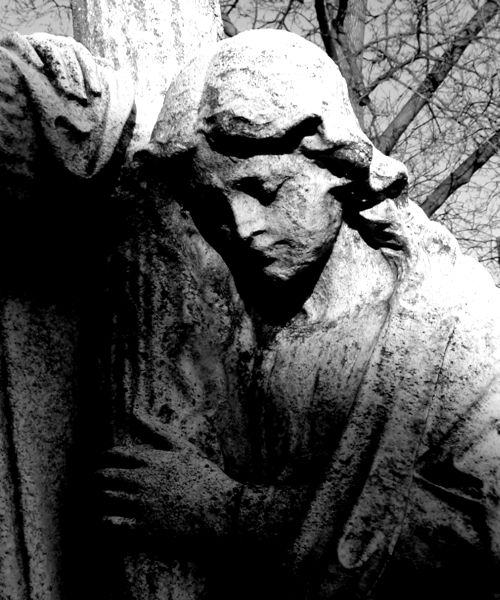
Valerie Noir
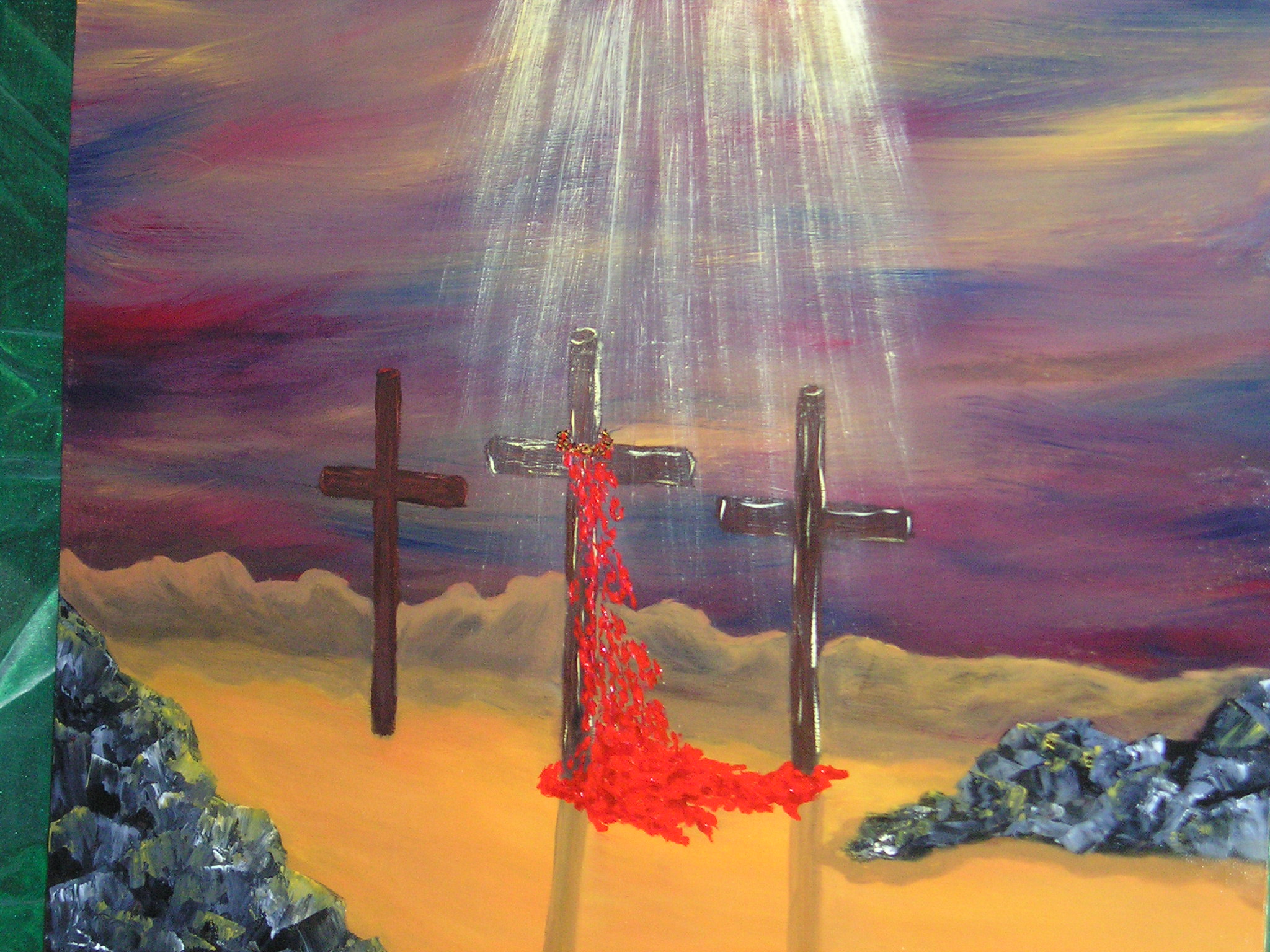
Salvation
by Bremandy Beal
	As I mentioned last issue, I'm going to try the theme of Poetry Noir or Poetic Noir, words thoughts and pictures that are inspired by the
Film Noir genre of the thirties and forties.  You must remember them, they featured a loner gumshoe who had a chip on his shoulder and while
usually tended to be amoral rather then immoral, had a heart for justice.  He wanted to see justice done and was willing to use whatever method
at his disposal.  There was also and this might be the theme of interest, the femme fatale, the woman in red, or white or black, with deep red lips
legs that stretch for miles.  She was the one who introduced the gumshoe into her problem or would be the temptress, seeking to draw him to
fall for the side of wrong.  There was the criminals, the police and all seeking the same thing, for different reasons.

Some interesting sites you may want to read for information and inspiration are:

Film Noir
High Heels on Wet Pavement

So put on the fedora, tighten your raincoat, find a seedy bar and wait for the mysterious woman in red to show up.  You'll hear her by the sound of
high heels clicking on the floor.  She'll ask you for a light and then after a few puffs, will say, "Mister. I wonder if you'd help a lady with a problem..."

For the ladies, wear the dress with the large shoulder pads, the pillbox hat and adjust the seam of your expensive silk stockings and get ready to
find trouble, because trouble is looking for you.


Visit my CafePress Store

As always the address for your submissions of poetry, short stories or artworks can be sent to abovegroundtesting@yahoo.com
The home page is still www.angelfire.com/on/abovegroundtesting,yes and one day I will work on it.

All work is copyright by the various authors.  My work is under a creative commons licence.  Go to  Creative Commons for more information.

This work is licensed under a
Creative Commons License.