
![[Image]](images/pict12.jpg)
'Largs' International Rocketry meeting 1998
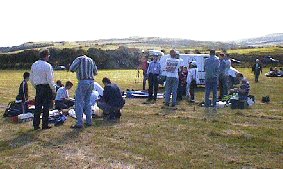
My son David and I arrived at Largs on Friday afternoon. Sean had arrived earlier and was asleep in his car. We erected tents and began to set to work in preparing for some launches. Next to us was Andy Issot. who helped out with prepping rockets and had brought his digital camera also. Sean had brought his Estes Thunderhawk, Estes Phoenix, Estes Shadow and his own design 2x upscale Thunderhawk. I had brought my Camera rocket, 1/3 scale Patriot, Two 2inch own design rockets for 29mm motors and a 2x upscale Estes Delta Clipper. Launches from the pavilion field where restricted to smaller models and the higher powered rockets would have two sessions at a remote field up on the hill at the back of the Kelburn Estate. I would do all my launches at the remote field. Sean did launches at both.We had two sessions at the remote field, one on Saturday and the other on Sunday. NOTAM's had been arranged for both these sessions by Ian and John Bonsor. In additon, a system of opening and closing flight windows was arranged with Glasgow airport. This may sound cumbersome but it worked very well.
Above images show Sean and the Shadow which claims to be the rocket with the most launches at IRW98. Sean launched his Shadow a number of times from the pavilion field on D12 power. During open flying sessions and another at dusk. The dusk flight was impressive with the flame from the motor being well contrasted against the night sky. During Saturday afternoon Sean and I prepared a rocket he had brought to originally fly on a 29mm motor. This was then modified to fly on a 38mm RMS H123 for a level 1 certification flight the following afternoon. This was a 2inch diameter rocket based on an Optima. The paint job was fantastic and faded from light blue metal flake at the top to dark blue flake at the bottom. We converted the motor mount to 38mm and put launch lugs on to suit my launch rail. FLYING AT THE HIGH POWER FIELD
I launched my 2inch diameter experimental rocket and my upscale Estes Delta Clipper. This was the Delta Clipper's first flight. The motor was an Aerotech G40-4W. The flight was straight and impressive. Only slight damage was received when it landed on the ONLY rock for miles around. The silver 2inch rocket had a perfect flight and the beeper worked well.
Above images show Sean and myself. Sean with the Thunderhawk and me with mt 2inch experimental.
Above image shows David (my son) with his upscale Estes Delta Clipper. Now came time for the certification flight. Ian Holtham of UKRA (THRUST) kindly lent me a H123W motor and casing and showed me how to load a RMS motor. MANY THANKS IAN (By the way I still owe you for the reload!). We loaded the rocket onto the launch rail and gave the countdown. When the button was pressed it just chuffed a little smoke. This happened three times! (Damn those copperheads) Eventually many hands came to help and some slow burn was added over the end of another copperhead. This time it worked. The rocket streaked off the pad at a tremendous rate. At burn out I could just see at high altitude the rocket shred!! Bits of it glinted in the sunshine and I decided it was time to run for cover. The rocket came down in lots of bits close to the launch pad. What appears to have happened is a structural failure of the fins and consequently the whole rocket at MaxQ. A while later the beeper was recovered smoldering some distance from the launch pad. The circuit had been damaged and the battery was shorted out.
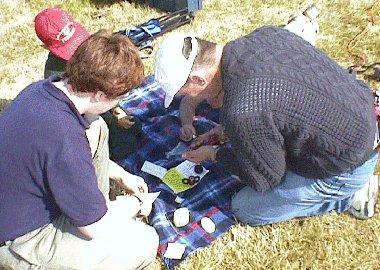
Above image shows myself being instructed by Ian on how to load an RMS motor for the first time.
Above iamges show Sean with the rocket prior to launch. Image right which was taken from a distance so is not the best quality is the first and last flight of the rocket! I am sitting in the foreground with video camera in hand. The next day saw us back at the same field but with a little more wind and a slightly different launch position on the field. Sean went first with his Shadow on D12-0 and D12-5 power. The rocket went fine until the second stage kicked in and began to weathercock downwind towards everybody! The parachute deployed but was tangled and was heading our way. There was a scattering of people as "INCOMING" was shouted out and the rocket managed to pick out the only bit of ground with nobody or rocket there.
Above images show the rocket before and after doing a core sample. Luckily the rocket only suffered slight damage. My turn came for my second attempt at a level 1 certification flight. This time I used my camera rocket loaded with an I211W motor. My certification officer was John Aurther who witnessed me loading the motor and the flight also. We had some trouble getting the motor to go and Ben Jarvis hepled out with the ignitor. The flight was perfect and deployment and recovery successful with both parachutes fully open and not tangled. I am now Level 1 certified. I hope to get my level 2 next year at IRW99.
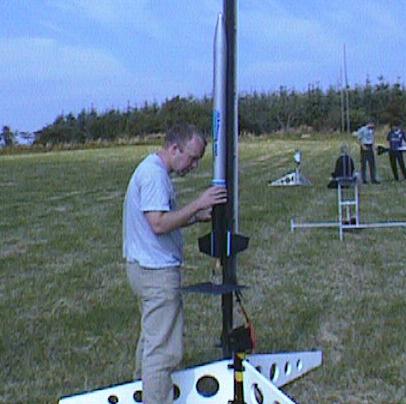
Above image shows the camera rockprior to being loaded onto the pad.
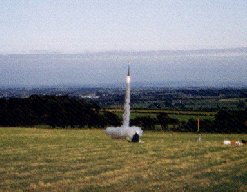
Above images show myself and Ben installing the ignitor prior to launch. Andy is holding the rocket steady while David watches on. The right image shows the rocket a second or so into the flight. I am in the forground with the video while hitting the button. The image is suffering a little in quality as it was taken quite a way off.
|
||||||||||||||||
|
|
||||||||||||||||



![[Image]](images/pict48.jpg)
![[Image]](images/pict56.jpg)



![[Image]](images/pict95.jpg)
![[Image]](images/pict96.jpg)
![[Image]](images/pict34.jpg)