|
BRAKES
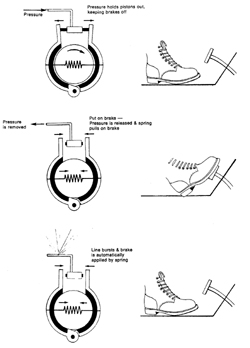
-If the brakes are not mechanically
linked to the pedals or control levers (pneumatic hydralic and electric
brakes) then the braking system must be designed so that the brakes will
be automatically applied if there is a loss of power or pressure. These
brakes must not release until the power has been restored to the machine
and then only when deliberately released.
-Brake pedals must be constructed
so that the operator's feet will not easily slip off. They should also
be equipped with a means for latching them in the applied position.
-All load hoisting drums should
be equipped with fail-safe brakes capable of being released electrically,
hydraulically or pnenmatically. The application of this type of brake
must be a direct effect on the hoisting drum and as such no belts or chains
are permitted between the brake and the drum.
-All load-holding brakes and
clutched must have sufficient size and thermal capacity to control all
rated hoist loads with minimum recommended reeving.
-The wearing surfaces of all
brake drums must be smooth and free from all defects and the assemblies
should have accessible devices to compensate for the wear of the linings.
-If the unit is equipped with
travelling brakes they must, in addition to stopping the unit, have sufficient
size to prevent the unit from moving during high winds.
-Slew brakes should consist
of a fail-safe mechanical unit capable of not only stopping the slew with
full load but also holding the full jib in winds of up to 48 km/h (30mph).
The brake must be capable of being set in the holding position and remaining
that way without further attention from the operator
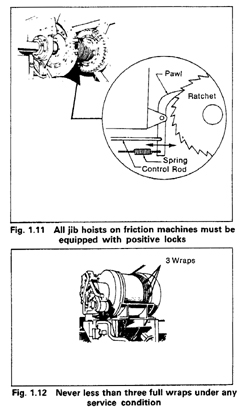
-The crane must also be equipped
with a positive slew lock or house lock that is designed to prevent accidental
engagement or disengagement. This lock should be used when travelling
the crane and when moving over rough terrain with heavy loads suspended
from the jib.
-On mobile cranes the brakes
must be capable of holding the machine stationary under normal working
conditions, and on the maximum grade for travel recommended by the manufacturer.
These brakes must also be fail-safe so as to be able to operate in the
event of loss of operation pressure.
|